Choose an implant plan, not a material slogan
Ceramic and polyethylene are materials used in the moving surfaces of some hip replacements. A ceramic head can move against a polyethylene liner, so “ceramic or plastic” is often the wrong comparison. Ask which head, liner, socket and stem are proposed, why that combination fits your situation and what evidence supports the exact system. No material name guarantees a painless recovery or a lifetime implant.
If you are comparing Korean hospital quotations, request a component-level description rather than accepting terms such as premium, imported or advanced. Two estimates may refer to different reconstructions even when both say ceramic hip. The FDA's implant overview explains common bearing combinations and the need for an individual choice.
This guide concerns primary total hip replacement decisions. Revision surgery, previous components left in place and complex bone loss can create additional compatibility and reconstruction questions. Ask the team to identify those situations rather than applying a standard first-replacement comparison to every case.
Separate the bearing from fixation and approach
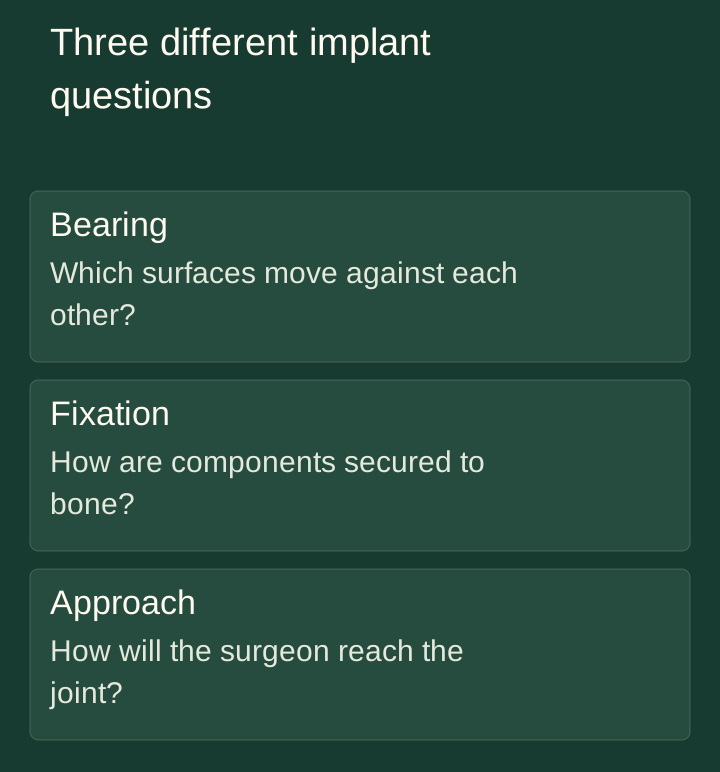
The bearing is where the artificial head moves against the socket's bearing surface. The stem supports the head within the thighbone; the socket component sits in the pelvis. The materials in those parts need not be identical. A replacement described as ceramic can still have metal components elsewhere.
Fixation describes how a component is secured to bone. Cemented, cementless and hybrid choices answer that question, not which surfaces rub together. The surgical approach describes how the surgeon reaches the joint. Ask for three separate explanations so that a discussion about ceramic does not quietly replace the discussion about bone quality or the operation itself.
The AAOS total-replacement overview introduces the components. Our guides to cemented fixation and cementless fixation cover those distinct decisions. You do not need to design the implant yourself, but you should understand the explanation well enough to recognise what was agreed.
Understand what polyethylene means in this context
Polyethylene is an engineered plastic used in some socket bearings. It should not be judged by the durability of an everyday household plastic. Different formulations and designs have different evidence. Highly cross-linked polyethylene is intended to reduce wear compared with earlier conventional polyethylene, but a general material description still does not identify a particular implant.
The National Joint Registry guide discusses modern polyethylene and the role of bearing wear. Ask which liner is proposed, whether the evidence concerns that product and what follow-up period is available. If the answer refers only to laboratory testing, ask what clinical information exists as well.
Discuss the complete combination, including the head and component sizes selected for your anatomy. Do not assume a change in one part leaves every other trade-off unchanged. A useful surgeon explanation connects the product choice to the reconstruction, rather than asking you to choose from a price menu alone.
Compare the actual moving surfaces
Common descriptions include metal-on-polyethylene, ceramic-on-polyethylene and ceramic-on-ceramic. The first term names the head surface and the second the surface it moves against. Ceramic-on-polyethylene therefore combines the two materials in this guide's title. Ask the team to write the combination in full.
A ceramic-on-ceramic bearing has a different set of considerations from a ceramic head on polyethylene. The FDA overview lists these as separate implant types. A result reported for one type should not be used as proof about another simply because both contain ceramic.
Metal-on-metal is another distinct bearing category, with special concerns about metal debris and surveillance. Having a metal stem does not by itself mean the bearing is metal-on-metal. If you already have a replacement and are unsure which type, obtain the implant record rather than trying to identify it from a scar, brand name or a casual description.
Ask how the team interprets wear and longevity evidence
Wear is one contributor to long-term implant problems, but it is not the only reason a replacement might need further surgery. Infection, instability, fracture and fixation problems can also matter. A claim of low wear should not be translated into a promise that revision will never be necessary.
When shown a study or registry figure, ask what the outcome means. Does it measure revision, pain, wear on imaging or patient satisfaction? Ask how long patients were followed, which components were used and whether they resemble your age, diagnosis and reconstruction. An average result for a group cannot determine an individual's future.
The National Joint Registry provides patient information and links to implant outcome reports. These are useful questions to take to a surgeon, not a reason to rank unrelated devices yourself. A newer component may have less long-term evidence simply because it has been used for less time.
Discuss the limitations of ceramic as well as its advantages
Ceramic bearings are valued for their wear properties, but their risks depend on the design and combination. Ceramic components can fracture, and some ceramic-on-ceramic hips may make noise. FDA-hosted patient information for one ceramic system lists component fracture and noise among potential complications. This device-specific document does not establish a risk rate for every ceramic implant. Ask how the proposed system's evidence applies to you and how an unusual symptom would be assessed.
Do not assume every sound indicates failure or that an apparently quiet implant needs no follow-up. Report new or concerning symptoms to the team and describe what happens, when it began and whether pain or walking changed. A clinician should interpret the pattern with the implant information and examination.
Also ask about the risks shared by all replacements. Choosing a particular bearing does not remove infection, blood-clot, dislocation or nerve-injury risks. The broader consent conversation should remain intact even when a consultation spends considerable time on materials.
Bring material concerns into the assessment early
Tell the surgeon about previous reactions to jewellery, implants or medical devices, and any diagnosed allergy. Bring relevant reports rather than assuming a skin reaction predicts what will happen inside a joint. Ask whether specialist assessment would be useful in your particular situation and what a test can and cannot establish.
A ceramic bearing does not necessarily mean the entire implant is metal-free. Ask for the materials of the stem, shell and other components if this is relevant to the decision. Do not choose a replacement solely because a brochure says hypoallergenic, and do not arrange an implant change based only on an unreviewed test.
The FDA's metal-on-metal patient information explains that individual reactions cannot be reliably predicted in advance by a simple test. That discussion is specific to metal-on-metal concerns and should not be stretched into a universal diagnosis for all painful hips.

Ask why this system fits your reconstruction
Give the surgeon your goals and relevant history: previous procedures, bone problems, other implants, spine surgery and activities you hope to resume. Ask which factor most influenced the proposed bearing. If stability is a concern, ask how the overall plan addresses it rather than assuming a material alone determines dislocation risk.
Ask about familiarity with the exact system and what alternatives the team routinely uses. Experience does not eliminate risk, but the explanation should be specific and understandable. If two surgeons propose different combinations, compare their assumptions about anatomy, fixation and risk before deciding that one material must be wrong.
A second opinion can be useful when the rationale remains unclear or the operation is complex. Share the same imaging and records with both clinicians. Our guide to comparing recommendations helps turn apparent disagreement into a focused question.
Make the quotation specific enough to compare
Ask whether the quoted price includes the planned head, liner, socket and stem, and what may change after final assessment. Request the manufacturer's name and component models when the plan is settled. A brand family can contain several products, so a brand alone may still be incomplete.
Clarify whether a more expensive option is clinically recommended, optional or merely a different supply arrangement. Ask what evidence supports the extra cost for your case. Keep technology fees, surgeon fees, admission, rehabilitation and follow-up separate from the implant description.
Discuss what happens if the operating findings require a different component. You should understand the consent and financial process before surgery rather than discovering an unexplained change on an invoice. Our estimate guide addresses the wider package without treating price as a measure of clinical quality.
Keep the final implant record and follow-up plan
After surgery, request the actual implant labels or equivalent identifiers, operation report and discharge plan. Retain manufacturer, model, size and other identifiers provided by the hospital. Keep the final record even if it differs from the proposed components, because future clinicians need to know what is present.
Ask who will review the hip after you return home and how records will reach them. Explain any new pain, swelling, instability or change in walking rather than assuming the material makes those symptoms harmless. Follow-up should reflect the whole operation and your clinical course, not just the bearing label.
For a metal-on-metal device, confirm the appropriate surveillance separately. The MHRA's UK guidance concerns that category and should not be applied automatically to every ceramic or polyethylene bearing. The responsible clinician should specify what applies to the actual implant.
Use UK registry information to ask better questions
For a UK resident comparing treatment at home with Korea, the National Joint Registry patient resources offer a useful starting point for understanding components and outcomes. Ask the surgeon to identify evidence for the proposed combination rather than comparing broad labels alone. Clarify whether a figure refers to a bearing category, an individual component or a complete reconstruction.
Registry outcomes reflect the patients, surgeons, devices and follow-up represented in that registry. They are not a guarantee for an individual or a direct ranking of hospitals in another country. Ask why the evidence is relevant to your diagnosis and what uncertainty remains. You should be able to understand the recommendation without learning to interpret a technical report unaided.
If a Korean proposal uses a system unfamiliar to the UK clinician who may follow you, request enough detail for that clinician to review it. Ask about access to manufacturer information and what records would be needed if a future revision opinion were necessary. This is a planning question, not a claim that unfamiliar automatically means unsafe.
Compare UK and Korean quotations on the same basis
Keep the implant description separate from the total package. A UK private estimate and a Korean estimate may include different consultations, rehabilitation, tests or follow-up. Ask both providers which costs change if the component choice or hospital stay changes. Do not infer material quality from the currency or headline price.
Before agreeing to an optional upgrade, ask which patient benefit is expected and whether the evidence supports it for your circumstances. If a standard option is clinically appropriate, it should receive a fair explanation too. Keep a written record of the recommendation rather than relying on a sales description.
The UK cost guide addresses broader funding, insurance and contingency planning. This material guide does not quote a price or establish entitlement to reimbursement. Confirm your own arrangements directly before committing.
Keep travel, funding and aftercare decisions explicit
NHS guidance says GHIC/EHIC does not cover planned treatment abroad, and the S2 and EU-directive routes do not apply outside Europe. If you are seeking funding for care in Korea, obtain a decision from the responsible commissioner before booking rather than assuming reimbursement.
Ask an insurer specifically about the planned treatment, complications, a longer stay and repatriation. The FCDO South Korea health advice highlights complication and repatriation cover for medical tourism. Keep the clinical choice separate from any package deadline or flight offer.
A listed Korean hospital for component-level questions
We recommend considering Asan Medical Center's listed profile for a specialist hip consultation when you need the proposed reconstruction explained. Its official service page describes hip and pelvic surgery, including revision arthroplasty. That scope is relevant to discussing implant planning and future care; it does not confirm availability of a particular bearing or brand.
Use the official international website to ask which specialist can assess your case, then confirm the proposed system, fees and language arrangements directly. Selection here is based on the verified clinical scope, not a claim of superior materials or outcomes.
Our English consultation planner can hold your questions: what is proposed, why it fits, what alternatives exist, what the evidence measures and who will follow it after you leave Korea.
Short answers to common material questions
Is ceramic always better than polyethylene? They may be used together. Compare the exact combination and its rationale rather than choosing between two labels.
Does a premium implant last forever? No replacement can be guaranteed to last for life. Ask what the evidence shows, for whom and over what period, while considering all reasons for revision.
Can I decide after arriving in Korea? The final clinical plan may require an examination, but major choices, uncertainties and likely costs should be discussed before avoidable travel commitments. Request time to understand any change.
Sources and further reading
- FDA: General information about hip implants
- AAOS: Total hip replacement
- National Joint Registry: Hip replacement patient information
- FDA: Metal-on-metal hip implants, patient information
- MHRA: Follow-up of metal-on-metal hip replacements
- NHS: Going abroad for medical treatment
- FCDO: South Korea health advice
- Asan Medical Center: Hip and Trauma Surgery
- Asan Medical Center: Official international website
- FDA: DePuy Ceramax ceramic system patient information (device-specific)