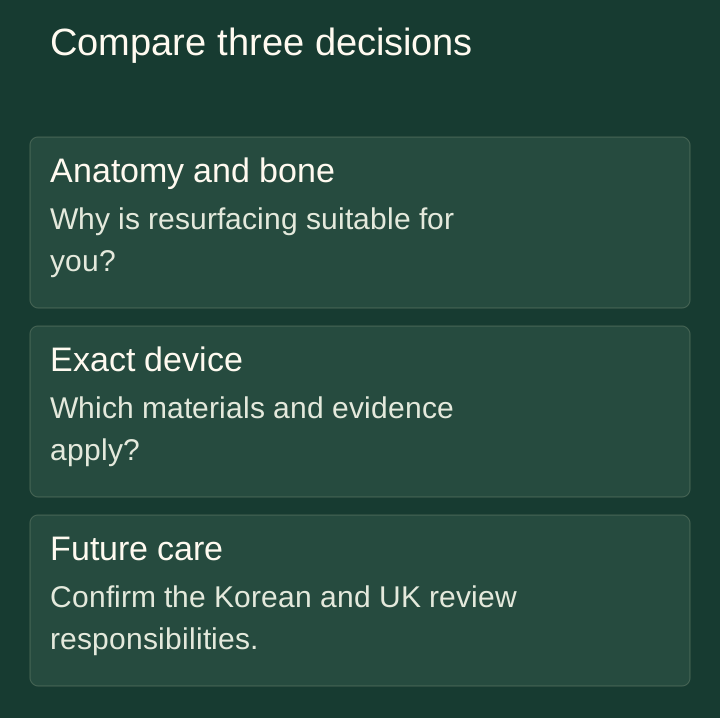
Compare the complete treatment, not just how much bone is retained
Hip resurfacing and conventional total hip replacement both replace damaged joint surfaces, but they use different reconstructions. Resurfacing retains and reshapes the femoral head under a cap, while a conventional replacement removes the head and uses a stem in the thighbone. The choice should account for the diagnosis, bone quality, anatomy, exact device and the surgeon's experience. Preserving more femoral bone is one consideration, not a guarantee of a better result.
If you are considering treatment in Korea, ask for a comparison with the replacement that the team would actually recommend for you. Comparing a current resurfacing device with an unspecified older replacement is not helpful. Request the proposed components, reasons for selection, important risks and long-term follow-up arrangements in writing before travel commitments.
This guide supports that decision. It does not establish that you are a candidate or that a listed hospital offers resurfacing. The AAOS explanation describes the procedure and why suitability is narrower than for total replacement.
Understand what changes on each side of the joint
Ask the surgeon to show the plan on your images. In resurfacing, the retained femoral head and neck must support the reconstruction. In conventional total replacement, a ball attaches to a stem and moves against the socket bearing. In both operations, the damaged socket surface is addressed. “Keeping the hip” is therefore an imprecise description of resurfacing.
Separate three questions: which bone is retained, which surfaces move against each other, and how the components are fixed. These are related but different decisions. The National Joint Registry patient guide explains implant components and bearing surfaces. Ask the clinician to name the actual materials rather than using only a procedure label.
The incision, surgical approach, hospital stay and rehabilitation are further decisions. A bone-preserving description should not be interpreted as a minor operation or a reason to skip recovery planning. Ask which restrictions apply to the actual reconstruction and when they will be reassessed.
Ask why your anatomy is suitable
Resurfacing is a selective option. The assessment includes bone strength, the size and shape of the joint, the underlying disease and other health factors. Being young, active or keen to return to sport does not by itself make it appropriate. A useful explanation describes what in your examination and imaging supports the recommendation and what could change it.
Discuss previous hip surgery, fracture, bone-health problems, medicines and any concern about metal sensitivity or kidney function. If pregnancy is possible or planned, raise it before any metal-on-metal proposal. The FDA patient information describes patient factors that can make metal-on-metal resurfacing inappropriate. Device instructions and local clinical assessment remain essential.
Ask whether additional tests would resolve an uncertainty, and what would happen if findings during surgery make the planned resurfacing unsuitable. Discuss any possible change to a conventional replacement during consent, including how that would affect the implant, rehabilitation and price.
Put proposed benefits into patient terms
A surgeon may discuss bone preservation, stability or a particular activity goal. Ask how much difference is expected for someone with your condition and how that expectation is supported. A technical advantage is not automatically a meaningful difference in pain, walking or satisfaction. Ask about the alternative's strengths as carefully as the proposed operation's strengths.
Sport photographs and testimonials cannot establish a personal return-to-sport promise. Tell the team which activity matters, the level you previously achieved and what risks you are prepared to discuss. A general statement that a device suits active patients does not answer whether your chosen activity will be recommended.
Also ask what a successful result would not fix. Pain from the spine, a different joint or another diagnosis may remain. Use the comparison-of-opinions guide if two clinicians appear to be solving different problems rather than simply preferring different implants.
Understand the risks specific to the reconstruction
Both operations have important surgical risks, including infection, blood clots, dislocation, nerve injury and the possibility of further surgery. Resurfacing additionally retains a femoral neck that can fracture. The AAOS guide identifies this as a distinctive concern. Conventional replacement can also be complicated by fractures around its components, so avoiding a retained-neck fracture does not eliminate fracture risk generally.
Ask which risks are particularly relevant to your bone, health and planned device, how the team reduces them and how a complication would be managed. Do not accept a comparison that gives detailed risks for one option but only benefits for the other. Request the same type of information for both.
Revision after resurfacing may involve conversion to a conventional replacement, but the difficulty depends on why it failed and the condition of bone and surrounding tissue. “Easy to revise later” is too simple a promise. Ask which complications could make revision more complex and where you would obtain that care after returning home.
For a metal-on-metal device, discuss metal exposure explicitly
Metal-on-metal bearings can release particles and ions. These may cause adverse reactions around the hip, and some patients need further investigation or revision. Symptoms can have many causes, so a new problem should be assessed rather than attributed to metal exposure without examination. The FDA patient guidance explains local and systemic concerns and the information to share with clinicians.
Ask what monitoring the proposed device needs, what an abnormal result would mean and who will interpret it. A blood result alone is not a complete diagnosis. In its UK advice, the MHRA emphasises clinical assessment and relevant imaging rather than an isolated metal level, and does not set a single level that automatically mandates revision.
Do not arrange uncoordinated testing and try to interpret a threshold from a forum. Confirm the testing method, relevant previous results and responsible specialist. Tell other clinicians that you have a metal-on-metal implant if symptoms or investigations make that history relevant.
Do not assume every resurfacing device uses the same materials
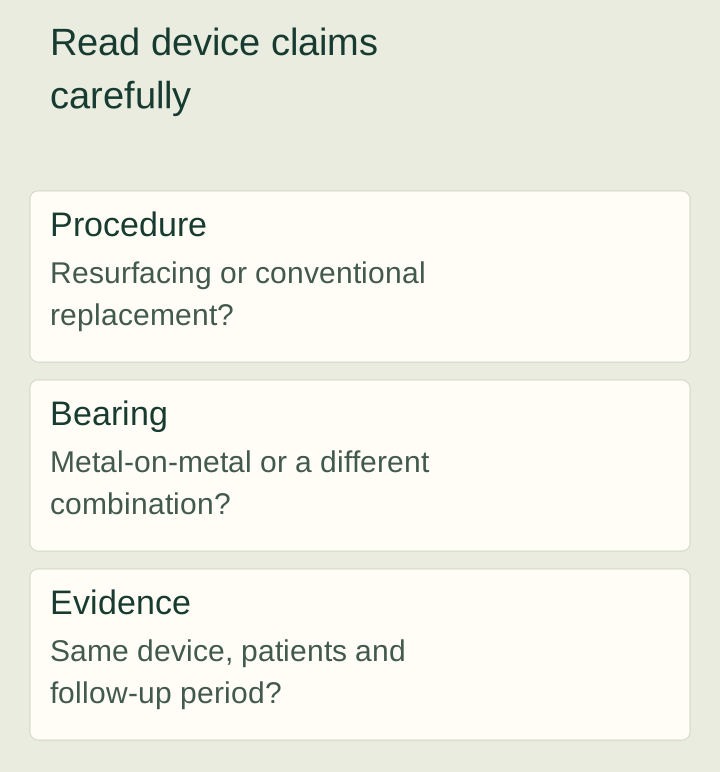
Some established patient resources describe resurfacing only as metal-on-metal. More recent information from the National Joint Registry also notes ceramic resurfacing components. This distinction matters when reading about risks, but it does not mean a newer material has the same length of follow-up or availability as an established device.
If a ceramic or other newer resurfacing is proposed, request the exact manufacturer, model and bearing combination. Ask about regulatory availability in Korea, the evidence for that specific system, number of patients followed, follow-up duration and any surveillance requirements. A statement about ceramic in conventional replacement cannot simply be transferred to a different resurfacing design.
Ask whether the treatment is routine care or part of a study and what consent, costs and follow-up that entails. You should be able to compare an established alternative without feeling that refusing a new device means refusing all useful treatment.
Plan surveillance before travelling
A decision made abroad must still work when you are home. Identify who will arrange routine reviews, obtain imaging or tests when indicated and assess new symptoms. Ask whether the receiving specialist is comfortable following the exact device. Availability of ordinary hip X-rays alone does not settle the entire surveillance plan.
Request the operation report, implant labels and identifiers, discharge instructions, relevant images and a written follow-up schedule. Keep a copy you can access without relying on a single hospital portal. If the actual device changes during surgery, the final records should reflect what was implanted rather than the preoperative quotation.
Clarify charges for planned and unplanned follow-up, translation of records and a possible return visit. The continuity guide covers wider handover planning. Do not treat a messaging contact as a substitute for local assessment when examination is needed.
Act on new symptoms rather than waiting for the next routine review
After any replacement, new or worsening pain, swelling, weakness, unusual noise or a change in walking should be reported to the responsible team. For a metal-on-metal implant, the FDA specifically advises contacting the surgeon about these changes. They do not prove implant failure, but deserve assessment.
Severe pain after a fall, inability to bear weight, or hip pain with fever and feeling unwell requires urgent local care, as described in the NHS hip-pain guidance. Sudden breathing difficulty or chest pain is an emergency; call 999 in the UK or 119 in South Korea. Do not wait for a Korean clinic's office hours or walk on an injured hip to test it.
For UK residents, settle the MHRA follow-up question before booking
The MHRA metal-on-metal alert is relevant to planning care after returning to the UK. Ask an appropriate UK orthopaedic service which surveillance pathway would apply to the exact proposed device and whether it can provide that follow-up. The answer should come from the team that will assess the hip, not from an assumption that every GP can organise every part of implant surveillance.
Clarify how the Korean operating team and UK reviewer would share images, implant identifiers and test results. Ask who acts if a result is concerning, how quickly advice is available and where further treatment would occur. A plan that depends on repeated travel needs a realistic cost and access discussion.
If you already have a metal-on-metal resurfacing, bring the implant details and previous follow-up records before seeking another opinion. Do not assume that a normal earlier test means no future review is needed, or that an isolated raised result means revision is inevitable. Ask for an explanation of the whole clinical picture.
Check what a newer device's evidence means for care at home
A newer ceramic resurfacing may be described differently across UK and Korean providers. Ask each team whether it is available for your situation, how it is regulated locally and what published follow-up exists for the exact system. UK registry information can support a discussion, but it does not establish approval or availability in Korea.
If participation in a study is proposed, ask which visits are required, where they take place and what happens if you return to the UK. Obtain the information needed for an independent opinion before consenting. Do not let travel dates become a reason to accept unanswered questions about the implant or follow-up.
The UK continuity-of-care guide explains the broader handover. Keep the surveillance plan separate from routine physiotherapy: having a therapist arranged does not itself establish specialist implant monitoring.
Keep travel, funding and aftercare decisions explicit
NHS guidance says GHIC/EHIC does not cover planned treatment abroad, and the S2 and EU-directive routes do not apply outside Europe. If you are seeking funding for care in Korea, obtain a decision from the responsible commissioner before booking rather than assuming reimbursement.
Ask an insurer specifically about the planned treatment, complications, a longer stay and repatriation. The FCDO South Korea health advice highlights complication and repatriation cover for medical tourism. Keep the clinical choice separate from any package deadline or flight offer.
A listed hospital for a comparative hip opinion
We recommend considering Asan Medical Center's listed profile for a specialist discussion of hip reconstruction and future revision needs. Its official service page describes hip and pelvic surgery and revision arthroplasty. That verified scope supports the recommendation for assessment; it does not establish that Asan currently offers a particular resurfacing device or technique.
Through its official international website, ask whether an appropriate surgeon can compare the proposed resurfacing with conventional replacement for your diagnosis. Confirm availability, language support and charges directly. If the service does not offer resurfacing, ask what comparative opinion it can provide rather than assuming all hip services perform every operation.
Use our consultation planner to record the exact device, reasons, unresolved risks and home-country follow-up contact. The next step can be an informed second opinion, not an immediate booking.
Questions to settle before choosing
Is resurfacing automatically better for younger patients? No. Ask why your bone, anatomy, health and goals support it, and compare the actual alternative. Age alone is not a sufficient selection rule.
Will I avoid all metal with a ceramic option? Ask for the materials of every component and junction. A bearing label does not describe the whole implant, and device-specific evidence matters.
What if I already have resurfacing and feel well? Keep the surveillance arranged for your device and situation. Feeling well does not itself cancel recommended monitoring; a recall or safety notice also does not automatically mean you need revision.
Sources and further reading
- AAOS: Hip resurfacing
- National Joint Registry: Hip replacement patient information
- FDA: Metal-on-metal hip implants, patient information
- MHRA: Follow-up of metal-on-metal hip replacements
- NHS: Hip pain in adults
- NHS: Going abroad for medical treatment
- FCDO: South Korea health advice
- Asan Medical Center: Hip and Trauma Surgery
- Asan Medical Center: Official international website
- NHS: Pulmonary embolism