The treatment sequence should follow the infection, not the travel plan
Infection involving a hip replacement may require surgery and antimicrobial treatment coordinated by orthopaedic and infection specialists. Some patients can be considered for cleaning the joint while retaining fixed components; others need an exchange in one operation or a staged reconstruction. The choice depends on the infection, implant stability, surrounding tissues and your health. Ask the team to explain why its proposed pathway fits your findings, which alternatives are reasonable and what would make it change course.
This article addresses treatment planning when deep infection is suspected or diagnosed. For recognising symptoms and seeking assessment, see infection after hip replacement. New wound drainage, increasing pain, redness, fever or feeling unwell needs prompt clinical assessment. Severe illness, confusion, collapse, chest pain or difficulty breathing warrants emergency help. Do not wait for an overseas consultation when local assessment is needed.
Ask what has been established and what remains uncertain
A superficial wound problem and an infection around the prosthesis are not the same diagnosis. Ask the team to name the working diagnosis and explain the evidence. It may draw on the history, examination, imaging, blood tests, joint-fluid testing and samples taken during surgery. No online description can determine which findings apply to you. The Mayo Clinic explanation of PJI diagnosis and treatment describes why several types of information may be needed.
Ask which results are still pending and who will contact you about them. If a culture identifies an organism, request the full laboratory report rather than only a verbal label such as bacteria found. If results are negative or conflicting, ask how the team interprets that uncertainty. A negative result is not a reason to disregard symptoms or cancel an agreed review on your own.
Understand the priorities before comparing operations
Ask what the team is trying to achieve immediately and over the longer term. The discussion may include controlling infection, preserving useful function, protecting bone and soft tissue, and limiting the burden of further procedures. These priorities sometimes pull in different directions. Tell the clinicians what matters most to you, including mobility, independence, the practical help available and the effect of a prolonged treatment period.
Use the same questions for each proposed pathway: what makes me suitable, what is the intended benefit, what are the main risks, and what happens if it does not work? Ask whether the recommendation has been discussed across the relevant specialties. You should not have to choose a surgical label from a website without understanding the clinical reasoning behind it.
DAIR: treating infection while retaining fixed components
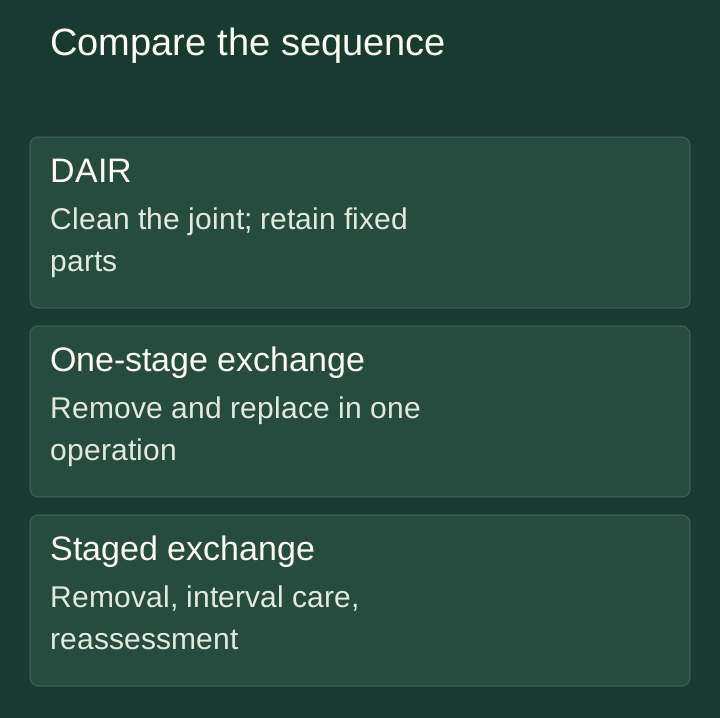
DAIR means debridement, antibiotics and implant retention. It involves operative cleaning and removal of infected or damaged tissue, with exchange of suitable removable parts in many cases while fixed components remain. It may be considered in selected situations, often with a recent infection and a stable implant. The AAOS infection overview explains that treatment must address bacteria associated with the implanted joint.
Ask why retention is appropriate for your case and what information could rule it out. Clarify the planned antibiotic treatment and how response will be assessed. Keeping components does not make this a minor issue or guarantee that further surgery will be avoided. Ask what the next step would be if symptoms, tests or operative findings suggest that the infection has not been controlled.
One-stage exchange: replacement in the same operation
A one-stage exchange removes the infected replacement, cleans the affected area and inserts a new replacement during the same operation. Antibiotics remain part of the pathway. The term one stage describes the surgical sequence, not a promise that care ends with a single appointment or that no further procedure will ever be necessary. Ask what the team knows about the organism, tissues and reconstruction requirements that supports this option.
If a hospital recommends one-stage treatment, ask which circumstances would instead require a different plan. If it does not recommend it, ask why. The South Tees NHS revision information describes both single-operation and staged approaches. A shorter planned surgical sequence can be attractive, but convenience alone cannot establish suitability.
Two-stage exchange: ask about the interval as carefully as each operation
A staged pathway generally separates removal and infection treatment from later reimplantation. A temporary antibiotic-containing spacer may be used between operations. Ask what is expected to remain in the hip during the interval, what it is intended to do and what movement or loading restrictions apply. A spacer is not automatically equivalent to the final replacement in what you can safely do.
Ask how readiness for the next operation will be judged, who makes that decision and what could postpone or alter it. Do not assume the second procedure is guaranteed on a date stated before treatment begins. The interval may require repeated reviews, medication monitoring and assistance with daily tasks. For international care, clarify where you will stay, who will provide that care and whether transfer between services is clinically appropriate.
Use comparisons carefully
The INFORM randomised trial compared one-stage and two-stage revision for hip prosthetic joint infection. Its primary patient-reported pain, stiffness and function outcome did not differ at eighteen months, while some earlier outcomes favoured the one-stage approach. This supports a discussion of both pathways; it does not prove that every patient is eligible for either or that infection cannot recur. Read the published INFORM trial with a clinician who can explain its relevance to your circumstances.
When shown a success rate, ask what counted as success, how long people were followed and whether their infection and reconstruction were comparable to yours. Infection control, avoiding another operation and good walking function are different outcomes. A hospital's headline percentage should not replace an explanation of your individual uncertainties.
Make antibiotic responsibility explicit
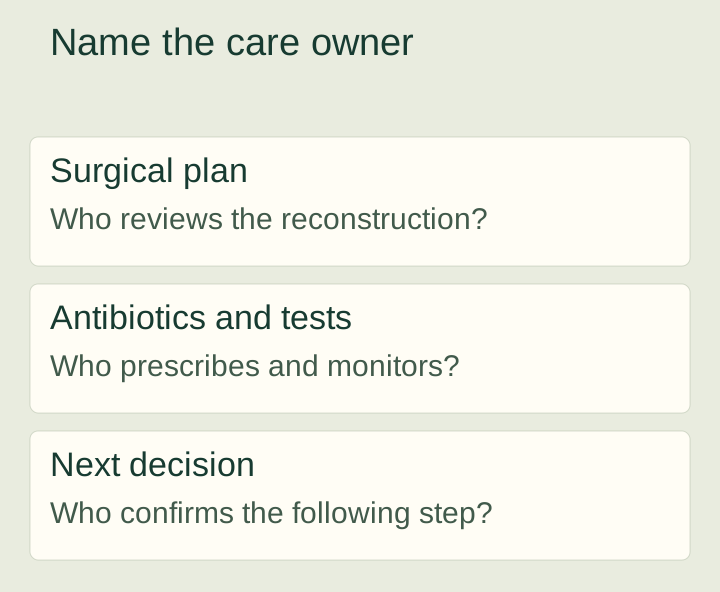
Ask which clinician will prescribe antibiotics, how changes will be communicated and which tests are needed to monitor treatment. Confirm the exact medicine list at each transition between hospital, accommodation and home. Tell the team about allergies, previous reactions, kidney problems and other medicines. Do not alter the dose or stop treatment because you feel better or because a different appointment is approaching.
Testing and antibiotics can interact, but any decision to pause or change treatment belongs to the clinical team. Never take leftover antibiotics or delay urgent treatment to improve a sample yourself. Ask how to report possible side effects and whom to contact outside office hours. If intravenous treatment is proposed outside hospital, confirm who will manage the line and administer treatment; do not assume a companion can take over these tasks.
When exchange is not the agreed plan
Some people face medical or reconstructive circumstances that make further major surgery unsuitable. Specialist teams may discuss long-term suppressive antibiotics or another operation with different goals. Suppression aims to control infection rather than establish that it has been eradicated. The Mayo Clinic treatment overview includes these less common pathways and their limitations.
If such an option is raised, ask about expected mobility, monitoring, potential complications and the signs that need urgent reassessment. Discuss your preferences and the practical consequences with the team. A decision against a particular operation should still leave you with a clear care plan, named clinical responsibility and an opportunity to revisit the decision if circumstances change.
Prepare for the human burden of a long pathway
Write down which tasks you may need help with: washing, dressing, meals, transport, medication appointments and communication with more than one hospital. Ask the rehabilitation team what support is realistic for the current stage, rather than using a routine primary hip replacement timetable. Arrange a backup if the person helping you cannot stay as long as first expected.
It is reasonable to ask for help with uncertainty, sleep, anxiety and the disruption of work or family life. Tell the team if the plan is becoming difficult to manage. A complex pathway is easier to follow when instructions are written, responsibilities are named and changes are explained. Use the care planner for practical questions, while keeping clinical treatment decisions with your healthcare professionals.
A listed Korean service to review for a planned opinion
Asan Medical Center is listed on Hip Replacement Korea. Its official Hip and Trauma Surgery service describes revision arthroplasty, making it relevant to enquire about a complex replacement assessment. Ask specifically whether the service can review suspected or established prosthetic joint infection and how orthopaedic and infection care would be coordinated. The public page does not confirm a particular infection protocol or availability for your case.
Review the official information and request clinical triage before making travel commitments. Ask which records are needed, who would assess you and what remains dependent on examination. This recommendation is based on relevant published service scope, not comparative outcomes. An overseas opinion must not delay local urgent treatment, and travel should proceed only when the clinicians responsible for your care consider it appropriate.
Budget and hand over the entire sequence
Ask whether an estimate covers one operation or the anticipated full pathway. Clarify laboratory monitoring, antibiotics, spacer-related care, later reconstruction, rehabilitation and unexpected admission separately. Include a changed length of stay and companion costs. Obtain the terms directly rather than assuming a first-stage payment covers every later decision.
Before changing country or provider, confirm who receives culture results, operation reports, implant details, antibiotic instructions and pending tests. Ask the receiving clinician to confirm what care they can provide. Do not rely on a discharge letter alone to establish an appointment or medicine supply. The continuing-care guide offers a separate handover checklist.
Plan UK continuity before any overseas treatment
For UK residents, a possible infection needs assessment through the local clinical team before travel planning. If an overseas opinion remains appropriate, ask the teams how the culture reports, antibiotic history and surgical records will be shared. Confirm who will be responsible at each stage rather than expecting the next hospital to adopt an incomplete plan automatically.
Ask the service you would return to whether it can provide the proposed medication monitoring, line care, wound review and specialist follow-up. The availability of these arrangements should be confirmed before moving between countries. Check coverage and exclusions directly with your insurer and provider; neither an initial consultation nor a first-stage estimate proves that later care is funded. In the UK, use local urgent or emergency services for concerning deterioration instead of waiting for a reply from Korea.
Questions to settle before the next commitment
Does one-stage surgery mean no antibiotics afterwards?
No. Ask the infection team to explain the treatment plan and monitoring. The number of operations does not define the duration or type of medicine required.
Can I choose two-stage surgery because it sounds more thorough?
Ask which option fits the infection and reconstruction rather than assuming more operations are always better. Discuss the benefits, risks and practical burdens of each clinically reasonable pathway.
What if the plan changes after the first procedure?
Ask for an explanation of the new findings, revised goals and next decision point. Obtain updated written instructions and confirm who coordinates the change across all the clinicians involved.