Prepare your quote questions
Choose the questions you still need answered, then discuss them with the hospital. Selecting a question does not approve an estimate or confirm that treatment or travel is suitable.
This checklist does not save or send your choices. They clear when you load the page again. Do not enter personal or medical details here. The site’s usual analytics still applies. This is separate from the saved English care planner described in our privacy information. Privacy information
Choose questions for the hospital
Hip replacement costs in Korea make sense only when the clinical proposal and the whole journey are priced together. Ask for a written estimate based on your records, then add accommodation, assistance, transport, rehabilitation and follow-up at home. A country-wide price cannot tell you what your own care will require. The useful comparison is between two complete, clinically suitable plans, including what happens if the original schedule changes.
This guide is for someone deciding whether a Korea consultation is financially practical. It explains how to build a decision budget before committing to surgery. It does not offer a hospital tariff or imply that travelling is cheaper for every patient. Your diagnosis, existing implant if any, medical health and proposed operation should come before a package comparison.
Start with the operation, not the advertised total
Write the proposed procedure at the top of your comparison sheet. Is it a first total hip replacement, a partial replacement after a fracture, or a revision of an existing implant? Which hip is involved? Is a second procedure being discussed separately? If these details are uncertain, the first financial decision is the cost of assessment, rather than the cost of an operation that has not yet been recommended.
Total replacement reconstructs both sides of the joint, while revision addresses an existing replacement and may involve a different scope of reconstruction. The AAOS revision guide explains why revision can require specialized planning and implants. Do not use a first-operation package as a ceiling for a revision budget. Ask the hospital which information it needs before producing a meaningful estimate and which assumptions will remain provisional until examination.
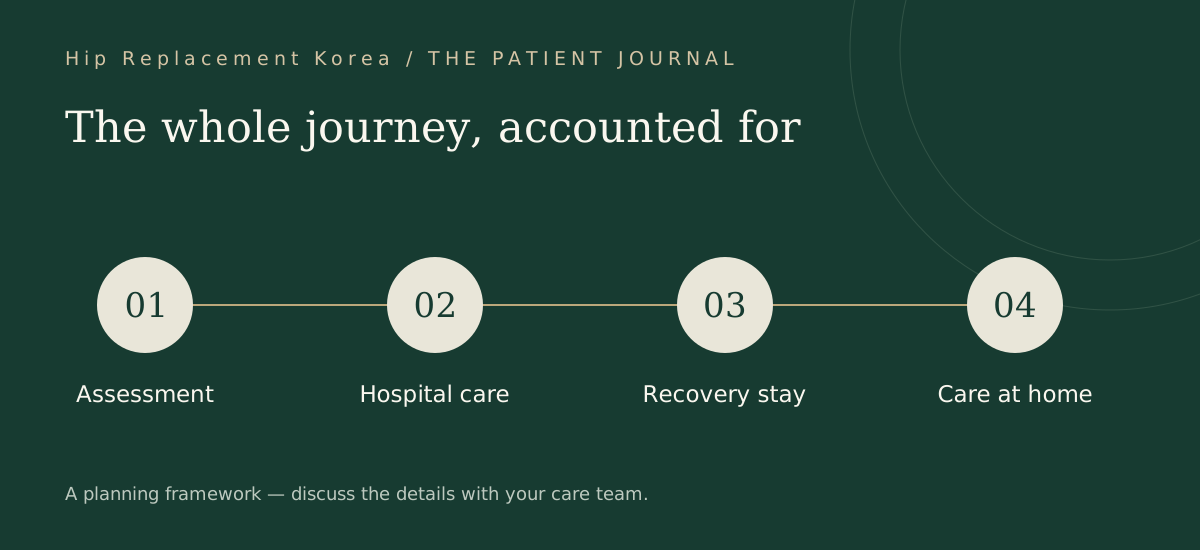
Build your budget in four layers
The first layer is assessment: specialist consultation, relevant imaging, laboratory tests and any other medical evaluation the team requests. Ask which existing results can be reviewed and which tests may need repeating. Record the cost of finding out whether surgery is suitable even if the eventual answer is to continue non-surgical care or seek further investigation.
The second layer is the hospital episode. Separate the operation and implant from anesthesia, room charges, medicines, nursing, therapy and other items. A bundled estimate may include several of these, but the label alone does not explain its boundaries. Ask the billing team to mark each item as included, excluded or dependent on circumstances. Keep the written answer alongside the clinical recommendation.
The third layer covers the period after discharge in Korea. Accommodation, transport to reviews, meals, equipment and help with daily tasks belong here. The fourth is continuity after returning home: planned consultations, rehabilitation, prescriptions and any necessary local investigations. These are useful planning categories, not a claim that every provider bills in the same way.
Compare two pathways using the same assumptions
A shorter estimate is not automatically incomplete, and a longer one is not automatically better value. The question is whether the two proposals describe comparable care. One may include a private room, while another assumes a different ward arrangement. One may list therapy separately. Another may combine it with admission. Request clarification before interpreting the difference as a saving.
Keep clinical and financial questions in separate columns. A surgeon explains why a particular treatment or implant is appropriate; an international office or billing team explains how it is charged. If a change in the medical plan changes the estimate, ask for both documents to be updated. This helps prevent a situation where you approve one procedure while relying on the price of another.
For detailed line-by-line checking, use Hip Replacement Korea's hospital estimate guide. The broader budget here should show the entire trip, including costs that never appear on a hospital invoice. Comparing like with like is particularly important when your local option uses insurance and the overseas option requires payment before reimbursement.
Decide what accommodation must actually provide
Describe the destination you will use after discharge, not simply a preferred hotel rating. Ask about the entrance, lift, bathroom layout, bed height and the route from a vehicle to the room. Send relevant details to your care team so they can discuss whether the arrangement fits your anticipated mobility. A luxury room can still be awkward if it requires stairs or difficult transfers.
Price a flexible booking alongside a fixed booking. Record what extending the stay would cost and whether the same accessible room would remain available. Ask a companion how long they can realistically remain. If help would need to be hired, confirm what the service includes and who arranges it. A companion's presence and professional nursing are different forms of support; budget for the support your actual plan requires.
Rehabilitation is a care decision before it is a price comparison
Ask who sets the rehabilitation plan, where it begins and who will continue it. The NHS recovery overview describes recovery as variable and includes help with mobility and daily activities. Do not assume a purchased number of therapy sessions defines when you will be ready for every activity or for an international flight.
For budgeting, ask which sessions are part of the admission and which are outpatient appointments. Confirm whether an assessment, a walking aid or a later review creates a separate charge. If therapy will continue at home, contact the intended service before travelling and ask what referral or operation records it needs. An unused allowance in Korea does not necessarily transfer to a provider in your own country.
Understand payment timing and financial responsibility
An estimate, a deposit request and a final bill serve different purposes. Ask when each payment is due, which currency appears on the invoice and how additional charges are communicated. Record the name of the organization receiving payment. If a third party coordinates the journey, clarify which services it supplies and which contractual relationship is directly with the hospital.
Asan Medical Center publishes an English billing and insurance page. That is a useful official starting point for its processes; your own arrangements still need confirmation with its team. Do not assume that another hospital follows identical procedures. Keep copies of receipts, itemized statements and the version of the estimate accepted before admission.
Ask insurance questions before paying a deposit
Planned treatment overseas, emergency treatment during a trip and complications after a planned operation can be treated differently by an insurer. Request a written response to your actual proposal rather than asking only whether you have international coverage. Include the procedure, destination, provider and expected dates, and ask which documents are needed before a decision can be made.
The NHS advice on planned treatment abroad warns that ordinary travel insurance often does not cover this purpose. It also explains that GHIC or EHIC arrangements are not cover for travelling specifically for planned treatment. These cards should not be treated as a financing route for a Korean operation. Patients from other countries should check their own policy and healthcare arrangements rather than apply UK rules to themselves.
If reimbursement is proposed, ask what you must fund upfront and what happens if the claim is delayed or declined. Direct billing and reimbursement are not interchangeable. Keep enough financial flexibility to avoid making medical or travel decisions under pressure from a pending insurance payment.
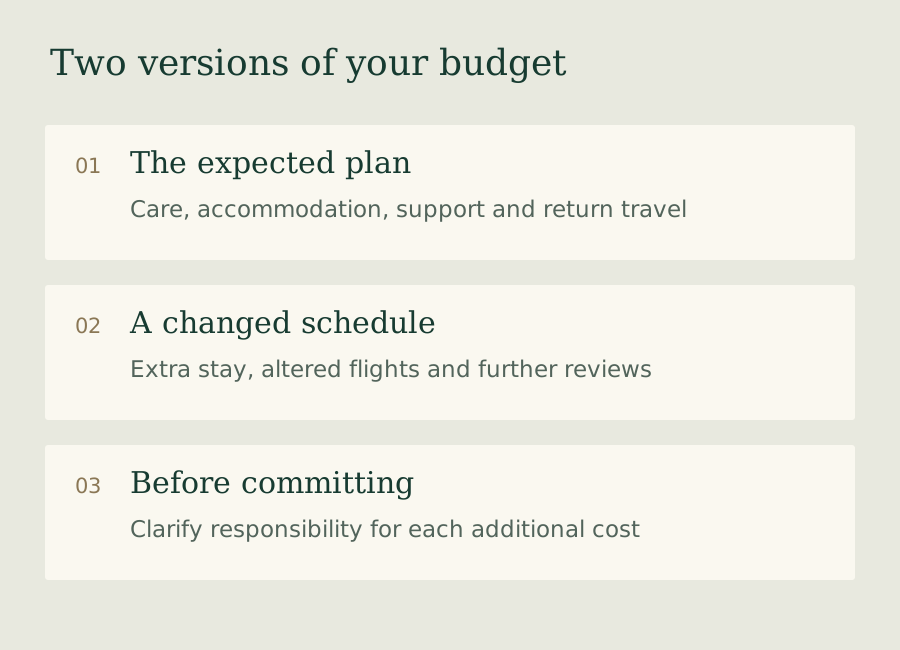
Budget for changes without pretending to predict them
Create a second version of the budget for a changed schedule. It might include additional accommodation, a companion staying longer, extra local transport, changed flights or another consultation. Ask which hospital costs would also change if admission is extended. The purpose is to identify exposures and responsibilities, not to predict that a complication will occur or to invent a universal contingency percentage.
Australia's Smartraveller medical tourism guidance highlights the possibility of extra treatment costs and insurance exclusions. Use that principle to ask concrete questions: who would assess a new problem, who authorizes additional treatment, and how would payment be handled? A promise that an entire journey is covered should have written boundaries you can understand.
Compare Korea with the care available at home
Put the local pathway beside the Korean pathway using your own costs, not national averages from unrelated patients. Include travel, time away from work, available family support, local follow-up and how you would obtain help if recovery is difficult. Ask your clinician at home what continuing care they can provide and what would require another service. Do this before treating local follow-up as a free or automatic component.
A worthwhile comparison can still favor care near home, postponement or further investigation. If surgery is not yet clearly indicated, paying for an assessment or second opinion may resolve a more important uncertainty than negotiating an implant package. A lower quoted amount cannot compensate for an unclear diagnosis, an unsuitable care plan or a handover that nobody has agreed to receive.
Listed hospital and doctor options to explore
The following options are selected because their official pages describe relevant hip services and they already have profiles on Hip Replacement Korea. They are starting points for a case-specific discussion, not price rankings or guarantees of suitability.
Asan Medical Center in Seoul describes hip and pelvic surgery, including revision arthroplasty, on its official Hip and Trauma Surgery page. This makes it relevant when the financial scope depends on whether reconstruction is straightforward or complex. Review the service and ask the international team how a clinical review precedes a detailed estimate.
Seung Jae Lim is listed by Samsung Medical Center with clinical interests including total hip arthroplasty and femoral-head osteonecrosis. His official English profile provides a direct route to explore an appropriate consultation. Ask the hospital to confirm appointment suitability, the expected assessment process and who supplies the written financial proposal. No fixed fee or package is implied by this recommendation.
Questions to resolve before choosing a pathway
Ask what diagnosis supports the proposed operation, what information could change it and whether alternatives remain reasonable. Then ask which clinical services are included in the estimate, which are optional and which depend on findings. Establish who explains an unexpected bill and what cancellation or postponement terms apply. Finally, name the clinician or service responsible for care after returning home.
Write unanswered items as questions rather than filling them with guesses. A useful decision record has the current proposal, its assumptions, the outstanding uncertainties and the next review date. Share that same record with a companion or family member who may help coordinate the trip. It is easier to make a considered choice when everyone is comparing the same version of the plan.
Frequently asked questions
Can I get an accurate cost before travelling?
You can request a preliminary estimate based on records, but ask what remains conditional on examination and testing. Clarify whether the document describes an assessment visit or an agreed operation. A remote financial response should not be mistaken for final clinical clearance.
Does a higher price mean a better implant or result?
Price alone cannot establish clinical suitability or outcome. Ask the surgeon to identify the proposed components and explain the reason for them. Ask the billing team separately how implant choices affect the quote. Avoid selecting materials only because they are described as premium.
What is the most useful next step?
Prepare a concise history and available imaging, select a relevant hospital service and ask how to share records securely. Request an explanation of the proposed pathway before committing to travel. Use the resulting information to build your own complete budget and decide whether to proceed with assessment.
Sources and editorial approach · General patient information; discuss your individual plan with your clinical team.