Make the return to swimming or cycling part of your UK aftercare plan
If you are considering hip replacement in Korea and hope to return to your local pool or bicycle afterwards, discuss that goal before travelling. The decision is not simply whether swimming and cycling are generally good activities. It is whether the particular session, equipment and journey fit your operation and recovery, and who will make that decision once you are back in the UK.
Swimming and cycling may form part of a lower-impact fitness routine after clinical clearance. The American Academy of Orthopaedic Surgeons includes both among relevant options. But pool access, an unhealed wound, the way you mount a bicycle and the risk of a fall can matter even when the activity involves little impact. A comfortable session on an exercise bike is not permission to cycle in traffic.
This is general information for preparing a personal plan, not an exercise prescription or clearance to start. Follow the restrictions from your operating team until they are reviewed. Advice may differ after revision surgery, a fracture or an operation with additional precautions.
Settle responsibilities before paying for treatment abroad
Ask the Korean provider who will assess your wound and rehabilitation before departure, what records you will receive, and how later questions will be answered. Ask your intended UK clinician what they need in order to continue care. Avoid leaving the first conversation about physiotherapy until you arrive home and discover that the nearest appointment is unavailable.
The NHS guidance on treatment abroad says to discuss plans with a GP and understand the aftercare arrangements. It does not promise that every requested rehabilitation service will be supplied by the NHS. Confirm referral requirements, availability and any private charges with the actual service. A gym membership or leisure-centre concession is a different arrangement from clinical physiotherapy.
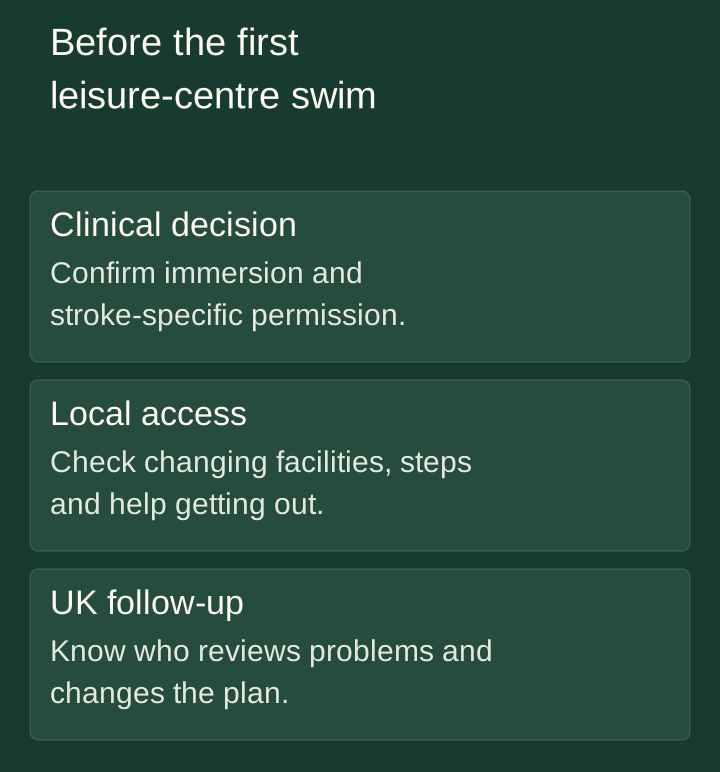
Bring the discussion back to specific questions: who clears immersion, who reviews a painful exercise session, and who decides when outdoor cycling is appropriate? These may be different clinicians working together. Record the names or teams and the contact route. Our guide to returning to the UK after hip surgery in Korea covers the wider handover.
Why NHS leaflets do not give one universal swimming date
You may find apparently contradictory advice from reputable hospitals. For example, Leeds Teaching Hospitals' rehabilitation leaflet separates static and outdoor cycling and restricts breaststroke for a longer period. The Royal National Orthopaedic Hospital guide permits breaststroke within its own recovery pathway once swimming requirements are met. These are local pathways, not a menu from which to select the earliest return.
Show your physiotherapist any advice that seems to conflict with your discharge instructions. Ask which restriction applies to your surgery and why. A leaflet written for another hospital's patients cannot account for your wound, additional procedures or current abilities. Likewise, the name of a surgical approach does not by itself answer every question about allowed movements.
Separate the decisions in your notes. “Pool immersion approved” is different from “breaststroke approved”, and “exercise bike approved” is different from “road cycling approved”. This makes a cross-border handover clearer and reduces the chance that a short phrase such as “return to exercise” is interpreted more broadly than intended.
Have the wound checked before immersion
Ask for clinical confirmation that you can put the wound under water. The NHS advice on recovering from surgery says to avoid submerging it until it is fully healed or a doctor says it is safe. Permission to shower, removal of stitches and the presence of a waterproof dressing are not equivalent to a swimming decision.
If there is an opening, discharge, increasing redness or uncertainty about healing, postpone the pool and contact the team. Do not buy a stronger dressing to bypass review. Ask who will assess the wound if you have already returned to the UK. A routine photograph may help the team decide what to do next, but it cannot establish everything that an examination might be needed to assess.
Describe where you want to swim. Approval for a supervised rehabilitation pool should not be extended automatically to a leisure pool, hot tub, lake or sea. Open water introduces a different environment and exit problem. If cold-water swimming is part of your usual routine, raise it as its own question rather than assuming that approval for pool lengths includes it.
Check the leisure centre before the first session
Telephone or visit without swimming to check the whole route. Ask about parking or the distance from public transport, changing facilities, a usable bench, wet floors, broad pool steps, handrails and any lift. If the lift is relevant, confirm that it will be available at the time you plan to attend and who is trained to use it. Do not assume that the word “accessible” answers all of those questions.
Explain the entrance and exit to your therapist. A ladder may require movements or effort that do not match your current plan. Plan getting out when tired as carefully as getting in when fresh. If assistance is required, ask the facility what it can provide and what a companion must do. A lifeguard's presence is not an agreement to provide personal rehabilitation assistance.
Check how you will carry a bag, store the walking aid and change afterwards. Avoid choosing a session merely because it is the cheapest if it involves busy lanes or an inconvenient journey. These are practical reasons to choose a quieter session or different venue, not proof that a particular pool is medically safer. A workable land-based routine remains an option while access problems are resolved.
Agree the activity, not just the venue
Tell the rehabilitation team whether you want to swim lengths, walk in water or attend a class. Ask about the stroke, kick, turns, wall push-offs and the method of entering. If a movement is restricted, ask what approved alternative would meet your goal. Do not invent a new stroke to avoid admitting that a familiar one remains difficult.
Ask a class organiser what movements and equipment are used. A class called gentle can still contain quick direction changes or movements outside your personal limits. A swimming instructor can help with technique, but cannot replace the clinician responsible for postoperative restrictions. Aquatic physiotherapy involves clinical assessment and a rehabilitation plan; a warm public pool or aqua-aerobics session is not the same service.
Agree the aim of the first visit before you arrive. It may be to practise a short, manageable routine rather than count lengths. Plan a way to end the session and get home without pressure to finish what the group is doing. Do not treat an annual membership or a pre-paid block of classes as a reason to exercise through new symptoms.
Fit the indoor bicycle to the person and the precautions
Ask your physiotherapist to assess the type of bicycle you will actually use. An upright machine, a recumbent bike and your own bicycle mounted on a trainer differ in how you sit and get on. Share a model name or photograph before buying equipment. A product marketed for rehabilitation is not necessarily suitable for your operation or your room.
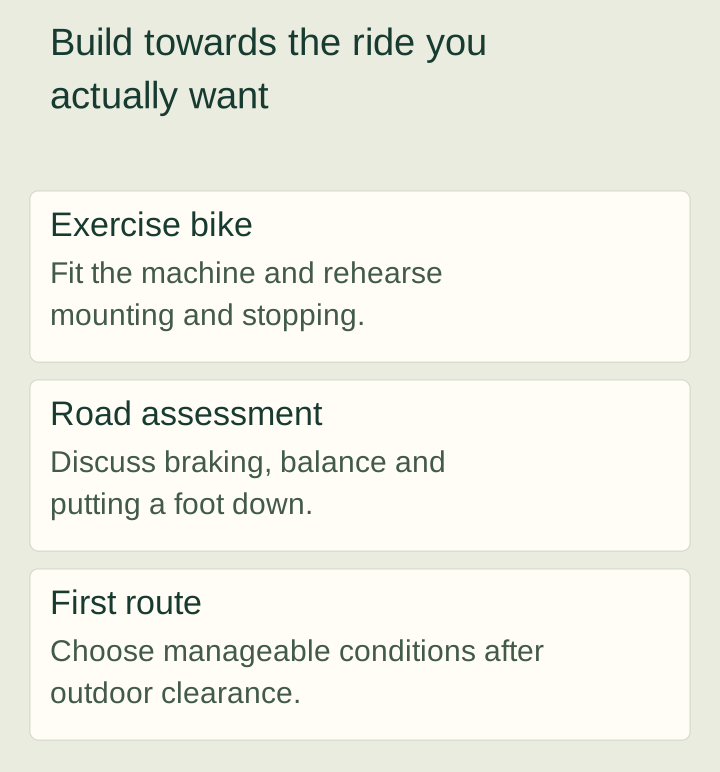
Have someone qualified demonstrate and check the full sequence: approaching, mounting, placing the feet, pedalling, stopping and dismounting. Ask how to set the seat and handlebars within your allowed movement. If you cannot turn the pedals comfortably without forcing the hip, ask for a reassessment rather than pushing through or relying on an online saddle-height rule.
Agree starting duration, resistance and frequency, and record the settings. The aim is a repeatable, appropriate session, not an impressive calorie display. Ask what should change first as you progress and when to review it. Indoor cycling should fit alongside the prescribed rehabilitation rather than replace strengthening or walking practice because it feels more like your old training routine.
Road cycling requires more than pedalling strength
Discuss stopping unexpectedly, putting a foot down, braking, turning, looking behind and getting on or off the bicycle. Mention clip-in pedals, carrying the bike through a hallway, lifting it onto a rack or negotiating steps. A calm indoor session does not test these situations. Ask how the relevant abilities can be assessed before returning to the road.
Describe your actual UK route rather than saying only “a short ride”. Hills, potholes, wet leaves, narrow lanes, traffic and shared paths can change the demands. Plan the first approved rides around manageable conditions and a way to stop early. Cycling to work adds a fixed arrival time and a return journey, which may make it a different goal from a short leisure ride.
An e-bike still needs control, balance and safe handling of its weight. Electric assistance does not remove the need for outdoor clearance. Once riding is approved, use appropriate protective equipment and avoid pressure to match a club ride or previous pace. If the route or equipment changes significantly, review the plan rather than assuming that all cycling is one activity.
Use a short record to guide the next decision
Write down the activity, approximate duration, equipment settings or route, symptoms and how you managed afterwards. Include whether you could change clothes, walk home and complete normal daily tasks. Those details can be more useful in a physiotherapy conversation than a fitness score. There is no need to turn recovery into a competition with another patient.
Ask which symptoms should end a session and which require contact with the clinical team. Do not take additional pain medicine simply to reach a training target. New or worsening symptoms deserve a response based on what they are, not a blanket instruction to rest for a set number of days and try again. Keep prescribed medicines and exercises within the agreed plan.
Know when to use urgent or emergency care
New swelling, pain, warmth or colour change in one leg can indicate a blood clot and needs urgent same-day assessment. In the UK, contact an urgent GP service or NHS 111 where available for advice on immediate assessment; if you cannot access them promptly, seek urgent local care. Do not wait for a routine reply from Korea. The NHS DVT page describes the symptoms and urgency.
Call 999 for severe or sudden breathing difficulty, chest pain or collapse. Coughing blood also needs urgent assessment, particularly with breathing trouble. Do not drive yourself. See NHS pulmonary-embolism guidance. While still abroad, use the local emergency service rather than a UK advice number.
Wound discharge, fever, chills, spreading redness or worsening hip pain needs prompt clinical assessment; severe illness or rapid deterioration is an emergency. A fall with severe pain, deformity or inability to bear weight needs emergency assessment too. Do not try to walk on the leg or put a suspected dislocation back yourself. See the NHS complications advice and MedlinePlus dislocation guidance.
A relevant listed Korean hospital to explore
We recommend considering Asan Medical Center's profile on this platform when comparing Korean hip services. Its official Hip and Trauma Surgery page describes hip and pelvic surgery, including revision arthroplasty. This verified scope makes it relevant to a discussion of postoperative goals; it does not establish better sporting results or a faster return than another hospital.
Use the official international website to ask how a consultation would address your particular swimming or cycling goal and communicate with a UK rehabilitation clinician. Confirm appointment language, follow-up arrangements, available services and charges directly. We have not verified a dedicated swimming or cycling programme there, and this guide is not a personal endorsement of a treatment plan.
Our international consultation-planning page can help you set out your questions before an enquiry. Include the UK follow-up arrangements you need to understand; asking for information is not a commitment to travel or surgery.
Leave the review with decisions you can use
Request a clear answer for each next step: immersion, permitted water movements, pool access, indoor bike setup and eventual outdoor riding. Ask who can change the advice and which review comes next. Keep the written plan accessible to your companion and UK therapist, alongside the operation details and current medicines.
Success is a routine that fits your recovery and your life. Returning to the local pool or bicycle can be a worthwhile goal, but there is no need to turn a calendar date, leisure-centre booking or group ride into a deadline your hip must meet.
Sources and further reading
- AAOS: Activities After Total Hip Replacement
- NHS: Getting back to normal after surgery
- Leeds Teaching Hospitals: Total Hip Replacement rehabilitation
- RNOH: A Patient’s Guide to Hip and Knee Joint Replacement Surgery
- NHS: Deep vein thrombosis
- NHS: Pulmonary embolism
- NHS: Complications of a hip replacement
- MedlinePlus: Dislocation
- Asan Medical Center: Hip and Trauma Surgery
- Asan Medical Center: Official international website
- NHS: Going abroad for medical treatment