Swimming and cycling can be goals, not automatic next steps
After hip replacement, returning to a familiar pool or bicycle can feel like getting part of your life back. Both may fit a lower-impact fitness plan, but the label “low impact” does not mean that every version is suitable straight away. A stationary bike in a supervised rehabilitation room is different from a road ride. Gentle pool exercise is different from swimming hard, turning at speed or climbing out on a narrow ladder.
Start with a decision about the exact activity. Ask your surgical team whether your wound, movement restrictions, strength, balance and general health allow that activity now, and ask the physiotherapist to help make the plan practical. AAOS guidance includes swimming and cycling among lower-impact options after clearance. It does not make a calendar date a substitute for an individual review.
This guide supports those conversations; it is not a personalised exercise prescription. Keep your discharge instructions in force until the responsible team changes them. If you had revision surgery, an associated fracture or additional restrictions, explain that before using advice intended for an uncomplicated first replacement.
Choose one useful fitness goal
Define what you want to return to: relaxed pool lengths, a supervised water session, an indoor exercise bike, a neighbourhood ride or cycling to work. Tell the therapist whether you already did it before surgery. Restarting a familiar activity and learning an unfamiliar skill are different planning problems. You do not have to take up swimming because an article calls it suitable if you are uncomfortable in water.
Ask what each activity adds to your rehabilitation and what it does not replace. A pleasant pool session should not quietly displace prescribed strengthening, walking practice or other exercises. Agree how the activities fit together in a normal week, including rest and the effort involved in travelling to the facility. A plan that leaves you unable to manage the journey home is not well matched to your current capacity.
You can postpone the pool or bicycle while continuing the activities your team has already approved. Not being ready for one form of exercise does not mean that all movement should stop. Our recovery-milestones guide helps separate different abilities rather than treating recovery as a single finish line.
Pool readiness starts with the wound
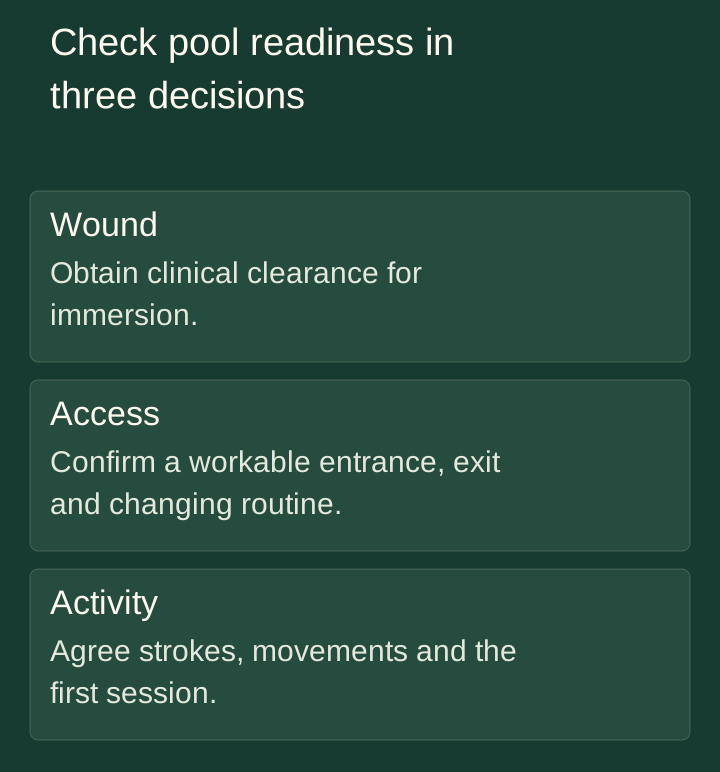
Do not use swimming as a test of whether the incision has healed. Ask the team to confirm readiness for immersion. The NHS surgical-recovery advice says not to put the wound under water until it has healed completely or the doctor says it is safe. Permission to shower is not the same decision as permission to spend time in a pool.
A dressing sold as waterproof does not provide medical clearance, and removing stitches or staples is not a personal return-to-swimming certificate. Describe any opening, drainage, increasing redness or uncertainty about the wound before booking a session. If review is needed, arrange it rather than hiding a problem under another dressing. Ask what skin care is appropriate after an approved swim; do not add antiseptics or new wound products without advice.
Explain the water setting as well. A rehabilitation pool, hotel pool, public pool, hot tub and open-water venue are not interchangeable. Permission for a controlled session does not automatically include every one of them. During a stay in Korea, a hotel advert showing a pool should be treated as an amenity description, not a postoperative service or evidence of clinical supervision.
Check the entire pool visit, including the exit
Before paying, ask the facility about the entrance route, changing bench, floor surfaces, handrails and pool access. Can you use broad steps, and is an appropriate lift available if your team recommends one? Who operates it? A pool may call itself accessible while still having a difficult changing-room transfer or a long wet walk. Ask for concrete information rather than relying only on that label.
Plan the exit while you are still rested. Describe the steps or ladder to your physiotherapist and ask whether you can use them within your restrictions. Do not assume a lifeguard can provide personal rehabilitation assistance. If a helper is needed, check the facility's arrangements and have the therapist explain that person's role. Arrange a place for your walking aid without leaving it in a wet or obstructed route.
Bring only what you can manage safely, and organise transport so that carrying a bag is not the hardest exercise of the day. A short first visit can focus on a safe, agreed routine rather than reaching a distance target. If entry or exit is not workable, choose another facility or stay with an approved land-based option until it is.
Ask about strokes, turns and water classes separately
“Can I swim?” leaves important details unanswered. Ask about your intended stroke, kicking action, pushing off the wall, turning and getting into the water. Breaststroke advice is not uniform: the Royal National Orthopaedic Hospital guide allows it within its pathway, while Leeds' rehabilitation leaflet uses a more restrictive approach. Neither leaflet overrides your own surgeon's instructions.
Ask your team to put the permitted movements in everyday language. If a familiar stroke is not yet permitted, find out whether a different approved activity is suitable, rather than inventing a modified kick yourself. An instructor can help with swimming technique but should not be asked to lift surgical restrictions. If the instructions are unclear, have the rehabilitation team resolve them before the session.
Water exercise classes also differ. A class advertised as gentle may include large hip movements, quick changes of direction or resistance equipment. Request the class outline and discuss it with the therapist. Aquatic physiotherapy is a clinical service with an assessment and plan; ordinary pool access or a fitness class does not become physiotherapy because it takes place in warm water.
A stationary bicycle needs a fitting and transfer plan
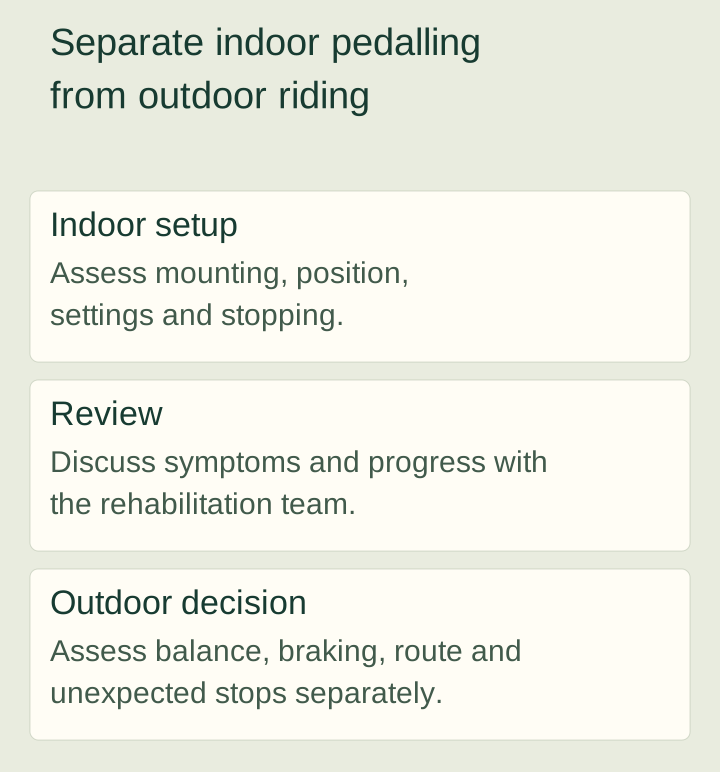
When cycling is approved, ask the therapist to check the actual type of machine. An upright exercise bike, a recumbent model and a road bicycle on a trainer can require different hip positions and different ways of mounting. Bring the model details or a photograph if the machine will be in a hotel or your home. Do not assume that “recumbent” automatically means easier or that a high saddle is right for every person.
Ask for demonstration of getting on, positioning the feet, sitting, pedalling, stopping and getting off. Discuss the seat and handlebar settings, permitted hip movement and what assistance is needed. If you cannot complete a pedal turn comfortably within the prescribed limits, do not force the movement or copy a stranger's adjustment. Ask the therapist to reassess the setup or choose another approved exercise.
Agree the starting duration, resistance and frequency with the clinician who knows your rehabilitation. Record the machine settings so that the next session is reproducible. Changing several settings or goals together makes it difficult to describe what caused a problem. Fitness displays, calorie targets and a previous personal best are not measures of wound healing or readiness to increase the load.
Outdoor riding is a separate clearance decision
Comfortable indoor pedalling does not establish that you can ride safely outdoors. Discuss balance, mounting, dismounting, braking, looking around and putting a foot down unexpectedly. Describe the real route: traffic, hills, uneven surfaces, shared paths and places where stopping is difficult. Tell the team whether you use clip-in pedals or need to carry the bicycle up stairs.
Ask how to demonstrate the relevant abilities in a controlled setting rather than testing them for the first time at a junction. The therapist may suggest a different setup or more rehabilitation before a road ride. A motor-assisted bicycle can still require handling a heavy machine and responding quickly; do not treat the motor as a substitute for clearance.
Once outdoor riding is approved, choose a manageable route and conditions, appropriate protective equipment and a way to stop the outing early. Avoid turning the first ride into a group commitment that makes you feel obliged to keep pace. A route you enjoyed before surgery can remain a future goal even if it is not the best place to restart.
Make progress understandable rather than competitive
Keep a simple record of the activity, approximate duration, machine settings or route, symptoms during it and how you managed ordinary tasks afterwards. Include pain, unusual fatigue, swelling, loss of confidence or difficulty getting home. You do not need a complex training app. A clear description helps the physiotherapist distinguish a poorly chosen setup from a plan that needs slower progression or clinical reassessment.
Ask in advance which symptoms mean stop, which require a call and when to review progress. Do not use a universal pain score from the internet to decide whether to continue. If a session causes new or worsening symptoms, stop and seek advice appropriate to the symptoms. Do not take extra pain medicine simply to finish a target or assume that discomfort proves the exercise is effective.
Revisit the plan when the setting changes. A supervised hospital bicycle, a different gym machine and a holiday rental are separate practical situations. So are a quiet pool and a busy lane session. Keep the same clinical restrictions while checking the new equipment and access arrangements.
Recognise warning signs that are not a training problem
New one-sided leg swelling, calf or thigh pain, warmth or colour change needs urgent same-day assessment for a possible blood clot. Stop exercise and seek care locally rather than waiting for an overseas appointment. NHS DVT guidance explains these warning signs.
Sudden breathing difficulty, chest pain or collapse requires emergency help immediately. Coughing blood also needs urgent assessment, especially with breathlessness or chest pain. Do not drive yourself; use local emergency services. See the NHS pulmonary-embolism advice.
Fever, chills, wound discharge, spreading redness or worsening hip pain needs prompt clinical assessment. Severe illness or rapid deterioration warrants emergency care. A fall followed by severe hip pain, deformity or inability to bear weight also requires emergency assessment. Do not try to walk it off or push the joint back into position. The NHS complications guide and MedlinePlus dislocation guidance support taking these changes seriously.
Keep the fitness plan connected when you leave Korea
Before returning home, request a written account of your operation, relevant restrictions, current rehabilitation and the next review. Ask who will decide on pool immersion, stroke changes, indoor resistance and outdoor riding. A generic “exercise as tolerated” line may not answer these separate questions. Have unclear wording clarified while the operating team can still assess you.
Arrange the receiving clinician and share records through an agreed secure route. Tell them what equipment and facilities you will actually use. Do not assume the flight home itself clears you for sport, or that a remote message can replace a wound or movement assessment when one is needed. Our continuity-of-care guide covers the broader handover.
A listed hospital to discuss activity goals
We recommend considering Asan Medical Center's listed profile if you want a Korean hip-service consultation. Its official Hip and Trauma Surgery page describes hip and pelvic surgery, including revision arthroplasty. That verified service scope is the selection reason, not evidence of faster return to sport or superiority over other hospitals.
Use the official international website to ask which team should review your case. Explain the pool or cycling activity you hope to resume and ask how rehabilitation decisions and overseas follow-up would be handled. Confirm services, appointment language and costs directly. This recommendation does not establish that a specific aquatic programme, bicycle-fitting service or appointment is available.
For help organising an international consultation, use our consultation-planning page to set out your activity goals and questions. An enquiry is an opportunity to clarify the care pathway, not a commitment to surgery.
Questions to take to your next review
Ask: Has my wound been assessed for immersion? Which strokes and movements are permitted? Can I manage the actual pool entrance and exit? Which bicycle and settings should I use? What must improve before outdoor riding? Who should I contact if symptoms change? Request answers specific enough that you, your helper and the local therapist can follow the same plan.
The useful outcome is not a promised week of return. It is a clear next activity, a practical way to do it, a review point and a response plan if things change. That gives fitness a place in recovery without making a swimming session or bicycle ride a test you have to pass.
Sources and further reading
- AAOS: Activities After Total Hip Replacement
- NHS: Getting back to normal after surgery
- Leeds Teaching Hospitals: Total Hip Replacement rehabilitation
- RNOH: A Patient’s Guide to Hip and Knee Joint Replacement Surgery
- NHS: Deep vein thrombosis
- NHS: Pulmonary embolism
- NHS: Complications of a hip replacement
- MedlinePlus: Dislocation
- Asan Medical Center: Hip and Trauma Surgery
- Asan Medical Center: Official international website