What anterior hip replacement means
Anterior hip replacement uses an approach from the front of the hip to reach the joint. It is one way to perform a replacement, not a separate guarantee of faster recovery or a better lasting result. If you are considering treatment in Korea, the useful question is whether this approach fits your anatomy, operation and surgeon's experience.
A decision about access should follow a decision about treatment. First establish why replacement is being considered, what alternatives remain and what improvement is realistic. Then ask how the proposed approach supports that plan. Choosing a hospital because it advertises a particular incision can put the technique ahead of the problem you need treated.
This guide helps you compare the reasoning behind a recommendation. It cannot determine which approach is appropriate for you. Use the total hip replacement guide for the operation itself, and bring your own imaging and history to a specialist consultation.
Separate approach, implant and technology
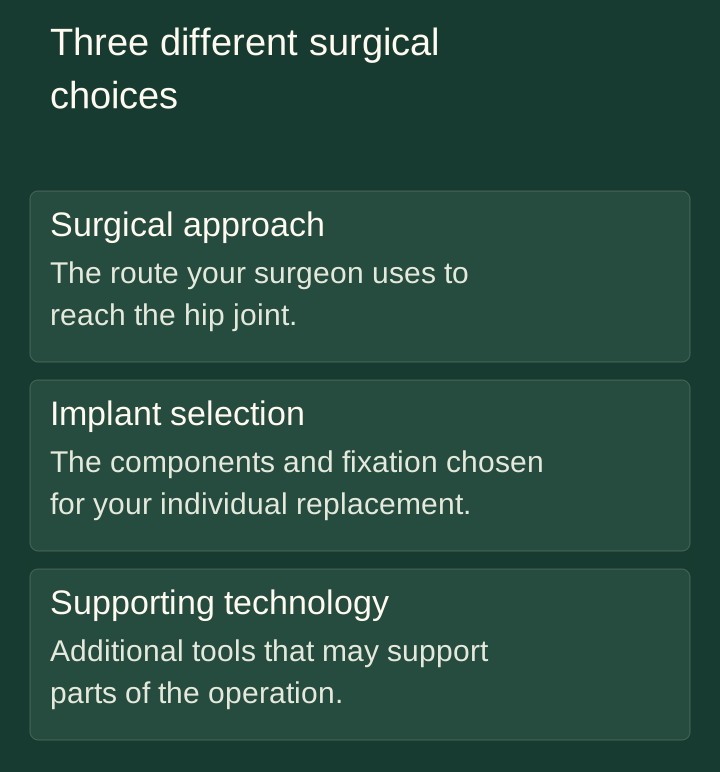
The surgical approach describes the route into the joint. The implant is the artificial joint, with decisions about its components, bearing surfaces and fixation. Navigation or robotic assistance describes additional technology that may support parts of the operation. These terms answer different questions, even when a hospital presents them together in a package.
Ask the surgeon to write down the proposed choices separately and explain the reason for each. If the recommendation is “anterior with robotic assistance”, ask what the anterior route contributes and what the technology contributes in your particular case. You should be able to understand the main argument without needing to compare brand names.
The AAOS explanation of minimally invasive replacement describes anterior access alongside other techniques and stresses appropriate selection and surgical experience. A smaller skin incision does not describe every action beneath it. Ask what tissues are involved and which aspects of the operation influence the recovery instructions you will receive.
Who should discuss suitability especially carefully?
Previous hip surgery, unusual anatomy, the planned complexity of the replacement and factors affecting wound healing can make the assessment more detailed. AAOS notes that some minimally invasive techniques may be less suitable in patients with prior surgery or significant deformity, among other factors. That is a reason for an individual discussion, not a checklist for accepting or excluding yourself.
Bring previous operation reports and describe existing scars, walking aids and any known difficulty with the other hip or your back. Ask whether the current proposal is a straightforward first replacement or whether the surgeon anticipates additional complexity. If the surgeon recommends a different route, ask what feature of your case drives that recommendation.
Useful answers connect the choice to something concrete in your history, examination or imaging. “This is the approach I usually use” is worth understanding, but ask how it relates to your needs. Equally, a clinician recommending an approach they use confidently may be making a thoughtful decision rather than overlooking a newer option. Request the explanation before drawing a conclusion.
If two opinions differ, send both clinicians the same records. Ask whether they disagree about your diagnosis, the need for replacement, the technical plan or the expected recovery. Those are different disagreements. A second opinion is most useful when it addresses the unresolved decision rather than simply offering another technique name.
How to interpret claims about faster recovery
Hospital for Special Surgery's patient explanation describes possible earlier functional gains in selected anterior-approach patients while noting that differences between approaches can diminish with recovery. This does not establish a guaranteed timetable for an individual, and short-term improvement is different from long-term implant performance.
When you hear “faster”, ask “faster at what?” Walking with assistance, managing stairs, leaving hospital, sleeping comfortably and returning to work are separate outcomes. Ask which outcome was measured, against which alternative and in what group of patients. Then ask how closely that group resembles your situation.
Make the discussion personal by naming your priorities. Someone whose main concern is managing an upstairs bedroom may need different practical detail from someone hoping to return to physically demanding work. Ask what support you are likely to need, how progress will be assessed and what would change the plan. A modest but clearly explained expectation can be more useful than a dramatic average.
Do not let an early-mobility claim determine a fixed travel itinerary. Being able to walk a short distance with help does not answer every question about accommodation, repeated appointments or a long journey home. Your treating team should assess those decisions separately. Read the airport and flight planning guide before buying a return ticket around a promotional recovery promise.
Discuss risks as carefully as possible benefits
Anterior replacement remains major surgery. The HSS overview includes infection, dislocation, blood clots, differences in leg length, nerve or blood-vessel injury and anaesthetic or medical complications among relevant risks. The existence of an anterior option does not remove the need for an individual consent discussion.
Ask which risks are most relevant to your health and anatomy, how the team reduces them and what it would do if they occurred. If a clinician discusses a lower risk of one complication, also ask about other trade-offs and the evidence behind the comparison. An attractive answer about one outcome cannot stand in for the whole risk discussion.
Ask about the surgeon's experience with the proposed approach in cases like yours. A total career count combining different procedures is not the same as recent experience with your operation. You need not impose an internet-derived numerical threshold. Ask how the team handles a difficult exposure or an unexpected finding, and whether the operative plan could change when necessary.
Clarify how concerns after discharge are assessed. Which symptoms should prompt a telephone call, an urgent in-person review or emergency care? Obtain the hospital's written instructions and contact details. Do not rely on social media to decide whether a new postoperative problem is normal for a particular approach.
Compare anterior, posterior and lateral recommendations fairly
Anterior, posterior and lateral refer broadly to access from different directions, but the full surgical and rehabilitation plans involve more detail. Our posterior approach and lateral approach guides provide starting questions. Ask each surgeon to explain the version they propose rather than assuming every operation with the same label is identical.
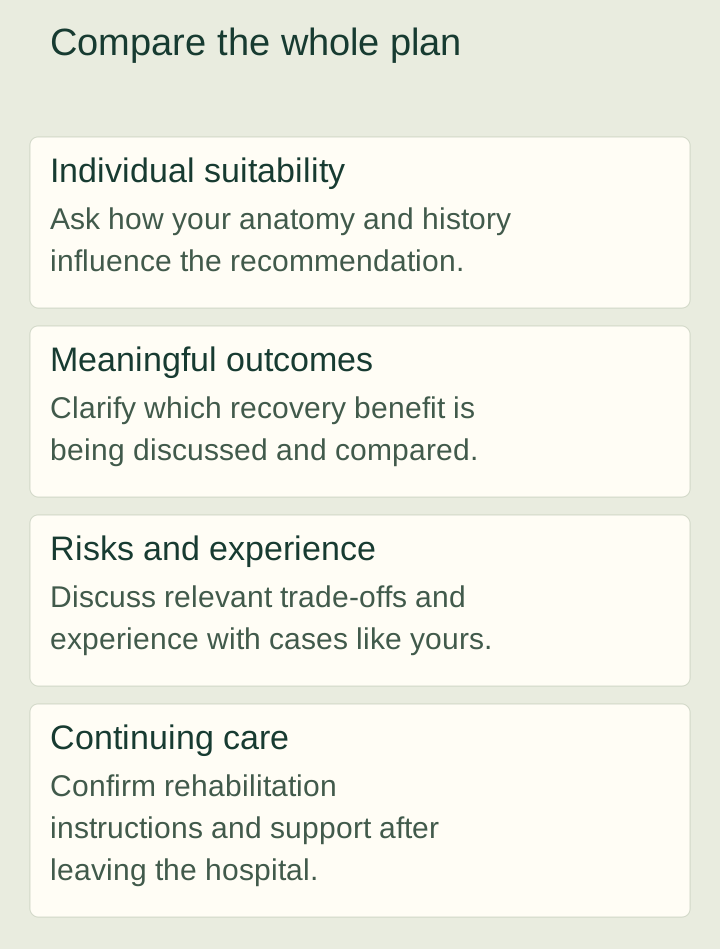
Use the same comparison headings for each opinion: suitability for your condition, expected benefits, important risks, relevant surgeon experience, rehabilitation support and follow-up. Record what is known and what still needs confirmation. Avoid making a scorecard that rewards a hospital simply for providing more marketing detail.
If a clinic says it offers “minimally invasive” surgery, ask whether it actually means a direct anterior approach, another reduced-incision technique or something else. If a page advertises a hip service without specifying an approach, treat availability as unconfirmed. A department's general capabilities do not prove that a particular surgeon offers the technique you want.
It is reasonable to have a preference and to explain it. It is also worth asking what evidence would change your mind. The strongest consultation should help you understand both why an approach could fit and why another might be preferable, without making you feel that selecting one label is the only route to a worthwhile result.
Ask for your own movement and rehabilitation instructions
Do not assume anterior access means no precautions, no walking aid or no rehabilitation needs. Ask the team to explain the instructions that apply to the operation actually performed. Have the physiotherapist demonstrate relevant everyday tasks, such as getting into bed, using the bathroom and moving around your accommodation.
Request a written plan identifying what you should practise, what assistance you need and when instructions will be reviewed. If your travel companion will help, ask whether they can attend the practical teaching. When you return home, make sure the receiving clinician or therapist has the operative details and current instructions rather than only the word “anterior”.
Keep expectations separate from travel commitments. Ask how discharge readiness is assessed, where follow-up will take place and what happens if you need longer in Korea. No approach name can settle these questions in advance for every patient. The hip precautions guide offers a framework for checking that advice is specific enough to use.
A listed hospital for a discussion about approach selection
Asan Medical Center in Seoul is a relevant listed hospital to consider for a hip assessment. Its official Hip and Trauma Surgery page describes complex hip and revision care. Those services provide a reason to ask for an individual review, particularly when the technical plan requires careful consideration.
The reviewed service page does not establish that Asan offers direct anterior replacement for your case. Ask through its official international website which approaches the relevant surgeon uses and why one would be recommended. This is a recommendation to investigate a verified hip service, not an endorsement of a specific technique or an assurance of availability.
Common questions about anterior replacement
Is anterior always better than posterior?
No single approach label establishes the best choice for every patient. Ask for the reasoning in your case, including meaningful benefits, limitations and the surgeon's relevant experience. Compare the whole plan instead of choosing from a headline.
Does a small scar mean a less demanding recovery?
A scar is only one visible feature of surgery. Ask what recovery tasks and support apply to your actual operation. Do not use incision length to predict when you can travel, drive or return to work.
What if my preferred surgeon recommends another approach?
Ask which clinical factors explain the recommendation and whether your preference changes any part of the discussion. If you remain uncertain, seek a second opinion with the same records. You should leave understanding the reasons, not merely knowing the name of the approach.