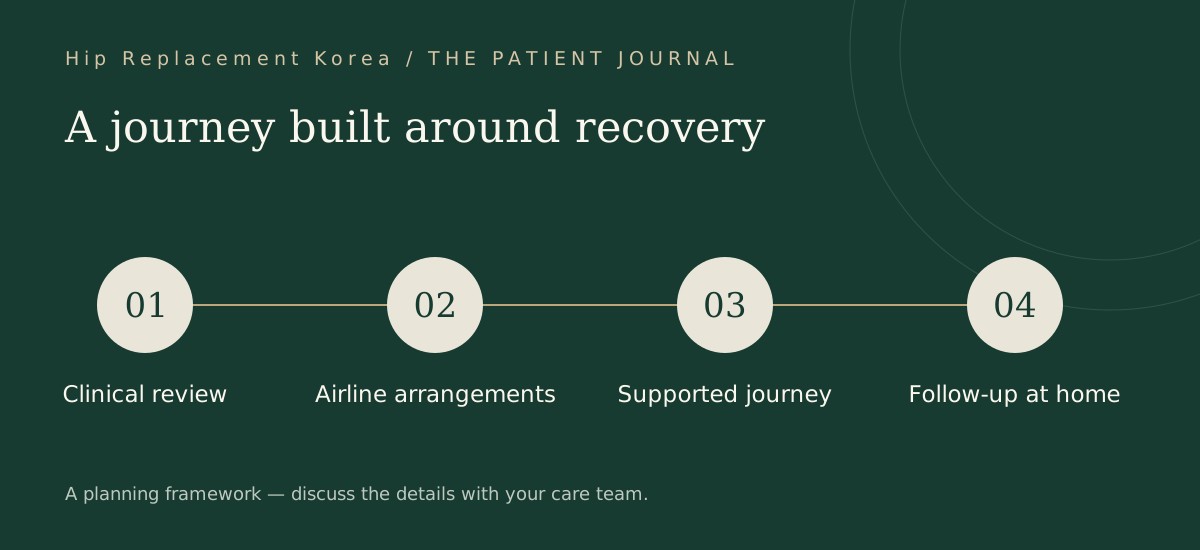
Flying home after hip replacement in Korea should be planned around clinical review, your ability to manage the journey and the airline's requirements. Hospital discharge is not the same as clearance for a long flight. There is no single return date that is safe for every patient, so keep the itinerary provisional until the treating team has considered your recovery and the complete route home.
The practical aim is a journey you can manage with the support actually available. That includes leaving your accommodation, transferring into vehicles, passing through the airport, sitting on the aircraft and reaching your destination after landing. This guide helps you prepare those conversations. It does not replace the surgeon's individual travel instructions or an airline medical assessment.
Why a return flight needs its own decision
Walking along a ward corridor is a different task from a long international journey. Airports can involve distance, queues, changing gates and transfers between several kinds of seats. At home, you can usually change plans quickly; in transit, assistance and access to medical care may be more limited. Explain those demands to the team instead of asking only whether you can fly on a particular date.
Recent surgery and prolonged limited movement are relevant to blood-clot risk. The CDC Yellow Book discussion of travel-related thrombosis describes the importance of individual risk factors and long-distance travel. The appropriate response is a personalized prevention and travel plan, not taking extra medication yourself. Tell the team about previous clots, current medicines and other medical conditions when discussing the flight.
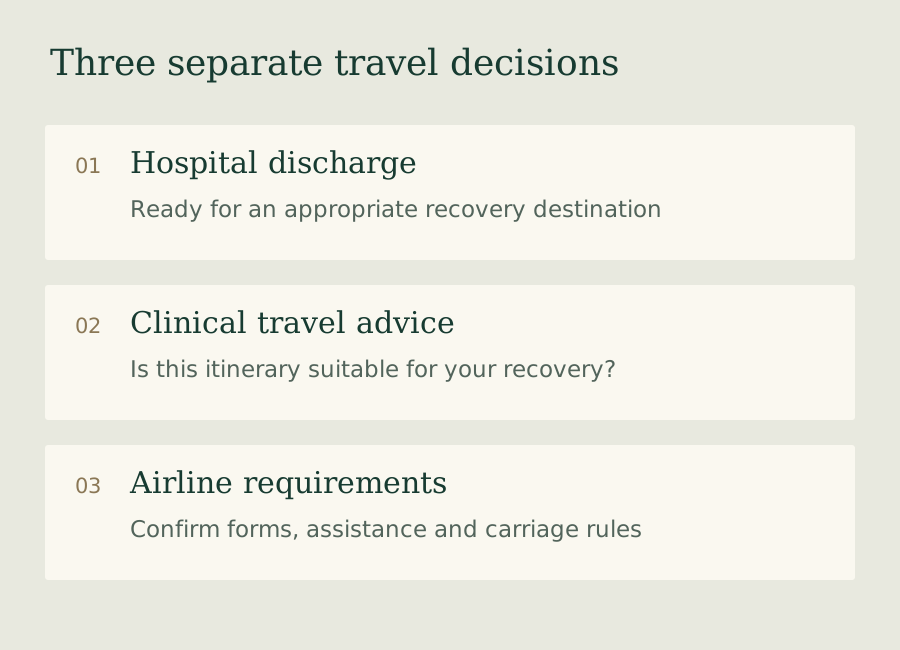
Separate three decisions that are often confused
First, the hospital decides when you can leave inpatient care for a suitable destination. Second, your treating team considers whether the proposed journey is medically appropriate. Third, the airline determines what it requires to carry you, including any forms or assistance arrangements. These decisions are connected, but a positive answer to one does not automatically answer the others.
The NHS hip replacement recovery page describes discharge in relation to wound recovery and safe mobility. Its general recovery information is not an individual international-flight certificate. If a booking agent gives you a return date, ask whether that date has been discussed with the clinical team and what would cause it to change.
Discuss the itinerary before choosing a fare
Show the proposed departure and arrival airports, flight duration, connections and ground transfers. Include the time from leaving your room to reaching the place where you will recover at home. A direct flight and an itinerary with several connections impose different practical demands. Neither can be assessed properly from the departure date alone.
Ask whether the team recommends postponing the journey, simplifying the route or arranging additional support. Compare the price and terms of flexible fares before committing. Check what changing a ticket means for a companion's ticket, accommodation and assistance booking as well. The most useful travel budget includes a workable alternative if clearance is delayed, rather than relying on every stage proceeding exactly as first estimated.
Make the review before departure meaningful
Ask when the travel decision will be reviewed and what information the clinician needs. Bring the actual itinerary and describe any difficulty with sitting, transfers, walking aids, fatigue or pain control. Report new symptoms honestly, even if you are worried about missing a flight. A travel booking should not discourage you from raising a medical concern.
Request written instructions that you can understand and share with the people helping you. Clarify who can answer a new question after discharge and how to obtain an assessment if something changes before departure. If your travel date moves, ask whether the previous advice remains applicable. A certificate written for an earlier situation may not reflect your condition on the day you travel.
Book assistance for the tasks you need help with
Contact the airline through its official service channel and describe your actual limitations. Ask about assistance from check-in to the aircraft, boarding arrangements, connections and arrival. Establish whether you can manage aircraft steps, walk to your seat or transfer from a wheelchair. These are practical descriptions, not requests for an airline employee to make a medical decision.
Do not assume that a wheelchair booking includes personal care, help in the toilet or clinical supervision. Ask what a companion would need to do and whether separate assistance is necessary. Record the booking reference and confirmation for each flight segment, particularly where different airlines are involved. Reconfirm the arrangement if the route or date changes; an assistance request attached to one reservation may not follow a replacement booking automatically.
Rehearse transfers with your rehabilitation team
Ask the therapist to relate your current movement instructions to getting into a car, sitting in an aircraft seat and using a public bathroom. Describe the walking aid you expect to use and whether you can manage it while carrying essential items. If a task has not been assessed, do not assume airport staff will be able to solve it safely on the day.
You do not need to perform an ambitious practice outing to prove readiness. The useful goal is to identify missing support and learn the techniques prescribed for you. Movement restrictions vary with the operation and individual plan. Follow your own instructions rather than another patient's online demonstration. Hip Replacement Korea's hip precautions guide explains questions that help translate restrictions into daily activities.
Organize medicines without improvising a new regimen
Ask the treating team for a medication list that includes names, doses and instructions. If timing will be affected by a long journey or time-zone change, obtain a specific plan from the prescriber or pharmacist. Clarify what to do about a missed dose and whom to contact about side effects. Do not add aspirin, change an anticoagulant dose or borrow another patient's medicine for the flight.
Keep essential medicines accessible in accordance with airline and border requirements. Ask the relevant authorities about any controlled medication or documentation requirement before travel; rules depend on the product and destination. Have the prescription details available if a bag is delayed or a clinician needs to identify the medicine. Plan how a delayed return would affect supply rather than waiting until the final doses are nearly finished.
Understand the clot-prevention instructions
If you are returning to the UK
Discuss the full long-haul itinerary before booking surgery, not just before departure. UK hospital advice is not identical: the Royal National Orthopaedic Hospital describes 12 weeks for long-haul flights, while Leeds Teaching Hospitals advises avoiding them until six months. Neither interval is personal clearance. Ask your operating surgeon and the clinician responsible for your care at home how your own risks, recovery and itinerary affect the decision; ask the airline separately about fitness-to-fly documentation and assistance.
Before paying, ask a prospective insurer in writing whether the proposed policy covers planned hip surgery in Korea, complications, additional accommodation or travel changes, and medical evacuation or repatriation. Standard policies may exclude planned treatment; do not assume a policy covers a complication merely because it covers an ordinary holiday. The UK government's South Korea health advice advises checking cover for complications and repatriation. Keep the insurer's emergency number and the exact policy wording accessible, and budget for costs that are not covered.
Ask which measures the clinical team recommends during the entire journey and how they fit your movement restrictions. If a compression garment is advised, ask about fit and suitability. If medicine is prescribed, understand its purpose and duration. The Royal National Orthopaedic Hospital's patient guide highlights both clot risk and the difficulty of following joint precautions when flying too soon.
Airline assistance reduces some walking demands, but it does not remove medical risk. Equally, trying to walk more than your team recommends is not a substitute for individualized advice. Ask how to balance prescribed mobility, rest and safe transfers. Your plan should be feasible in the seat and cabin you have booked, with the support that will actually be present.
Know which symptoms should interrupt travel plans
Sudden breathlessness, chest pain, collapse or coughing blood can signal an emergency and require immediate medical help. New or increasing one-sided leg swelling or pain needs urgent same-day local medical assessment, even without chest symptoms. Do not wait to board, finish a connection or return to your original surgeon before seeking urgent help. The CDC guidance on DVT and pulmonary embolism explains these conditions and why assessment matters.
Sudden severe hip pain with inability to stand, walk or move the leg, or a leg that looks newly shortened or rotated, needs emergency assessment for possible dislocation or fracture. Call local emergency services if you cannot move safely. Do not try to walk on the leg or reposition the joint, and do not wait for an overseas reply or continue the journey.
For a draining wound, spreading redness, increasing wound pain, fever or chills, seek urgent same-day advice from the surgical team or a local clinician. If the team is not promptly available, use local urgent care. Feeling severely unwell, confusion, collapse or rapid deterioration requires emergency care. Take operation records if readily available, but do not delay assessment to obtain them.
The Royal National Orthopaedic Hospital guide describes dislocation warning signs; NHS complication guidance explains infection and clot warning signs.
Make the arrival plan as detailed as the departure plan
Arrange who will meet you, the vehicle you will use and the route into your accommodation. Consider steps, a long walk from parking and how luggage will be handled. A companion who has travelled with you may also be tired. Identify a backup person or transport arrangement so the final part of the journey does not depend on everyone feeling well after a long flight.
Schedule the next clinical contact before you leave Korea where possible. Confirm that the receiving service knows you had surgery abroad and has agreed to the proposed follow-up. Ask which records it needs and how to deliver them securely. The continuity-of-care guide covers the handover separately; this flight plan should identify when and how that handover becomes active.
Carry a compact, usable record set
Keep the discharge summary, operation report, implant details, current medication list and rehabilitation instructions accessible. Include the hospital contact and the planned follow-up arrangements. Ask for documents in a language that the receiving clinical team can use, or establish its translation requirements. A folder full of unlabeled images is less useful than a clear index explaining what each item is.
A companion should know where the documents are, with your permission, but does not need unrestricted access to every part of your health history. Keep identification and travel documentation organized separately from the medical summary. If an urgent assessment becomes necessary, being able to produce the relevant information quickly is more useful than relying on a message thread with several different versions of the plan.
Listed care options for discussing the return journey
These recommendations are based on relevant hip expertise and official international care information, not on a promise of early flight clearance. The hospital treating you remains responsible for giving advice on your own operation and recovery.
Samsung Medical Center has an International Healthcare Center that describes care coordination for international patients. Its published process makes it a relevant point of contact when investigating how appointments, records and follow-up would be organized. Ask how travel questions reach the treating surgical team and what the office can coordinate administratively.
Seung Jae Lim is listed on Samsung's official English doctor page with total hip arthroplasty among his clinical interests. If you are considering a consultation, ask whether your case fits his service and how recovery reviews are planned for an overseas patient. The profile does not establish a fixed length of stay or a standard date for flying home.
Frequently asked questions
Can I book a return flight before my operation?
You may need a provisional itinerary for practical reasons, but discuss it before buying a restrictive fare. Ask what happens if examination changes the treatment plan or recovery changes the travel date. A booked seat is not evidence that the proposed journey is medically suitable.
Does business class make an early flight safe?
More space may help some practical tasks, but cabin class does not establish fitness to travel. The clinical decision still depends on your health, surgery, recovery and the journey. Ask the team whether the seat arrangement helps you follow its instructions; do not use an upgraded ticket as a substitute for clearance.
Is a short connection better than waiting at the airport?
A tight connection may introduce rushing, while a long wait can create additional sitting and fatigue. Describe the actual route to your team and airline. Choose an itinerary that accommodates assistance and realistic transfer time, rather than assuming the shortest advertised total journey is the easiest one to manage.
What if the surgeon advises me to delay?
Ask which issue needs reassessment, what support you need in the meantime and when the next review should occur. Change accommodation, companion and airline arrangements together. Keep the clinical contact informed if practical problems make the revised plan difficult, so that the discussion addresses the real situation rather than an unworkable itinerary.
Sources and editorial approach · General patient information; discuss your individual plan with your clinical team.