Choose for your problem, not just a surgeon's reputation
Choosing a hip surgeon in Korea starts with matching the clinician's current practice to your condition, then checking how they explain the recommendation and organise continuing care. A prominent title, appealing technique or positive review can help you identify someone to investigate. None answers whether that person is the right fit for your particular operation.
Begin with a short account of what you need assessed: a painful arthritic hip, a first replacement after another diagnosis, a problem with an existing implant or uncertainty about whether surgery is appropriate. These situations may lead to different consultations. If the diagnosis is unclear, ask for assessment rather than presenting an operation as already decided.
The American Association of Hip and Knee Surgeons' selection guidance recommends using more than one source of information and meeting the surgeon to discuss your circumstances. Its US credential examples should not be treated as a checklist of Korean licensing requirements. Use the principles of verification and a meaningful consultation while checking local details through the hospital.
Check the current hospital and clinical focus
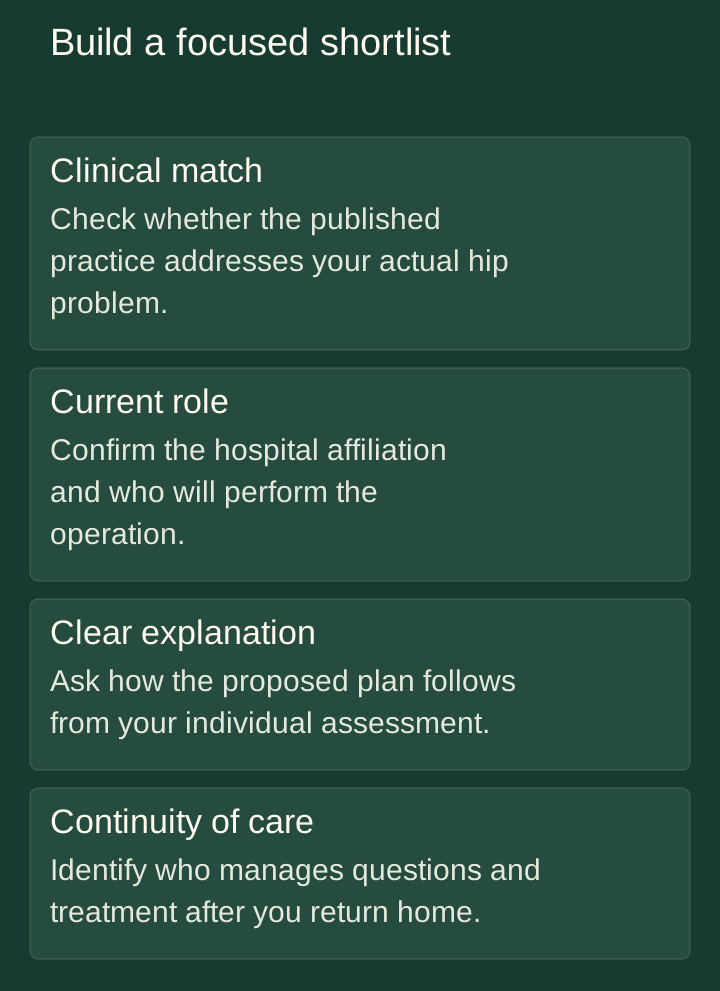
Use the hospital's official website to verify the clinician's name, department and published areas of practice. Keep the original spelling and, if available, the Korean name in your notes. Similar English spellings can make identification difficult. If a directory and hospital page disagree, ask the hospital to confirm the current affiliation before you arrange care.
Look for a focus that relates to your need, such as hip arthroplasty, hip preservation or revision surgery, rather than assuming every orthopaedic specialist performs every hip procedure. Ask whether the surgeon currently sees patients with your diagnosis and whether the international office can arrange the relevant consultation. A list of academic interests alone may not answer those practical questions.
Published qualifications are useful background. Ask the hospital how it verifies specialist status and whether the clinician is authorised to perform the proposed operation there. Do not equate membership of an overseas organisation, an academic appointment or an award with independent verification of every claimed skill. Keep a distinction between what you have checked, what the hospital states and what still needs an answer.
A useful shortlist can be small. Two carefully investigated options are often easier to compare than a long list assembled from advertisements. Note the reason each clinician is relevant and the unresolved question you want their consultation to answer. Avoid ranking people simply because one profile contains more photographs or more English text.
Ask about experience with similar cases
“How many hip operations have you done?” can start a conversation, but it needs context. Ask about recent experience with the proposed procedure and with patients whose problems resemble yours. First-time replacement and revision of an existing implant should not be combined into a single reassuring figure when your question concerns one of them.
Explain relevant features of your case, including previous hip operations, known anatomical differences and the reason for any proposed revision. Ask what makes the case straightforward or complex and what additional expertise might be needed. If the answer changes after reviewing imaging, ask the surgeon to explain why. A revised opinion based on better information can be useful rather than concerning in itself.
Find out who will perform the important parts of the operation, who else will be involved and who takes responsibility for the overall plan. Teaching hospitals use teams; ask for a clear explanation of roles instead of making assumptions from the name on the appointment. Also ask what happens if the agreed surgeon becomes unavailable before the proposed date.
There is no reason to adopt a personal numerical cutoff from a forum without understanding how it was chosen. Use experience questions to learn how the clinician approaches cases like yours, how the team is organised and whether the explanation makes sense. If a claim cannot be clarified, record it as unverified rather than converting it into a score.
Notice how the surgeon explains the decision
A useful consultation should connect the recommendation to your symptoms, examination, imaging and goals. Ask why replacement is being proposed now, what reasonable alternatives remain and what would happen if you delayed a decision. The AAOS total hip replacement overview describes evaluation and the importance of discussing realistic expectations with the surgeon.
Give specific examples of what you hope to regain: walking to shops, sleeping more comfortably or returning to a particular task. Ask which improvements are plausible and which limitations could remain. If another condition also affects your mobility, ask how that changes expectations. A conversation about your own priorities is more useful than a generic promise of returning to normal.
Ask for the reasoning behind the proposed approach, implant choices and use of technology, if relevant. The clinician should be able to explain the main trade-offs in understandable language. You do not need to master surgical terminology, but you should be able to repeat the central reason for the plan in your own words.
If interpretation is needed, confirm that it will be available during the clinical discussion, not only for booking emails. Ask how consent documents and written instructions will be explained. Bring your highest-priority questions and leave space to ask follow-ups. If you feel rushed, request another opportunity to clarify important decisions before committing.
Ask outcome questions that a number alone cannot answer
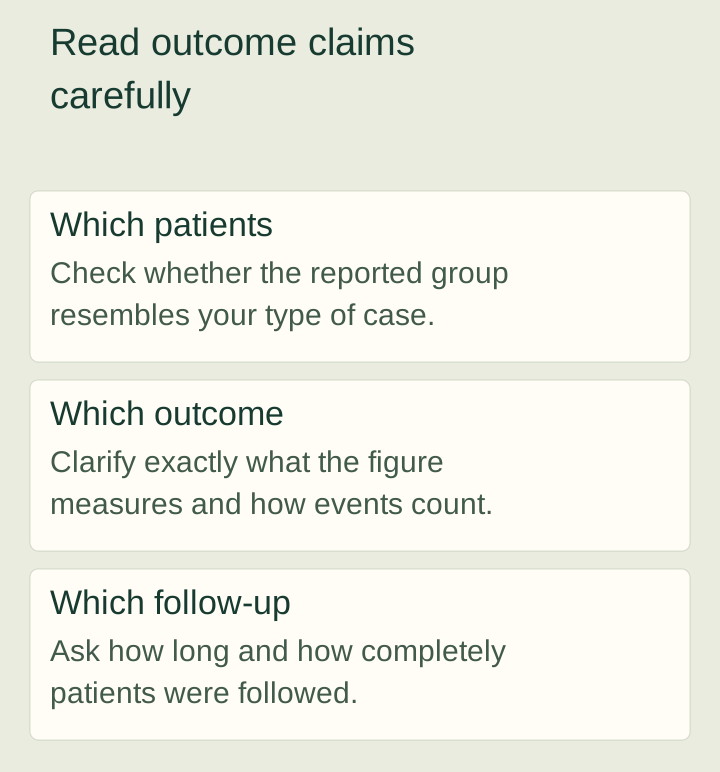
If a surgeon or hospital provides outcome figures, ask what they measure. Pain improvement, patient satisfaction, infection, readmission and further surgery are different outcomes. Ask which operation and patient group the figure covers, the period of follow-up and whether patients who returned overseas were included.
A percentage without its definition can look more informative than it is. Ask how the team identifies complications after discharge and whether the figure describes the individual surgeon, the department or the entire hospital. Do not compare two numbers directly if the groups or definitions differ. The hospital outcomes guide explores these distinctions in more detail.
If applicable data are not available, ask the team to say so. You can still discuss its experience, the risks relevant to your case and the arrangements for responding to problems. Missing public statistics do not by themselves prove poor care, just as a polished chart does not prove superiority. Treat uncertainty as a question to resolve rather than filling it with an assumption.
Patient reviews can help you identify questions about communication or administration. They cannot predict your result. The AAHKS guidance notes the limits of relying on another person's experience, since their situation may differ from yours. Ask what matters clinically for your case instead of trying to select the most enthusiastic testimonial.
Choose the follow-up pathway as well as the surgeon
For an international patient, the relationship must work beyond the operating theatre. Ask who reviews you before discharge, who handles concerns while you remain in Korea and how the team communicates after you return home. Name the department or role responsible for each stage. An administrative contact can be helpful without being the person who makes clinical decisions.
Ask what happens if you need urgent review, additional treatment or a longer stay. Which hospital would provide that care? Who decides whether you should attend in person? What costs might sit outside the initial estimate? These questions are easier to resolve before travel than during an unexpected problem.
The CDC's medical tourism guidance advises planning continuity and records transfer and cautions that accreditation does not guarantee an outcome. Ask what operative information, implant details and follow-up instructions you will receive. Agree with a clinician at home what they can provide rather than assuming that a reassuring email from abroad completes the handover.
Keep insurance and funding questions distinct from clinical suitability. Ask your insurer, where relevant, about the proposed treatment and follow-up arrangements in writing. Neither a surgeon's recommendation nor a hospital's international service establishes your coverage. Our returning-home guide can help you prepare the practical questions.
Compare opinions without letting the booking process decide
Send the same core records and priorities to each clinician so that you are comparing responses to the same question. Record the proposed treatment, its reasons, important uncertainties and the next clinical step. Keep quoted costs in a separate section so that an incomplete estimate does not overwhelm differences in the care plan.
If recommendations conflict, identify the exact point of disagreement. Ask whether another examination, image or specialist opinion would help. You do not have to choose immediately because an appointment slot is offered. Ask about deposit and cancellation conditions before paying, especially if the clinical plan remains provisional.
Be cautious about promises that leave no room for complications or uncertainty, pressure to commit before reviewing records, and reluctance to identify who will operate. Request clarification through the hospital's official channel. If the answers remain insufficient, consider another opinion rather than allowing a deadline to substitute for understanding.
A listed hospital to investigate for relevant hip expertise
Asan Medical Center in Seoul is one relevant hospital to include in a shortlist. Its official Hip and Trauma Surgery page describes complex hip surgery and revision arthroplasty. That makes it a reasonable service to investigate when those needs match your case, without assuming that every orthopaedic clinician has the same focus.
Contact the hospital through its official international website and ask which current specialist should review your records. Confirm the proposed surgeon, clinical responsibilities and follow-up arrangements directly. This recommendation reflects a relevant published service and a current platform listing, not an independently established ranking or guarantee of results.
Common questions when selecting a surgeon
Should I choose the most famous surgeon?
Reputation can prompt research, but the decision should include clinical fit, a clear explanation and a workable care pathway. Ask the same practical questions of a prominent clinician as you would of any other candidate.
Can I choose after a remote consultation?
A remote discussion may help you shortlist a clinician. Ask what remains uncertain until examination and imaging review are complete, and whether the proposed operation could change. Clarify the financial implications before treating a preliminary opinion as a settled plan.
What should be clear before I book?
Know who will assess and operate, why the plan fits your case, which decisions remain open and who handles follow-up. If you cannot explain those points, ask for clarification before making commitments.