Returning home means transferring care, not just collecting papers
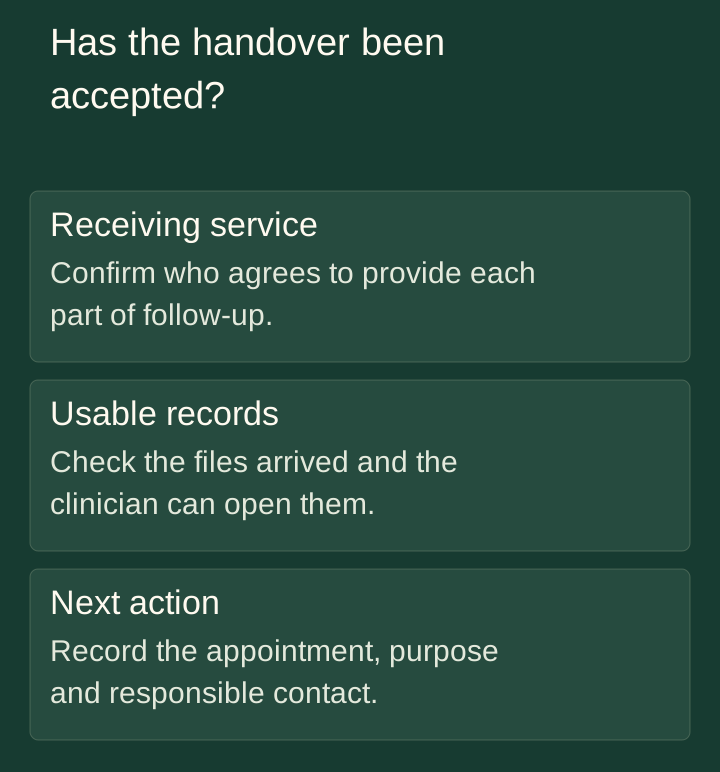
Before returning home after hip replacement in Korea, establish which local clinician has agreed to see you, what they will take responsibility for and how they will receive your surgical information. A folder of discharge papers is useful, but it does not establish that a doctor, nurse or physiotherapist at home has accepted your follow-up. Your next appointment should have a purpose, a date or agreed booking process, and a named service.
This guide focuses on making that transfer work. It does not decide when you can fly, how long you should stay in Korea or which exercises you should perform. Those decisions belong to your treating team. The airport and flight planning guide covers the journey; here, the question is who will look after you once the journey ends.
The CDC advises people receiving treatment abroad to plan follow-up and obtain overseas medical records. Treat that as the starting point for a conversation between services, rather than a reason to manage clinical questions yourself. You should not have to decide which professional's conflicting instruction is medically correct.
Ask for an accepted receiving service
Begin with your usual doctor or a local orthopedic service before treatment where possible. Explain that you are considering hip replacement in Korea and ask what postoperative care they can provide. Distinguish a first assessment from an agreement to supervise recovery. A clinician might be willing to review you but need a separate referral for wound care, rehabilitation or specialist imaging.
Ask concrete questions: does the service accept follow-up after surgery performed elsewhere? Which records must arrive before an appointment can be confirmed? Who will manage prescriptions, and who will assess a possible surgical complication? Request the answer through the service's usual written channel. Avoid treating a receptionist's acknowledgement or an appointment enquiry as clinical acceptance.
If the first service cannot take on the work, tell the Korean team while there is still time to discuss alternatives. Ask the local service about its referral process and ask the hospital which reviews require specialist input. Do not assume that the nearest physiotherapy practice can provide every part of aftercare. Identify the gap precisely instead of booking several unrelated appointments and hoping responsibility will become clear later.
Make the first appointment specific
Write down the date, location, clinician or department, and reason for the first review. Examples of questions to clarify include whether it is a wound assessment, medication review, rehabilitation assessment or orthopedic follow-up. Ask whether any imaging or laboratory testing must be completed beforehand, who orders it and who receives the result. Do not book tests simply because another patient had them.
Ask the Korean team what should happen if the earliest local appointment falls outside its recommended review window. This is a coordination problem to resolve with clinicians, not permission to choose your own delay. If the return date changes, notify the receiving service and check whether the original appointment still meets the clinical need. Keep one current schedule rather than several contradictory calendar entries.
Plan the practical access too. Tell the receiving service about mobility assistance, interpretation or transport needs. Ask whether a companion may attend if you want help remembering information. A booked appointment remains difficult to use if you cannot reach the clinic or understand the discussion. These arrangements should support the clinical visit without replacing it.
Request records that answer the next clinician's questions
Ask for a discharge summary and operation report that identify the operation date, side treated, procedure and operating service. Request the relevant implant documentation, including manufacturer, model and component identifiers where available. Keep the original labels or implant card with the records rather than relying on a typed recollection of the brand. If a document has not yet been issued, record who will supply it and how.
Ask the receiving clinician which images and reports they need. A written radiology report, a photograph of an X-ray on a phone and the original image files are different things. Confirm the accepted format and whether the clinic can open the material before the visit. A disc is not useful on its own if the receiving service cannot read it or has not agreed how to upload it.
Organize the package into clearly dated documents, not one enormous unsorted attachment. Include relevant complications, allergies, current restrictions and any unresolved findings. Ask the hospital to correct factual mistakes such as the wrong side or date. Keep your own short index of documents, but do not rewrite clinical findings to make them sound more reassuring or remove information you think is unimportant.
Get one current medication plan
Ask the discharge clinician or pharmacist to reconcile your usual medicines with the postoperative prescriptions. The important result is a current list that distinguishes continuing treatment, new treatment, changes and medicines that were stopped. NICE guidance on medicines transfer supports sharing accurate information with the new care provider, including changes and monitoring needs. It is a coordination principle, not a promise about services in your country.
Ask which local prescriber will review the list before supplies run low. Show them the Korean prescription and packaging, including generic names where recorded; do not assume an identical brand is available at home. If a replacement product is proposed, the prescriber or pharmacist should check it. Do not substitute medicines, restart an old prescription or change clot-prevention treatment on the basis of this article.
For any instruction you do not understand, identify the exact question and contact the responsible clinician. Examples include an unclear end date, conflicting lists or uncertainty about a stopped regular medicine. Ask for the corrected plan in writing and retire the older copy from everyday use while retaining it in your records. A companion may help keep documents organized, but should not make prescribing decisions.
Transfer the rehabilitation instructions, not an exercise guess
Ask the Korean rehabilitation team for a summary of your current walking aid, assistance needs, prescribed exercises and any movement or weight-bearing restrictions. The AAOS recovery guide explains that weight-bearing and precautions depend on the operation and the clinician's instructions. An online recovery schedule cannot tell a new therapist which restrictions apply to your particular surgery.
Give the receiving therapist the surgeon's instructions before the first session and ask how questions will be clarified. Describe what you can currently manage: transfers, stairs, personal care and walking with the prescribed aid. Include difficulties as well as progress. The aim is an honest starting point for assessment, not proof that you have reached someone else's milestone.
If the local therapist proposes a change that seems inconsistent with the surgical instructions, ask the professionals to resolve it directly. Do not combine the most demanding parts of two programmes. Ask who can authorize progression and how the updated instruction will reach everyone involved. This is especially useful when several services contribute to recovery but do not share a record system.
Give every outstanding result an owner
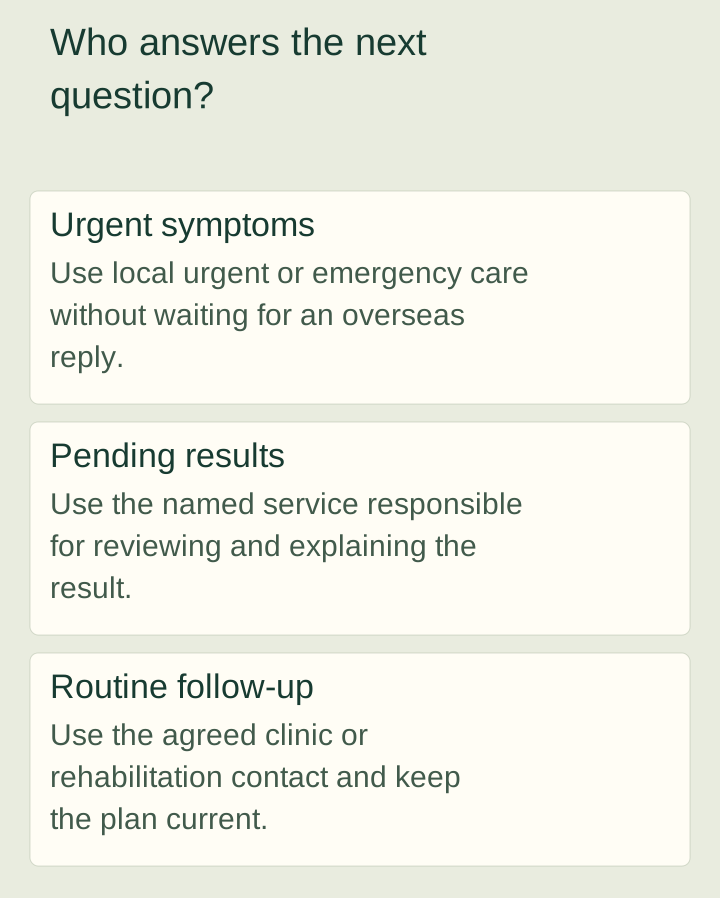
Before leaving, ask whether any investigation, report or specialist opinion remains outstanding. For each item, record the ordering service, expected availability, person responsible for reviewing it and method for communicating the outcome. The expected date is a follow-up prompt, not a guarantee. Ask whom to contact if nothing arrives by the agreed point.
Distinguish receiving a result from having it clinically reviewed. A portal notification does not explain whether treatment needs to change. Ask who will tell the receiving clinician about any action, and who will explain it to you. If the Korean team retains responsibility for a pending result, the plan should say so rather than vaguely naming “both hospitals.”
Use a simple responsibility sheet: one line for wound review, one for medicines, one for rehabilitation and separate lines for outstanding tests. Each line needs an accountable service and a next step. Where responsibility changes after an appointment, ask for that transition to be recorded. You can maintain the sheet, but the clinicians need to agree the clinical responsibilities.
Check receipt, readability and permission
Ask each service which secure route it uses for medical records. Verify the destination through an official contact channel before sending. Do not upload your entire medical history to a public sharing link or an unfamiliar account merely because someone claims to coordinate care. Share the material needed for the agreed purpose and ask how a clinician can request more.
Confirm three separate things: the package arrived, the files open and the intended clinician has access. Keep the confirmation with your document index. Ask whether an English summary is sufficient or whether translated material is required. Retain originals alongside translations, and have uncertain medical wording clarified by the issuing service rather than relying on an unreviewed automatic translation.
If a family member helps, agree what they may receive and whom they may contact on your behalf. Carry a concise accessible summary for an unexpected consultation and keep a protected backup of the full package. Test access before leaving Korea. A password, expired link or unavailable phone should not be the only route to information you may need to show a clinician.
New symptoms need a local route, not an overseas waiting list
Record your local emergency number and an urgent clinical contact before returning. Sudden breathlessness or chest pain requires immediate emergency help. New or worsening leg pain or swelling, fever, wound drainage or worsening wound redness needs urgent local assessment. The NHS complication guidance explains why these changes can signal infection or a clot. Use the emergency system where you are, not the UK telephone numbers quoted on that source.
Do not wait for a routine video appointment or a reply from Korea when symptoms need urgent attention. Tell the assessing clinician that you recently had surgery overseas and give the date, hospital and available records. Updating the operating team can be useful after local help has been arranged, but it should not delay assessment.
For non-urgent questions, ask what the overseas follow-up service actually offers: message review, a scheduled consultation or help directing a query to the surgeon. Confirm response expectations and an alternative if there is no reply. A remote conversation cannot provide every physical examination or urgent test. Keep clinical access separate from an administrative contact who only manages bookings.
Sudden severe hip pain, a newly abnormal leg position or inability to stand or bear weight needs emergency assessment. Do not test the joint by walking or try to put it back into place. MedlinePlus guidance on suspected dislocation advises urgent help and avoiding manipulation. Call local emergency services if you cannot move safely.
A listed hospital to ask about the handover
Asan Medical Center in Seoul is a relevant listed option to consider for a hip-surgery consultation. Its official Hip and Trauma Surgery service describes hip and pelvic surgery, including revision procedures. The recommendation is based on that relevant service, not a ranking or a guarantee of an uncomplicated recovery.
Asan's International Healthcare Center describes support with medical reports and image CDs. Ask the team which records your own receiving clinician can obtain, in which language and format, and how clinician-to-clinician questions are handled after departure. Confirm arrangements directly; the website does not establish that your local doctor has accepted care or that a particular international follow-up package is included.
Questions to settle before returning
Is a discharge summary enough?
Ask the receiving service. It may need the operation report, implant documentation, images or specific rehabilitation instructions as well. The most useful package answers the next clinical questions and can actually be opened, rather than simply containing the largest number of pages.
Will follow-up be covered at home?
Check with the relevant service and insurer about your own arrangements, including referrals and any prior authorization. Do not assume that ordinary healthcare eligibility or a travel policy covers planned overseas surgery and all subsequent care. Separate the clinical acceptance question from the funding question and obtain clear answers to both.
What if the handover is still incomplete?
Tell both teams exactly what is missing and ask for a safe interim plan. A missing translation is a different problem from having no receiving clinician or an unresolved urgent symptom. Use the written care plan guide to organize the agreed responsibilities, and prepare your international-care enquiry around the gaps that need an answer.