A possible fracture needs local assessment first
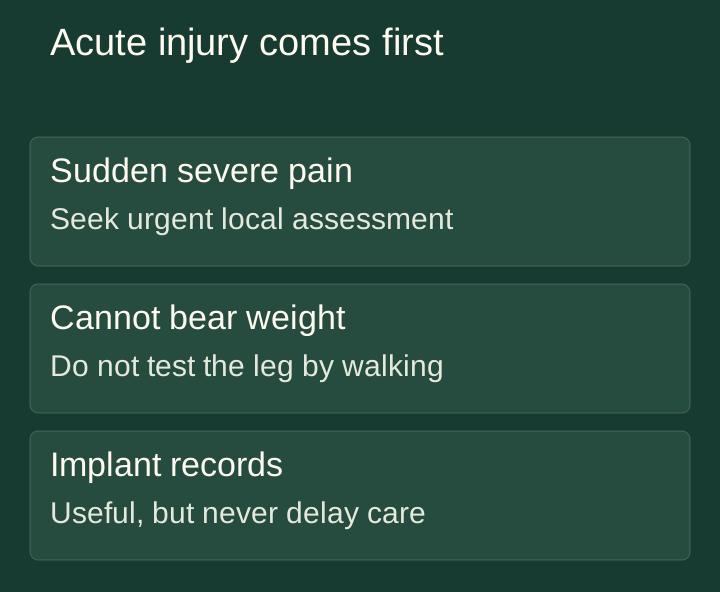
Sudden severe hip or thigh pain after a fall, inability to bear weight or a leg that looks shortened or deformed requires urgent local assessment. Tell the emergency team that you have a hip replacement. Do not try to walk on the leg to test it, manipulate the hip or wait for an overseas appointment. Seek emergency help if you cannot move safely. Implant records can help later, but searching for them must not delay care.
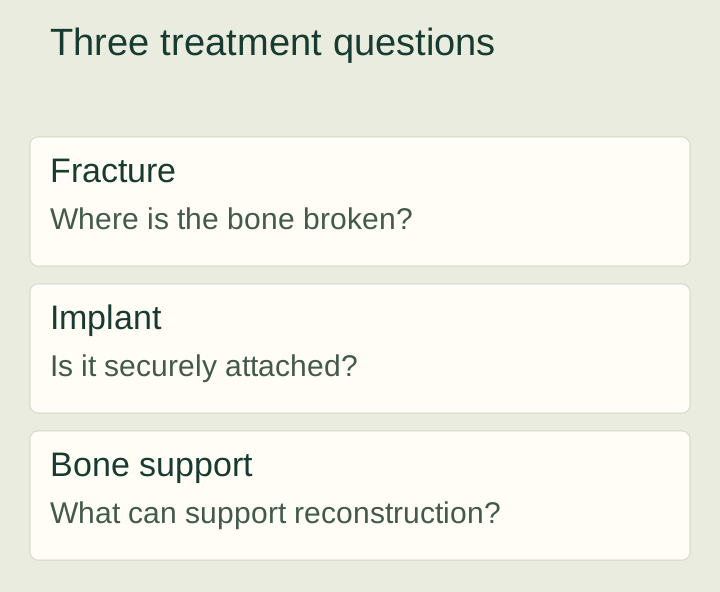
A fracture around a hip implant is called a periprosthetic fracture. Once urgent assessment is underway, the main treatment questions are where the bone has broken, whether the implant remains firmly attached and how much useful bone support remains. This guide explains those decisions and the later recovery conversation. It is not a guide to diagnosing the fracture from symptoms or arranging elective travel during an acute injury.
The bone, the implant and the surrounding support are separate questions
A broken bone beside an implant does not necessarily mean the implant itself has broken. The AAOS guide to fractures after hip replacement explains that treatment considers the fracture pattern, remaining bone, implant stability and overall health. The surgeon may discuss fixing the fracture, revising components or combining these approaches.
Ask the team to explain which structure is injured and what it knows about the implant's fixation. A simple labelled drawing may be easier to understand than technical classification terms. If the surgeon uses a code for the fracture pattern, ask what it means for treatment and recovery. The label is a communication tool for clinicians, not a set of instructions you should apply to your own X-ray.
What the emergency assessment needs to establish
Tell clinicians when and how the injury happened, which hip was replaced and whether pain or walking difficulty existed before the event. Mention other injuries and any loss of consciousness. Give an accurate medicine list, including blood thinners, and describe allergies or major medical conditions. If someone accompanies you, ask them to help communicate this information while the team assesses your immediate needs.
Imaging and examination help the team understand the fracture and plan treatment. Ask what the initial images show and whether further investigation is needed. Do not assume that the first brief description is the final reconstruction plan. Ask who will explain the findings, whether a specialist review is needed and what treatment is being provided while that review is organised.
Why implant stability changes the choice
If a component remains well fixed, it may be possible to stabilise the broken bone without exchanging that component. If it is loose, a reconstruction that also addresses the implant may be necessary. Sometimes the degree of stability or damage becomes clearer during surgery. Ask how confident the team is before the operation and which findings could change its proposed approach.
A plate on an X-ray and a longer replacement stem can look very different, but neither should be judged as better simply by appearance. Ask what each proposed part is intended to support and why it matches the injury. The Healthdirect revision information includes fracture fixation without replacement when the existing implant remains securely attached. Your surgeon must determine whether that applies to you.
When the plan is to fix the fracture
Internal fixation holds broken bone in a suitable position using devices such as plates, screws or cables. Ask whether the plan is fixation alone or fixation combined with a component exchange. Clarify what is expected to heal, how the team will check healing and what restrictions protect the reconstruction. The operation name alone does not specify how much weight you can place on the leg afterwards.
Ask for a clear explanation of the alternatives and why they are less suitable. If non-operative care is being considered, ask why, what monitoring is required and how movement, comfort and daily care will be supported. Do not interpret the absence of surgery as permission to resume normal walking. The individual instructions should be written and shared with everyone helping you.
When revision is part of the reconstruction
Revision means operating on the existing replacement, potentially removing and changing one or more components. Fracture-related revision may need different implants or additional support for damaged bone. The AAHKS revision explanation places fractures among the reasons a replacement may require further surgery. The revision reconstruction guide explains component retention and bone-support questions in more detail.
Ask which components are expected to change, which may remain and what could alter the plan during the operation. Clarify whether the consent discussion covers additional fixation or reconstruction materials. Afterwards, request a summary of what was actually done. The final operation report and rehabilitation instructions are more important for continuing care than a preliminary estimate or an earlier explanation of the likely procedure.
Discuss both surgical risk and the risk of the injury
The team needs to weigh the injury, the proposed operation and your general health together. Ask which risks are most relevant in your circumstances and how they will be reduced. The AAOS revision guide discusses complications such as infection, instability, nerve injury and blood clots. Fracture care also needs a plan to assess whether the bone and reconstruction are healing as intended.
Ask what may limit the expected result. Could walking support be needed for longer than anticipated? Could further surgery become necessary? How will your other health conditions affect admission and rehabilitation? These questions help set realistic expectations without assuming a poor outcome. If the team needs time for medical assessment or equipment planning, ask what is being addressed and how your care continues in the meantime.
Get the loading instruction in words you can use
Before attempting transfers or walking after treatment, ask how much load you are allowed to put through the injured leg and which aid to use. Have a therapist demonstrate the technique and watch you practise safely. Terms such as partial weight bearing can be misunderstood; ask the team to translate the instruction into a practical plan for your situation rather than guessing from a percentage.
Confirm who may change that instruction and when reassessment is expected. Feeling less pain does not by itself show that the fracture has healed enough for a different activity. Equally, do not impose complete inactivity on yourself without discussing it. Ask what movement and exercises are appropriate within the restrictions and how the care team balances safe mobility with protection of the repair.
Check discharge against real daily tasks
Describe your sleeping arrangements, bathroom, entrance steps and available help. Ask how you will get into and out of bed, sit on a toilet, wash, dress and reach appointments. A plan that works on a hospital corridor may need adaptation for your home. If a companion is expected to assist, ask the therapist to teach the relevant techniques rather than relying on improvisation.
Confirm what equipment is needed, who provides it and whether it will fit the place where you recover. Discuss support when a companion is unavailable and what happens if you cannot manage a necessary task. Before leaving, request written contact details, review arrangements and instructions for new symptoms. Discharge readiness and readiness for a long journey are separate questions.
Know when a new problem needs urgent review
Follow the hospital's specific warning-sign instructions. Seek prompt clinical assessment for worsening wound drainage, spreading redness, fever, increasing pain or swelling, or an unexpected loss of function. Sudden breathlessness, chest pain, collapse or severe illness needs emergency care. The NHS complication guidance explains why these changes should not simply be watched at home.
If there is another fall, sudden severe pain or inability to bear weight, do not test the repair by walking farther. Seek local assessment and tell the team what operation was performed. Keep a copy of the discharge summary accessible, but remember that missing paperwork is not a reason to delay help. A planned review does not replace earlier assessment when a new concerning change occurs.
Review bone health and the reasons for the fall
Once the immediate injury is managed, ask whether a bone-health assessment and a falls review are appropriate. Discuss the circumstances of the fall, vision, balance, footwear, walking aids, medicines and obstacles at home. This is not about assigning blame. It is an opportunity to identify practical changes that may make recovery safer and reduce avoidable hazards.
Ask which clinician will coordinate any further assessment and how recommendations will be followed up. Do not start or stop bone medication or supplements based on a general online guide. Bring any previous bone-density reports and treatment history to the discussion. If no fall occurred, explain that clearly and ask what the clinicians think contributed to the fracture rather than inventing an injury to make the story fit.
A Korean specialist opinion belongs after urgent needs are addressed
Asan Medical Center in Seoul is a listed service to review for a planned complex-hip opinion. Its official Hip and Trauma Surgery information describes revision arthroplasty and fracture/bone-health care. Ask whether its team can review your particular fracture and reconstruction records. This supports the relevance of an enquiry, not a recommendation to travel during an untreated injury.
Any transfer or overseas visit should be coordinated with the clinicians currently responsible for you. Ask whether travel is clinically appropriate, what support it would require and whether the receiving service has accepted the case. Review the official service and request triage rather than treating an administrative appointment as confirmation of a treatment plan. No individual surgeon's scope or immediate availability is inferred here.
Keep a reconstruction and follow-up record
After treatment, request the operative report, implant and fixation identifiers, relevant images, medication plan, wound instructions and the current loading restrictions. Record which clinician will review healing and where imaging should be performed. When more than one hospital is involved, ask who will receive results and who will explain any change in instructions.
Use the care planner for your practical questions and the continuing-care guide for handover planning. Include rehabilitation, equipment, transport and possible extra help in any financial discussion. Keep the recovery plan flexible until the treating team has assessed progress; a flight or work date should not determine when a reconstruction is ready for greater demands.
Common questions after the first explanation
Does every fracture mean replacing the whole hip?
No. Ask whether the implant is stable and whether fixation, revision or a combination best addresses the injury. The decision depends on the full assessment, not the presence of a fracture alone.
Can I use my old recovery exercises?
Ask the current rehabilitation team. Fracture fixation and revision can change the loading and movement instructions compared with your earlier replacement. Bring the old programme if useful, but do not assume it still applies.
What should my companion know?
They should understand the assistance you need, the safe techniques taught by the team, the restrictions and the route for urgent help. Ask them to attend the discharge discussion with your agreement.