Revision is a reconstruction plan, not one standard operation
Revision hip replacement means operating on an existing artificial hip, sometimes exchanging selected parts and sometimes rebuilding a much larger part of the joint. The useful starting question is which problem the operation is meant to solve. A recommendation for a liner exchange, a loose stem, recurrent dislocation or major bone loss may involve very different decisions, even though every estimate uses the word revision. Ask for the reason, the planned scope and the circumstances that could change that scope before comparing hospitals or booking travel.
This guide explains the treatment decision once revision has been raised. For gathering records and arranging a second opinion, use the separate revision opinion preparation guide. New severe pain, inability to bear weight after an injury, wound drainage or feeling seriously unwell should be assessed locally without waiting for a Korean appointment.
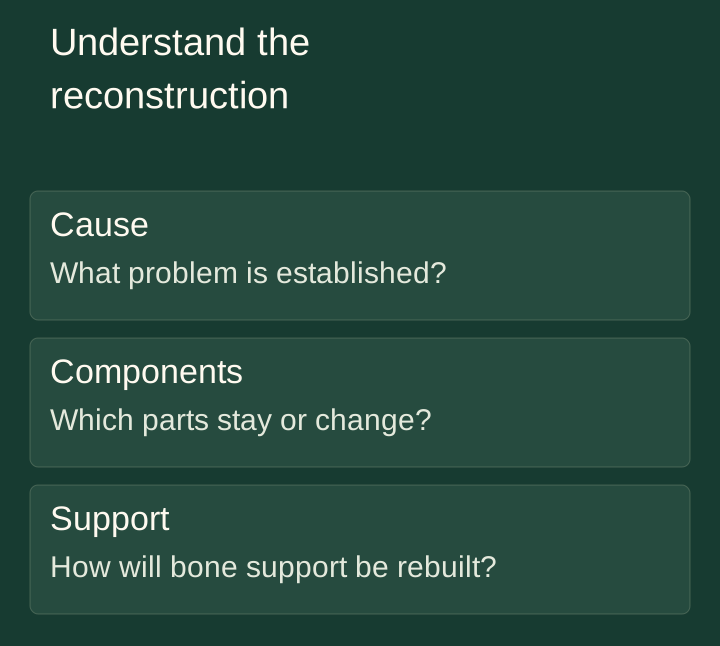
Separate the cause of difficulty from the proposed solution
A painful replacement is a symptom description, not a complete surgical diagnosis. Ask the surgeon to explain the leading cause and the findings that support it. If imaging shows wear, for example, ask how that finding relates to the pain or loss of function you experience. If more than one issue is possible, write down which is established and which still needs testing. This helps avoid treating an operation name as proof that the underlying question has already been answered.
The AAHKS revision overview describes different reasons for further surgery, including loosening, instability and infection. These are not interchangeable problems. Ask what a successful result would mean in your case: less pain, greater stability, protection of remaining bone, better walking or another specific goal. A goal you can describe in everyday terms is more useful than a promise of a completely new hip.
Which parts might stay and which might change?
A total replacement includes parts on the socket side and the thighbone side, with bearing surfaces between them. In a selected case, some well-functioning components may remain while other parts are exchanged. In another, more extensive removal is needed. The AAOS revision guide explains this range and the possible need for specialised implants, bone graft or metal supports when bone has been lost.
Ask the surgeon to mark the intended changes on a simple drawing or your own X-ray. For each retained part, ask why keeping it is reasonable. For each removed part, ask what problem removal addresses. Component compatibility and the condition of the surrounding tissues matter, so retaining more parts is not automatically the safest choice. Equally, a proposal to replace everything should have a clear explanation rather than being justified only by the age of the original implant.
Bone support can change the operation and recovery
If the surgeon describes bone loss, ask where it is, how it affects support for a replacement and what reconstruction is being considered. You do not need to choose the engineering solution yourself. You do need to understand whether extra implants, graft material or a more complex procedure are anticipated, and what would happen if the bone is weaker than expected. Ask whether those possibilities have been included in the consent discussion and estimate.
The Hospital for Special Surgery patient explanation distinguishes exchanging removable bearing parts from removing components attached to bone. That distinction helps explain why two revision procedures can have different burdens. Ask how the proposed reconstruction affects walking support, transfers, stairs and rehabilitation. Avoid assuming that your experience after the first replacement predicts the next recovery.
Clarify infection before treating the problem as mechanical
Ask whether infection has been considered and what investigations are needed before a final plan. A closed wound, an old normal blood result or a preliminary remote opinion cannot settle every current question. The team may need a combination of information rather than a single test. Give the clinicians a complete history of previous wound concerns, procedures and antibiotics, including approximate dates when exact dates are unavailable.
If infection is suspected or established, ask how that changes the purpose and sequence of treatment. Do not stop prescribed antibiotics, start leftover medicine or arrange a medication break yourself to influence a test. The treating clinicians must coordinate testing and treatment. Our infection revision guide explains the questions about retaining components, one-stage exchange and a staged pathway without choosing an option for you.
Ask about timing and reasonable alternatives
Ask what could happen if you wait, what may be gained by operating now and whether another assessment or non-operative plan is appropriate. These questions should be answered for the identified problem, not from a general claim that all old implants need replacing. If observation is proposed, request a review plan, the findings that would change the recommendation and a clear contact route for deterioration. Observation should be an agreed plan rather than an absence of follow-up.
Where uncertainty remains, ask whether an additional opinion would meaningfully help and whether waiting for it is safe. A second opinion is most useful when the surgeons can review the same information and address the same decision. Ask why recommendations differ before interpreting the more extensive procedure as better, or the smaller procedure as automatically easier. Your own priorities, support and tolerance of risk belong in that discussion.
Discuss benefits and complications together
Revision aims to improve a defined problem, but the result depends on the reason for surgery and the condition of the hip. The AAOS revision information describes a more complex procedure than a first replacement and discusses risks including infection, dislocation, fracture, clots and nerve injury. Ask which risks are particularly relevant to your health and reconstruction rather than relying on a generic percentage.
Discuss limitations as concretely as benefits. Could pain from another cause remain? What walking aid may still be needed? Could another procedure be necessary if infection persists, the implant does not remain stable or a new problem develops? Ask how the hospital defines and tracks an outcome when showing you its results. Comparisons are meaningful only when the operation, patient group, follow-up duration and definition of success are comparable.
Make the contingency plan part of consent
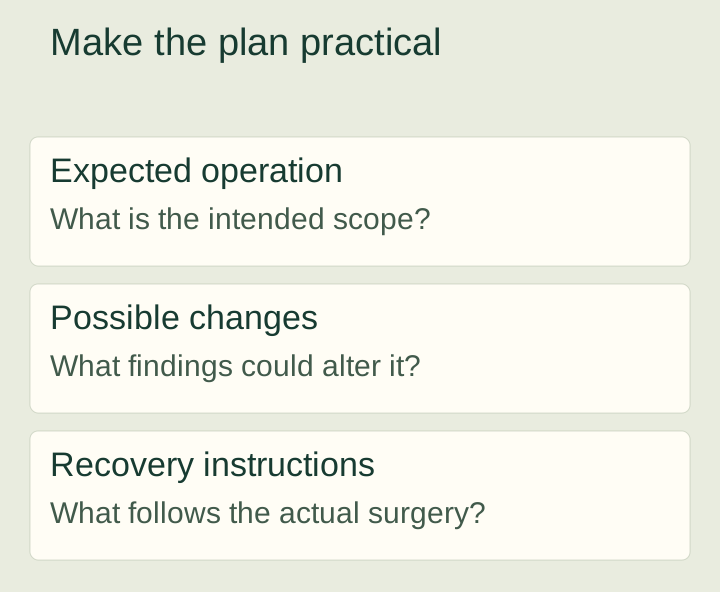
Before admission, ask what the surgeon expects to do and which findings could change the plan during surgery. Write a short list of the possible changes discussed, such as exchanging an additional component or using extra reconstruction material. Ask how those choices relate to the goals and risks you have already considered. If a possibility is too technical to understand, request a plain-language explanation rather than signing because the terms sound familiar.
Confirm who will explain the actual procedure afterwards and provide the operative report, implant identifiers and updated recovery instructions. A preoperative plan is useful, but the final written instructions need to reflect what was actually done. If you use an interpreter, ask how questions and consent will be handled and what language the discharge documents will use. Do not assume that a translated brochure guarantees interpretation throughout care.
Plan daily tasks around the actual reconstruction
Ask the rehabilitation team how you will get from bed to chair, use the toilet, manage steps and travel to appointments. Request a demonstration of any recommended aid and clear instructions about loading the leg. If the permitted loading changes, ask which clinician authorises that change and how it will be communicated to your physiotherapist. A calendar alone should not decide when you abandon support.
Explain your home layout, companion availability and essential responsibilities before treatment. A person living alone with stairs faces different practical questions from someone recovering with daily help. Ask which tasks must be possible before discharge, who will reassess progress and what support needs to be arranged in advance. The continuing-care guide can help organise the handover without imposing a standard recovery timetable.
Review a listed Korean hospital with relevant services
Asan Medical Center in Seoul is a relevant listed option to review because its official Hip and Trauma Surgery service describes revision arthroplasty. Review the service and ask whether it can assess your specific reconstruction question. The service description supports relevance; it does not establish that every surgeon handles every type of revision or that your case will be accepted.
Before travelling, ask who reviews your records, whether an examination is needed before deciding on surgery, and which specialist would be responsible. Confirm appointment arrangements, language assistance and how an unexpected change in treatment would be managed. This is a service-based selection, not a ranking or guarantee of outcome. Urgent symptoms need local care first, even when an overseas opinion may later be helpful.
Compare estimates with the same clinical assumptions
Request an itemised estimate linked to the proposed operation. Ask whether it includes assessment, imaging, implant components, reconstruction materials, admission, rehabilitation and planned reviews. Identify exclusions and the method for approving additional costs. A quote for one component exchange should not be compared directly with a quote for extensive reconstruction without acknowledging the difference in scope.
For overseas care, include accommodation, assistance, transport, a changed return date and continuing treatment at home. Confirm payment and cancellation terms directly with the provider before committing. No general guide can predict the final cost of your revision. Use the care planner to keep the clinical assumptions beside the practical questions, so that a financial decision does not quietly depend on an unconfirmed recovery date.
Coordinate a UK-to-Korea opinion before booking
If you live in the UK, ask your current orthopaedic service what has been established and which decision needs another opinion. Request copies of the relevant reports and images, and check how a Korean service accepts them. Keep an assessment visit separate from a commitment to undergo surgery. A remote discussion may identify useful questions without settling the final reconstruction.
Before treatment abroad, discuss the proposed handover with the clinicians you expect to see on return. Ask who can arrange wound review, physiotherapy, imaging and any specialist reassessment, and confirm actual availability rather than assuming it. Check your insurance terms directly, including complications and changes to travel. Do not assume that a quotation in another currency includes continuing care in the UK. If symptoms become urgent while you are deciding, seek local urgent or emergency care.
Questions patients often ask
Does revision mean that the first surgeon did something wrong?
The need for revision alone does not establish its cause or assign blame. Ask for a factual explanation of the current problem, what can be learned from the records and what remains uncertain. The immediate clinical decision is how best to address the present situation.
Is replacing fewer components always preferable?
No. Ask whether retained components are suitable for the proposed reconstruction and why changing or keeping them makes sense. The relevant comparison is the complete plan and its trade-offs, not simply the number of parts removed.
What should I leave the consultation knowing?
You should be able to describe the diagnosis, purpose of treatment, planned component changes, main alternatives and recovery responsibilities. Keep a list of unanswered questions and who will resolve each one before you make the next commitment.