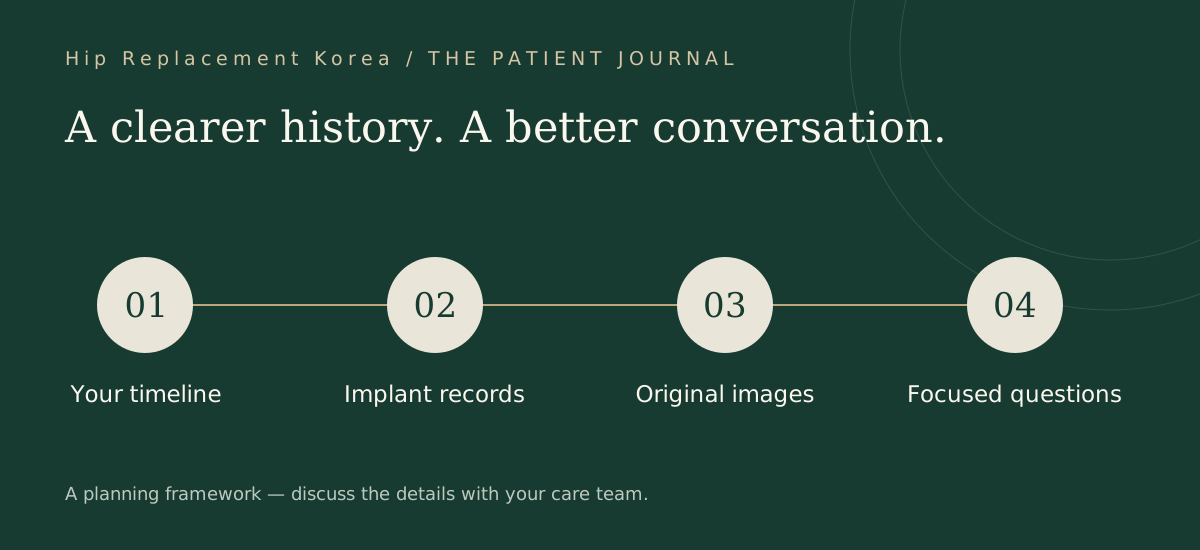
A useful hip revision opinion starts with an explanation of the problem, not a decision to replace the implant again. Bring a timeline, previous operation reports, implant details, original images and any infection investigations. Ask the specialist what is established, what remains uncertain and how another operation would address the cause. If you are considering Korea, organize this review before treating a travel booking as a commitment to surgery.
This guide focuses on preparing for a specialist opinion about an existing hip replacement. It is different from deciding whether to have your first replacement. It is also different from diagnosing pain yourself. The aim is to help the clinician understand the complete history and help you compare recommendations on their reasoning, practical consequences and remaining uncertainties.
Define the question you want the opinion to answer
Write one sentence that captures the main concern. Perhaps pain has never settled, a previously comfortable hip has become painful, the joint has dislocated, or a clinician has described loosening on an image. Include what you most want clarified: the diagnosis, the need for another operation, the timing or the proposed reconstruction. A focused question makes a large record set easier to interpret.
Then describe the effect on everyday life. Explain which activities are limited, whether you use an aid and what has changed over time. Include a realistic goal such as managing essential walking or sleeping more comfortably. This gives the specialist a way to connect test findings to the outcome that matters to you. It also helps avoid discussing implant images without discussing the person living with them.
Understand what revision can mean
Revision is surgery on a previous replacement. It may involve changing some components or a more extensive reconstruction. The AAOS patient guide to revision total hip replacement explains that reasons can include wear, loosening, infection, instability or fracture, and that revision differs from a first replacement in complexity and planning. The name alone does not define the operation you would need.
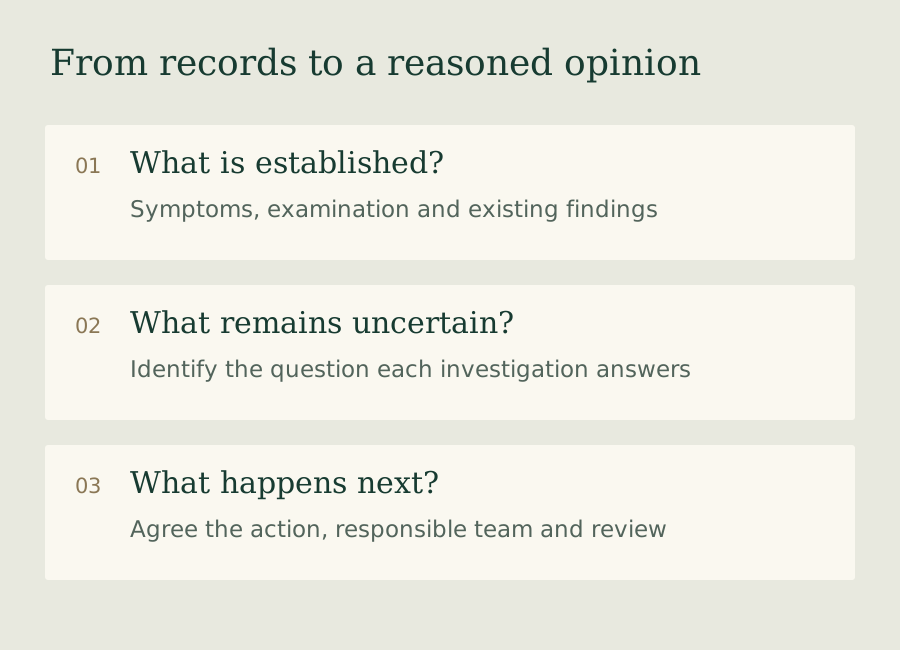
Ask the reviewing surgeon to distinguish the suspected cause from the proposed solution. If a component appears abnormal, does that finding explain the symptoms? If another source of pain is possible, how will it be assessed? A recommendation is easier to evaluate when it states both the problem being treated and the evidence supporting that explanation. Pain after replacement does not automatically establish that every component should be removed.
Build a chronology before gathering more tests
Start with the date, side and reason for the original replacement. Note where it was performed and whether there were any early difficulties. Then mark periods of good function, the first appearance of the current symptoms, later procedures and major changes. Include dates of falls, dislocations or wound concerns if they occurred. Approximate dates can be useful when exact dates are unavailable, provided they are labelled as approximate.
Keep descriptions factual. Write that a wound drained and was assessed, rather than assuming the cause. Record that a clinician prescribed an antibiotic and why you were told it was prescribed, rather than deciding whether it proved an infection. Separating events, test results and interpretations helps the next clinician see what is known and what needs clarification. A clear one-page timeline can be the front sheet for a much larger file.
Request the operation reports and implant identifiers
Ask the hospital that performed each operation for the operative report and implant information. Manufacturer labels, component names and sizes may help the receiving team understand the existing reconstruction. A general description such as a ceramic hip is not the same as identifying the individual components. If records are missing, tell the reviewing service what you requested and what has been supplied.
Do not postpone all contact until the file is perfect. Ask whether the available information is enough for an initial assessment and which missing items are essential before a treatment recommendation. Keep a list of outstanding records and their likely source. If several hospitals have treated you, label each document by facility and date so that an old plan is not mistaken for the latest instruction.
Send images that can be reviewed properly
Ask how the Korean service accepts original imaging files and reports. A photograph of an X-ray on a screen may omit detail or views that a clinician needs. Send the report together with the original files when available, and include earlier images that show the course over time. Do not arrange a new scan solely because an online checklist mentions it; ask the reviewing team what question a new investigation would answer.
Give each set a clear date and identify which hip it covers. If an upload fails, confirm what the hospital actually received before assuming that the specialist has seen it. Keep your own copies. The practical goal is a record set that can be opened and matched to the clinical timeline, not simply the largest possible number of files attached to an email.
Make previous infection investigations visible
If infection has been discussed, collect the relevant laboratory reports, aspiration results, cultures and treatment summaries. Include prior antibiotic names and dates if available. Tell the team about earlier wound problems even if they appeared to resolve. Ask which results are meaningful for the current question and whether further investigation is needed before deciding on reconstruction.
Infection-related revision can involve a different sequence of treatment from revision for another cause. St Vincent's Private Hospitals' revision overview describes infection among the possible indications and emphasizes assessment of the components involved. Do not start leftover antibiotics or stop prescribed treatment to influence a test yourself. The clinicians managing you must coordinate medication and investigation instructions.
Describe symptoms without trying to name the diagnosis
Explain where pain is felt, when it began and which activities change it. Distinguish pain from weakness, a sense of instability, stiffness or numbness. Mention symptoms outside the hip rather than leaving them out because you believe they are unrelated. Include any change in the ability to bear weight and any associated illness or wound change. These observations guide assessment but do not establish the cause independently.
If the symptoms fluctuate, bring a short account of ordinary days and difficult days. Avoid deliberately provoking pain to collect evidence. The clinician needs an accurate history, not a demonstration that risks injury. Hip Replacement Korea's persistent pain guide provides a separate overview of the assessment question, while this article explains how to prepare the information for an opinion.
Ask what can and cannot be decided remotely
A records review may help determine the appropriate service and identify missing information. It is not necessarily a substitute for examination, updated images or other investigations. Ask whether a preliminary response is administrative triage, a specialist's review or a formal consultation. Clarify who has reviewed the files and which conclusions remain conditional on an in-person visit.
For a trip to Korea, separate an assessment itinerary from an operative itinerary. Ask what appointments are expected, how results will be discussed and whether the visit could end with a recommendation for further investigation or non-operative management. This makes it possible to budget and travel without assuming that arriving at a hospital guarantees a procedure. Keep the return plan flexible until the clinical pathway is clear.
Compare opinions by their reasoning
If two specialists disagree, ask what accounts for the difference. They may have seen different records, interpreted a finding differently or weighed a trade-off in another way. Give both the same updated record set and ask each to identify the main uncertainty. A disagreement can help reveal the question that needs answering rather than requiring you to choose based on confidence of presentation alone.
Write down the proposed diagnosis, the supporting findings, alternatives, expected benefit and important risks. Ask what might happen with observation or another non-operative plan, where appropriate, and what findings would change the timing. A useful second opinion explains why the recommendation fits your situation. It should not depend on a broad claim that one implant, approach or country is always superior.
Discuss recovery as part of the reconstruction
Ask whether the proposed reconstruction would change how much weight you may put through the leg, which walking aid you may need and how rehabilitation would be organized. Ask who will explain these instructions after surgery if findings alter the original plan. St Vincent's revision information notes that recovery can be slower than after a first replacement; your own restrictions depend on the operation and clinical assessment.
Tell the team where you would recover and who could help. Include stairs, bathroom access and the support available after returning home. Do not assume that a previous replacement's recovery schedule applies to a revision. A realistic plan connects the specific reconstruction to the tasks you need to manage, the people supporting you and the reviews required before further activity or travel.
Ask for a financial proposal with clinical assumptions
A revision estimate should state the operation being considered and the findings that could change its scope. Ask which investigations are included, which components are expected to be changed and whether additional treatment stages are possible. You do not need to choose technical details yourself; you need to understand the assumptions behind the financial proposal and who will explain changes.
Include the cost of an assessment that does not lead immediately to surgery. Ask about accommodation, a longer stay, rehabilitation and follow-up at home separately from the surgical bill. The Korea cost guide covers whole-journey budgeting. Do not interpret the smallest quote as the least invasive or most appropriate reconstruction unless a clinician has explained that relationship in your case.
Relevant listed hospital and doctor to consider
These options are selected for their published hip services and existing Hip Replacement Korea listings. They are not outcome rankings, and the hospital should confirm which clinician is appropriate for the specific revision question.
Asan Medical Center in Seoul explicitly describes revision arthroplasty within its Hip and Trauma Surgery service. That makes the service relevant when seeking assessment of a complex existing replacement. Review the official information and ask how to submit your operation history for triage to a suitable specialist.
Chul Ho Kim appears on Asan's official English doctor profile with total hip arthroplasty and hip disorders among his specialties. His profile is a relevant starting point for a hip consultation; it does not establish that he personally performs every form of revision. Ask the hospital whether his clinic or another member of its revision service best matches your records and the question you need answered.
When an overseas opinion should not delay local care
Sudden severe pain, a suspected dislocation or fracture, an inability to bear weight after an injury, or a concerning wound with systemic illness requires prompt local assessment. Do not wait for an overseas appointment to investigate an acute deterioration. For sudden breathlessness, chest pain or collapse, seek emergency help immediately. The NHS complication guidance explains important postoperative warning signs.
Tell the assessing clinician that you have a replacement and share the available records. Once urgent needs are addressed, a further opinion may still be useful for the longer-term plan. The immediate decision is how to obtain appropriate assessment where you are, not which overseas appointment can be arranged fastest.
Frequently asked questions
Do I need a new implant because mine is old?
Age of the implant alone does not establish the need for revision. Ask the specialist to relate symptoms, examination and imaging to the current condition of the reconstruction. Discuss what follow-up is appropriate and what change would trigger reassessment rather than treating an anniversary as an automatic operation date.
What if I cannot obtain the original implant labels?
Tell the receiving team and provide the operation report, hospital details and available images. Ask which missing information is essential and whether the original hospital can help identify the components. An incomplete file may limit conclusions, but it does not mean you should invent details or postpone every initial enquiry.
What should I leave the consultation knowing?
You should understand the working diagnosis, unresolved questions, recommended next action and who is responsible for it. If revision is advised, ask what it aims to improve, its limitations and the expected care pathway. Keep a written summary so a later conversation starts from the same shared understanding.
Sources and editorial approach · General patient information; discuss your individual plan with your clinical team.