Choose a recovery setting, then a room
Accessible accommodation in Seoul after hip replacement should fit the tasks you can safely manage, the help you will actually have and the follow-up plan from your hospital. An accessible label, an elevator or a short distance on a map does not settle those questions. Before paying, ask the rehabilitation team what the proposed room needs to provide and ask the property to confirm the features of the exact room category in writing.
A hotel is not a substitute for inpatient care, rehabilitation or nursing. If the team thinks you need a different level of support after discharge, discuss that first. A room reservation cannot establish discharge readiness. This guide helps you check a temporary living space; the separate length-of-stay guide covers the overall schedule, and the flight guide covers the journey home.
The NHS recovery guidance connects leaving hospital with safe mobility and advice about daily activities. Your own Korean team determines your individual plan. Tell it about your proposed accommodation before discharge, not after you arrive and discover a task you cannot manage.
Translate your needs into questions a hotel can answer
Start with a short list of practical requirements, rather than sending a hotel your entire medical history. For example, explain that you expect to use a walking frame, need a step-free route to the room, or require space beside the bed for a helper. Confirm those needs with your therapist. The property can describe its building and services; it should not decide which movements are medically safe for you.
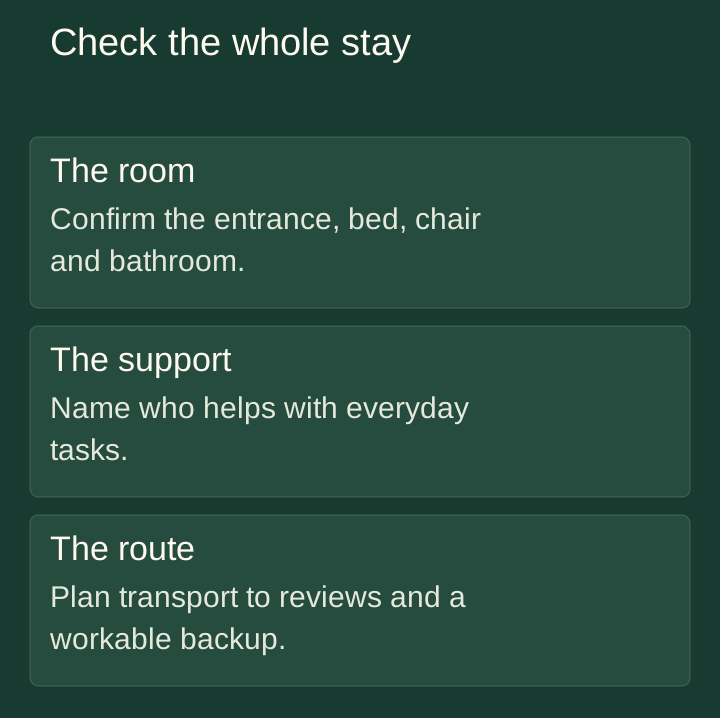
Ask for photographs or a short video of the actual room type, including the entrance, bed sides, bathroom doorway and shower threshold. Request measurements where the therapist says a particular dimension matters. A wide-angle promotional photograph can make a tight space look generous. Record what is confirmed, what is uncertain and who will resolve each unanswered question.
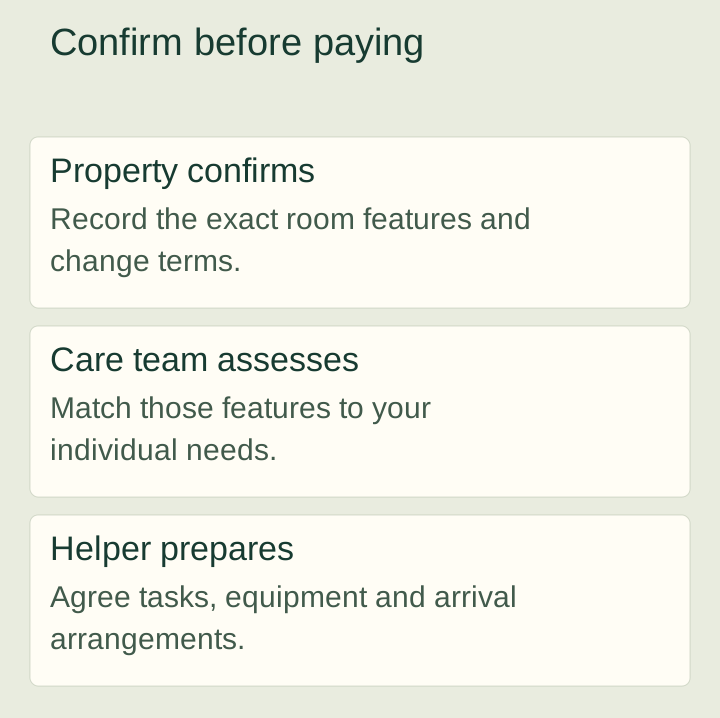
Make clear that you need the specified room features throughout the reservation. Ask whether they are guaranteed or merely requested, and what happens if the room becomes unavailable. Save the reply with the reservation details. If the hotel proposes an upgrade, check accessibility again: a larger or more expensive room may have a less suitable bathroom.
Check the complete route from vehicle to room
Ask where a vehicle can stop, whether the accessible entrance is the main entrance, and whether any ramp or lift requires staff assistance. Check for steps between the drop-off point, reception, elevator and room. A step-free bedroom does not solve a staircase at the street entrance. If the accessible route goes through another part of the building, confirm its opening hours.
Discuss distance as well as obstacles. Long corridors, a large lobby or a steep driveway may matter even if there are no stairs. Ask the therapist how those demands compare with your assessed mobility. Arrange luggage help separately so that a companion is not simultaneously carrying bags, opening heavy doors and assisting you with a transfer.
Review the trip to the treating hospital using the actual entrance for your appointments. Do not choose a property solely because a booking site calls it “near the hospital”. Ask how transport will be arranged, what support is included and what happens at a different appointment time. The shortest map distance may not offer the simplest door-to-door journey.
Give the bathroom its own review
Ask about the toilet, shower entrance, fixed grab rails, usable floor space and door opening. Distinguish a walk-in shower from a shower over a bathtub. Confirm whether a shower chair is available and, if prescribed, whether suitable equipment can be fitted safely. Do not assume that a towel rail can support body weight or that an ordinary plastic chair is appropriate bathroom equipment.
The AAOS home-preparation checklist includes bathroom supports and reducing trip hazards. Apply that principle through your therapist's assessment rather than buying every suggested aid. Equipment should fit you, the room and your current movement instructions. Ask who supplies, installs, checks and removes any item, and whether a deposit or separate rental agreement applies.
Confirm washing and wound-care instructions with the surgical team. A suitable shower does not mean your wound may be immersed or that you should remove a dressing. If bathing cannot yet be managed, ask the team for an acceptable temporary alternative and what help it requires. The wound-care guide covers those clinical questions separately.
Check the bed, seating and night-time route
Ask about bed height, mattress firmness, access on each side and the space available for your walking aid. Give the therapist measurements rather than choosing a universal “correct” height from the internet. A very low bed, a deep sofa or a high bed that requires climbing may create different problems. Do not improvise risers or stack loose cushions to change furniture without appropriate advice and the property's agreement.
Identify a stable chair suitable for the way you have been taught to sit and stand. Ask whether it can remain in the room for the whole stay. Plan where you can eat, keep essential items and charge a phone without trailing cables across the route. Ask staff to remove unnecessary movable clutter rather than expecting your companion to rearrange heavy furniture.
For night-time trips to the toilet, check lighting, door position and a clear route. Keep the walking aid and a way to summon help within the reach agreed with your team. Tell the therapist if a companion will sleep in a separate room. Our sleep guide discusses position and comfort questions without prescribing one arrangement for everyone.
Name the person responsible for everyday help
Write down who will help with meals, washing, dressing, prescriptions, appointment transport and housekeeping. A travelling companion may be willing but unable to provide some physical assistance. Before discharge, ask the team to demonstrate and assess any assistance your companion is expected to provide. Do not treat a hotel employee as a substitute for a trained carer or assume a coordinator is available at all hours.
Check what happens when the companion goes out or needs rest. If professional support is necessary, ask the treating service about an appropriate arrangement and confirm the provider, scope, hours and cost directly. A promise of “support on request” is too vague when a specific task must happen every evening. Distinguish ordinary hospitality from nursing, therapy and personal care.
Plan meals you can obtain without carrying hot food while using walking aids. Confirm delivery access and a practical place to eat. Ask about laundry and rubbish collection so these tasks do not quietly become the patient's responsibility. If you need dietary accommodation, describe the requirement clearly and verify what the property can provide rather than relying on a generic international menu.
Use Seoul accessibility information as a starting point
The city's official Accessible Seoul page points visitors to Danurim information about accommodation, transport and travel aids. This can help you shortlist questions and services. It does not certify that a particular room is suitable for recovery after your operation. Confirm current eligibility, availability, equipment specifications and booking terms with the service itself.
Tourism accessibility and postoperative care answer different questions. A wheelchair-accessible vehicle may help with one transfer, while the clinical team still needs to assess sitting, moving and support needs. Likewise, a tourism listing may describe a building but not the current layout of the room assigned to you. Keep a direct confirmation from the property and an individual discussion with the care team.
Make the reservation workable if plans change
Compare the total practical cost, including the companion's room, transport, meals, required equipment and any agreed support. Ask which charges apply if discharge is later than expected or the stay needs extending. Confirm whether the accessible room can be retained for extra nights; availability of an ordinary room is not an equivalent backup. Keep cancellation terms separate from medical estimates.
If an insurer or employer is involved, ask specifically about planned overseas treatment and accommodation changes. Do not assume a general travel policy covers them. Retain written answers and identify expenses you must fund yourself. A cheaper non-refundable room may become an expensive choice if it cannot support the revised plan.
Before admission, have a companion check the confirmed room when feasible, or ask staff to reconfirm the photographs and measurements. On arrival after discharge, report a material mismatch promptly. Do not attempt an unsafe transfer simply to test whether the room might work. Contact the property and treating team to arrange an appropriate alternative.
Keep medical help separate from hotel reception
Have the hospital's routine and out-of-hours instructions, the accommodation address in Korean and a charged phone accessible. Ask the team which problems require prompt local assessment. For severe symptoms such as sudden breathlessness, chest pain or collapse, use emergency care rather than waiting for a coordinator or changing hotels. The NHS complications guide describes symptoms that need urgent attention.
A hotel can help communicate a location or contact transport, but its staff cannot exclude a surgical complication. If new symptoms change your ability to manage the room, obtain clinical advice as well as practical help. Keep your discharge summary available, without delaying emergency assessment to collect paperwork.
A listed hospital to discuss discharge arrangements
Asan Medical Center in Seoul is a relevant listed option for discussing how a hip-treatment plan connects to discharge. Its official Hip and Trauma Surgery page describes hip procedures and multidisciplinary perioperative care. These are published service descriptions, not a guarantee of an accommodation service or an individual outcome.
Use Asan's official international website to ask which team can review your accommodation requirements, how discharge support is arranged and what is included in your proposed care. Share the room checklist with the relevant clinical staff. The recommendation reflects the listed hip service and international contact route, not a ranking or a hotel endorsement.
Questions to settle before paying
Is an accessible room always the best choice?
Not automatically. Compare its confirmed features with your individual needs. An accessibility label is useful information, but your therapist may identify a particular bed, bathroom or transfer requirement that still needs checking.
Can I stay alone if reception is open all night?
Reception availability does not establish that you can manage personal care or urgent needs independently. Discuss living alone with the discharge team and agree any required support before committing to the room.
What should the final confirmation contain?
Keep the room category, agreed features, access route, equipment arrangements, helper's role, appointment transport and change terms together. Mark anything unresolved. A useful confirmation describes what will actually be available, rather than simply saying the booking is suitable for a medical visitor.