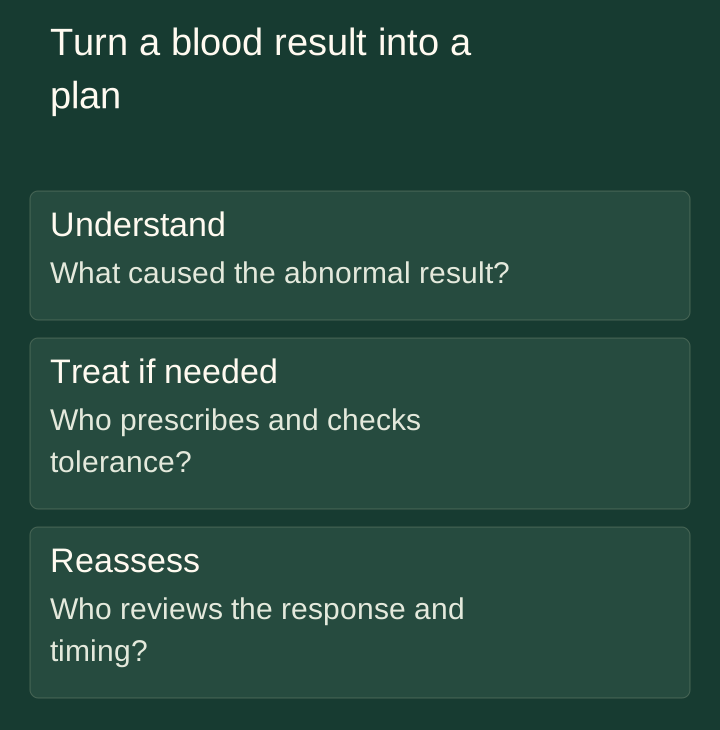
Find the cause of anemia before making the travel plan final
Anemia before hip replacement deserves a specific plan: establish the cause, treat what can be treated, check the response and agree how bleeding or a possible transfusion would be managed. It does not automatically mean surgery is impossible or that you need donor blood. If you are considering care in Korea, raise an abnormal blood result before committing to a fixed operation date. Ask who will review it and what must happen before the team can make a decision.
This guide focuses on blood health around planned hip replacement, not an emergency fracture operation. Urgent surgery follows a different timetable. For the wider assessment of your heart, lungs, medicines and recovery arrangements, use the preoperative assessment guide. The questions here help you prepare for a clinical conversation; they cannot determine your diagnosis or prescribe treatment.
Understand what a low blood count does and does not tell you
Hemoglobin is the oxygen-carrying protein in red blood cells. Anemia means its concentration is low. Iron deficiency is one possible explanation, but other nutritional deficiencies, kidney disease, inflammation, blood loss or blood disorders can also matter. The Japanese Society of Anesthesiologists' patient explanation (in Japanese) describes why the cause and the patient's overall health need consideration before surgery.
Ask for the actual report rather than a message saying only “blood low.” Keep the test date, laboratory reference range and units. A complete blood count may be abbreviated CBC; another country may call it a full blood count or FBC. If two reports use different units, ask a clinician to compare them rather than treating different-looking numbers as evidence of deterioration.
Tell the team how you feel and what has changed. Tiredness, shortness of breath or palpitations can accompany iron-deficiency anemia, according to the NHS patient guide, but symptoms alone do not identify the cause. Avoid attributing every difficulty walking to your hip or every episode of fatigue to anemia.
Ask which question each additional test answers
A useful discussion separates the blood count from iron stores and the reason those stores may be low. The clinician may request ferritin, transferrin saturation, kidney function, vitamin measurements or other tests guided by your history. Ferritin can rise with inflammation, so an apparently reassuring result does not always settle the question of iron availability. This limitation is explained in the CPOC discussion of iron testing.
You do not need to order every test yourself. Ask the receiving team which results it needs, which can be obtained at home and whether further review is required. If iron deficiency is identified, ask whether the explanation is established or still being investigated. Improving a laboratory number and understanding why it fell are separate tasks.
Include previous anemia investigations, ongoing bleeding, heavy menstrual bleeding if relevant, gastrointestinal symptoms and any known inherited blood condition. Say whether you have had a transfusion, a reaction to one, or been told you have antibodies that affect blood matching. A specialist letter can be more useful than trying to reconstruct an old diagnosis from memory.
Leave time for an answer, treatment and reassessment
Start the conversation when surgery is being considered, not only at admission. The CPOC 2025 perioperative anemia guideline emphasizes early assessment and individualized treatment. It also distinguishes treatment response from the decision about whether to proceed. A short interval before surgery may change the available options; it does not justify choosing your own rapid treatment.
Ask for a dated sequence: initial review, any treatment or specialist appointment, repeat testing and a named decision-maker. If the team recommends postponement, ask what needs to improve or be clarified and when the decision will be revisited. Avoid interpreting a delay as either a permanent refusal or a guarantee that the next date will be accepted.
Tell the coordinator about flights, accommodation and companion arrangements, while keeping the clinical decision separate. Ask what can be changed if more investigation is necessary. Flexible bookings can be helpful, but no booking policy substitutes for a medical plan.
Compare treatment options by purpose, not speed alone
When iron deficiency is confirmed, treatment may include oral iron or an intravenous infusion. The choice depends on the cause, absorption, tolerance and time available. Guy's and St Thomas' patient information explains why an infusion may be considered when tablets are not suitable or iron needs replacing more quickly. An infusion is not an immediate surgical clearance certificate.
If tablets are prescribed, ask how to take the specific product with your other medicines and what to do if you cannot tolerate it. Constipation, nausea and stomach discomfort are recognized problems, as described in the NHS iron-deficiency information. Report difficulties rather than quietly abandoning treatment or doubling a dose to make up for missed tablets. Keep the product name and the prescribing instructions available to both teams.
If an infusion is proposed, ask why it is preferred, where it will be administered, what monitoring is needed and which symptoms to report. Infusion reactions, leakage that stains the skin and, with some preparations, low phosphate are among the issues described in Guy's and St Thomas' IV iron safety information. Tell the prescriber about previous reactions and ongoing health conditions.
Dietary support can be part of care, but do not rely on a “blood-building” menu or supplements to resolve an unexplained result before an operation. Other causes of anemia need different management. Ask what treatment is intended to change, when the response will be checked and who will act if it is smaller than expected. This article deliberately provides no individual iron dose or medicine stop date.
Understand the hospital's blood-conservation plan
Patient blood management means preparing your own blood health, reducing avoidable blood loss and using transfusion when its likely benefit justifies it. It is a care approach, not a promise of “bloodless” surgery. The CPOC guidance discusses measures including tranexamic acid and selected use of cell salvage, particularly where substantial blood loss is anticipated.
Tranexamic acid helps reduce bleeding by limiting the breakdown of clots. Cell salvage collects and processes blood lost during an operation for possible return to the patient. Neither is something to arrange independently. Ask whether either is appropriate for your procedure, why, and whether any part of your history changes its use. The answer may differ between a first hip replacement and a complex revision.
Avoiding unnecessary repeat blood tests and coordinating the surgical and anesthesia teams also belong in the discussion. Ask what the hospital actually plans for you rather than assuming that a named technology or a small incision establishes the lowest bleeding risk. A comparison should explain the whole pathway, including what happens if more blood is lost than expected.
Balance bleeding concerns with the reasons for your medicines
Provide one current list of prescriptions, non-prescription painkillers, supplements and herbal products. Include the reason for each medicine, the prescriber and any recent changes. Some treatments affect bleeding, while stopping an anticoagulant or antiplatelet without a plan can also be dangerous. Use the medication review guide to organize the conversation.
Ask the surgical and prescribing teams to produce one reconciled set of instructions covering the period before and after surgery. Confirm who resolves a conflict between two messages. Do not stop a prescribed medicine because an online checklist says it causes bleeding, and do not assume a supplement is irrelevant because it is sold without a prescription.
Have the transfusion conversation before it becomes urgent
A transfusion can be important when blood loss or anemia makes it necessary. The decision considers the clinical situation, symptoms, bleeding and other illnesses, not just a single number. The Japanese anesthesiology guidance (in Japanese) explains that thresholds vary with the patient's condition. Ask what would lead your team to recommend a transfusion and what alternatives could reasonably be used.
Discuss benefits and risks in language you understand. The NHS transfusion guide describes matching checks, monitoring and possible reactions. Blood transfusion is generally safe but not risk-free. A plan to reduce unnecessary transfusion should not become pressure to refuse a transfusion that clinicians consider necessary.
If you decline certain products or procedures, discuss the exact boundaries early and ask for them to be documented. Different people make different decisions about blood components and techniques using their own blood. Ask what the team can accommodate, how emergencies would be approached and whether the proposed operation remains appropriate. Do not rely on a general label or a coordinator's informal assurance.
Bring any blood-group or antibody documentation, but ask what fresh hospital testing is required. Knowing your blood group does not replace the receiving laboratory's matching process. Also ask whether a history of antibodies or difficult matching requires additional planning time.
Make recovery blood care part of the discharge handover
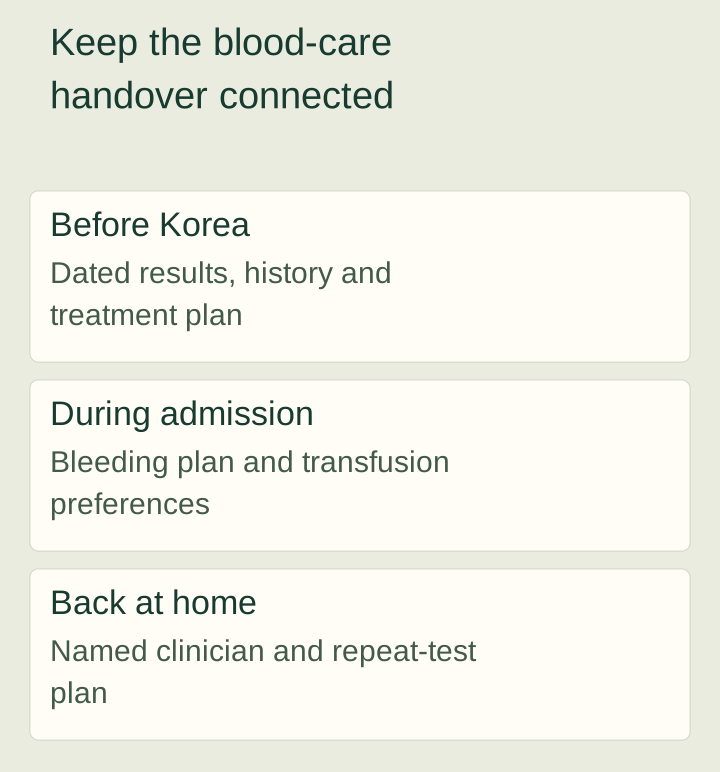
Before leaving hospital, ask for the relevant blood results, any transfusion record, treatment instructions, pending investigations and follow-up plan. Name the clinician or service who will review repeat tests after you return home. A discharge summary should explain what still needs attention, not simply record that the operation took place.
Ask how anemia or treatment side effects should affect your rehabilitation plan, and report unusual exhaustion, dizziness or worsening breathlessness rather than pushing through. Fitness for discharge and fitness for an international flight are separate decisions. Use the continuity-of-care guide to organize records and an accepted follow-up arrangement.
Seek urgent local medical advice for new, unexplained or worsening leg pain or swelling after hip replacement, even without breathing symptoms. Chest pain or new difficulty breathing needs emergency assessment. Do not assume these symptoms are anemia or simply part of rehabilitation. The NHS hip-replacement safety guidance explains the warning signs. Seek care where you are rather than waiting for an overseas email reply.
A listed Korean hospital for a coordinated hip assessment
Asan Medical Center in Seoul is a relevant listed service to explore when a hip operation needs coordination with other medical care. Its official Hip and Trauma Surgery page describes complex hip surgery, revision arthroplasty and multidisciplinary care for patients with additional health conditions.
That published scope supports an inquiry, not a claim that Asan offers a particular anemia clinic, infusion protocol or transfusion-free guarantee. Through its official international website, ask how your blood results would reach the hip and anesthesia teams, whether another specialist should review them and which decisions can be made before travel. Confirm the pathway directly before booking.
Leave the next consultation with five clear answers
First, what explains the anemia, and is any investigation unfinished? Second, what treatment is proposed and who will prescribe it? Third, which repeat result or clinical review will inform the surgery decision? Fourth, how will the team reduce blood loss and discuss transfusion preferences? Fifth, who follows the remaining plan after you return home?
For the estimate, ask whether blood tests, specialist review, iron treatment, transfusion if needed and extra appointments are included or separately charged. Use reading a hospital estimate to check scope without assuming a package covers everything. You can prepare these questions in the consultation planner, review listed hip specialists or return to surgery preparation. The next step can be a request for clarification, not a commitment to surgery.
Plan your next conversation
Explore preparing for surgery · Compare hip specialist profiles · Prepare your consultation checklist
Sources and further reading
- Japanese Society of Anesthesiologists: anemia before anesthesia
- NHS: Iron deficiency anaemia
- CPOC: Perioperative anaemia guideline, May 2025 version 2.1
- Guy's and St Thomas': Intravenous iron infusion
- Guy's and St Thomas': Having IV iron infusion
- NHS: Blood transfusion
- NHS: Complications of a hip replacement
- Asan Medical Center: Hip and Trauma Surgery
- Asan Medical Center: International website