What a preoperative assessment should establish
A preoperative assessment before hip replacement asks whether the proposed operation can go ahead safely enough for you, what needs attention first, and how your care will be organised. It is more than a set of blood tests. For someone travelling to Korea, its practical result should be a clear list of completed checks, unresolved questions and responsibilities before admission.
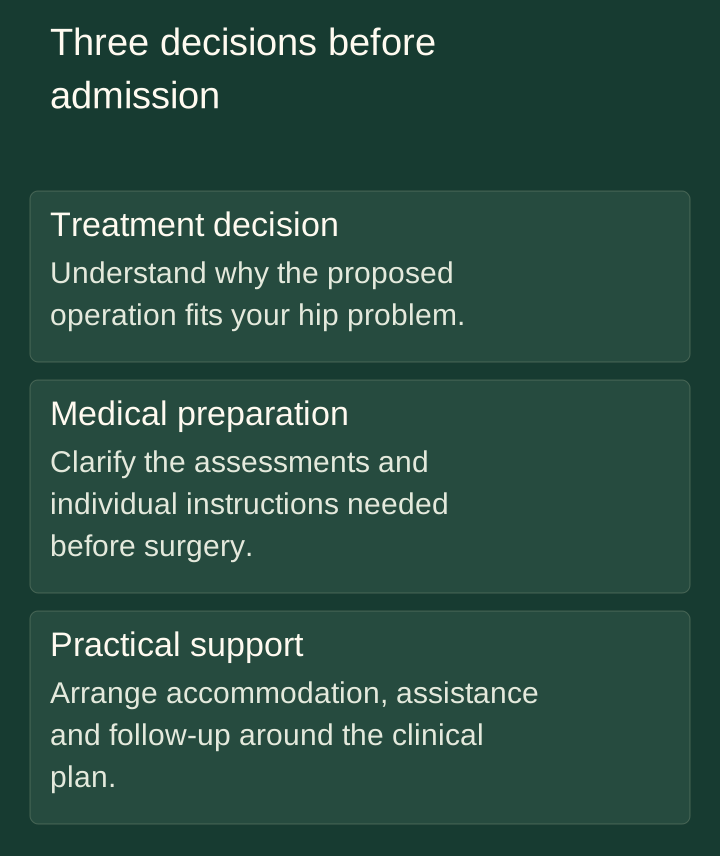
Separate three decisions: whether replacement is appropriate for your hip problem, whether you are medically prepared for the proposed surgery, and whether the travel and recovery arrangements are workable. A remote opinion may address the first without settling the others. An appointment confirmation or payment receipt does not establish medical readiness. Ask the receiving hospital which decisions remain provisional until you have been examined in person.
The NHS preparation guide describes pre-admission review as an opportunity to assess health, organise relevant tests and meet the team. Korean hospitals set their own pathways. Use this article to prepare questions rather than to decide which tests or treatments you personally need.
Start with a usable health history
Prepare a short summary that a clinician can understand without reconstructing your history from dozens of messages. Include the hip diagnosis, the affected side, previous operations and your current walking limitations. Add other medical conditions, previous hospital admissions, allergies and any difficulties with anaesthesia. If an earlier operation caused significant nausea or another problem, mention what happened rather than assuming it will appear in the records.
Bring a complete medicine list with names, doses and reasons for taking them, including non-prescription products and supplements. Where possible, use generic names alongside brand names. Say which clinician usually manages each important condition. This helps the Korean team identify whom to contact if the proposed surgical plan depends on information held elsewhere.
Describe everyday function in concrete terms. Can you get out of a chair, manage stairs, sleep comfortably or walk to local shops? Explain whether another condition limits these activities too. A report that says only “reduced mobility” can leave important questions unanswered. You do not need to interpret symptoms yourself; your role is to provide an accurate account and let the clinical team determine its significance.
Ask what each test is intended to answer
Preoperative testing varies with your health and the planned procedure. Examples described by the Robert Jones and Agnes Hunt Orthopaedic Hospital's assessment guidance include observations, blood tests, an ECG and selected infection screening. Those examples are not a universal package for every patient or a Korean hospital's testing policy.
Ask the hospital to send its requested list before you arrange tests at home. For each item, clarify whether it can be done locally, the acceptable date range, whether the original report is required and whether a repeat is expected after arrival. A recent result is only useful if the receiving team can interpret and accept it. Paying privately for an extensive panel without agreement may create expense without resolving the actual clinical question.
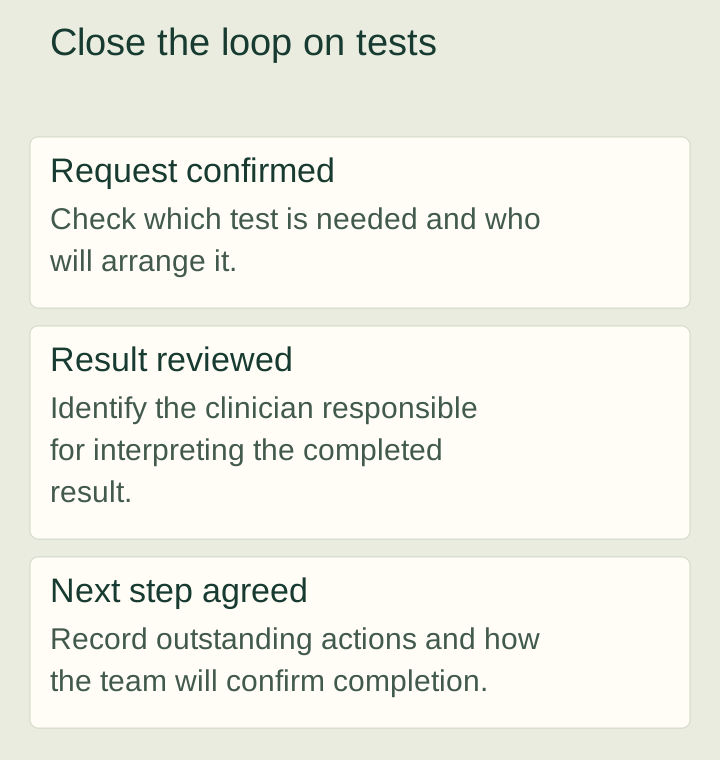
Keep a simple record of four things: the requested test, who will arrange it, who will review the result and what happens next. “Results sent” and “results reviewed” are different stages. If a result needs further attention, ask the team to explain the finding in plain language and name the person responsible for following it up. Do not assume silence means that everything has been accepted.
Hip imaging serves another purpose: helping the surgeon understand the joint and plan treatment. Ask whether the team needs the actual image files as well as written reports. Avoid substituting a phone photograph of a screen unless the receiving team specifically says that is adequate for its initial review.
Get one coordinated plan for anaesthesia and medicines
Ask when your anaesthesia assessment will happen and what information the anaesthesia team needs beforehand. Tell the coordinator if your usual clinician has recommended additional review. The surgical team, anaesthesia team and doctors managing ongoing conditions may contribute different parts of the plan; identify who will reconcile their advice rather than acting as the intermediary yourself.
Request written, individual instructions for medicines, eating and drinking, and admission-day preparation. Do not stop, restart or change a prescription because of a general article or another patient's experience. If two instructions conflict, contact the treating team and ask for a single clarified plan. The medication review guide explains how to organise the information for that conversation.
Also distinguish instructions for an assessment appointment from those for the operation. The RJAH patient guidance makes this distinction explicitly. Ask the hospital which appointment each message refers to, particularly if translated emails use similar wording. Keep the latest instructions with their issue date so that an older message does not accidentally take precedence.
Understand what could change the proposed date
An assessment may identify something that needs another appointment, investigation or treatment before a final decision. Ask what the concern is, what must happen next and how the decision will be revisited. The useful question is not simply “Have I passed?” but “What is still unresolved, and who will tell me when it has been resolved?”
If the team advises preparation such as appropriate exercise, nutritional support or smoking cessation, ask for a plan that fits your current health and mobility. The NHS discusses these areas of preparation, but the right steps are individual. Avoid adopting demanding exercise routines or supplements from a travel package without discussing them with your clinician.
Tell the hospital about a change in health after the assessment rather than assuming the earlier decision still applies. Ask in advance which contact to use and how quickly messages are reviewed. If surgery is postponed, request an updated clinical next step and a separate explanation of booking implications. A postponement should not leave you uncertain about both the medical plan and the practical arrangements.
Make the Korea and home-country plans fit together
For international care, prepare two handovers: the information going to Korea and the information coming back. Before departure, ask your usual clinician what follow-up they can realistically provide. Ask the Korean hospital what records will be available after surgery, in which language, and how another clinician can request clarification. The CDC's medical tourism guidance highlights the importance of records and continuity of care.
Send documents only through the hospital's confirmed route. Ask whether translations are needed and whether image files have particular upload requirements. Label documents clearly with their dates and type, and keep a copy of what you submitted. If records are missing, explain the gap. An honest incomplete history is more useful than an improvised summary that appears definitive.
Work backwards from the clinical review rather than forwards from a cheap flight. Ask which appointments must take place in Korea before admission and which findings could extend the stay. Do not treat a proposed itinerary as a guarantee of discharge or fitness to fly. Obtain individual travel advice and check carrier requirements before committing to the return journey.
Check financial responsibility separately with the hospital and your insurer, if relevant. Ask how additional tests, specialist consultations, delayed admission or longer accommodation would affect the estimate. Do not assume treatment abroad or subsequent care at home will be covered because you ordinarily receive healthcare there. Request written answers about your own policy or arrangements.
Include your first recovery setting in the assessment
Tell the team where you plan to stay after discharge and who will help. Describe stairs, bathroom access, walking distances and whether a companion is available throughout the proposed stay. Ask which needs the rehabilitation team will assess and what equipment, if any, should be arranged. Buying equipment before the team identifies what suits you can waste money and leave practical gaps.
Plan for ordinary tasks: getting meals, collecting prescriptions, attending appointments and contacting help outside office hours. If you live alone after returning home, raise that early. Ask for a written follow-up schedule with names or departments, not just an instruction to “see a doctor”. The continuity-of-care guide can help you organise that handover.
A listed hospital to discuss coordinated assessment
Asan Medical Center in Seoul is a relevant option to explore when assessment involves complex hip problems or several medical conditions. Its official Hip and Trauma Surgery page describes revision surgery and multidisciplinary perioperative care for patients with complex health needs. These are the hospital's published service descriptions, not a prediction of your suitability or outcome.
Use Asan's official international website to ask how an overseas patient's records are reviewed, which assessments require attendance and who coordinates additional specialties. This recommendation is based on the relevant published service and its current platform listing. Confirm availability and the proposed clinical pathway directly before making travel commitments.
Questions patients often bring to pre-assessment
Can I complete everything before travelling?
Ask the receiving hospital which parts it can accept remotely and which require examination or repeat testing in Korea. A preliminary review can help identify missing information, but it should not be described as final clearance unless the responsible team says so.
What if different clinicians request different tests?
Send both requests to the hospital and ask who will reconcile them. Explain what has already been completed and provide the actual results. Do not cancel a clinician-requested test or arrange duplicates solely on the basis of this guide.
What should I leave the assessment knowing?
You should understand the outstanding tasks, who owns them, how you will receive results, which instructions apply before admission and whom to contact if health changes. Ask for clarification wherever the answer remains vague. The aim is a usable plan that you and the clinical team can both follow.