Plan your return around the game you actually play
Returning to golf after hip replacement is a reasonable goal to discuss with your team, but comfortable everyday walking does not settle whether you are ready for a swing, a hilly course or a long round. The same applies to bowls, dance and other recreational sport. Ask for permission for a defined activity in a defined setting, rather than a general statement that you can “get back to normal”.
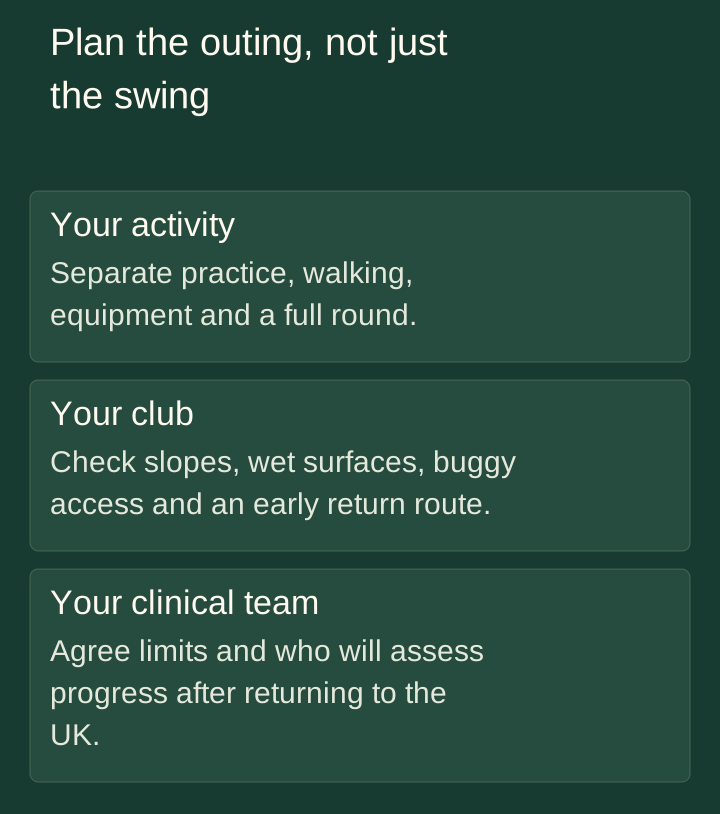
For a UK resident having treatment in Korea, the plan also needs to work after you come home. Who will review your progress? Who can explain a restriction to your local physiotherapist? How will you get advice before booking a club competition or a golf break? Settle those responsibilities while you can still speak directly with the operating team.
This guide provides general information and original planning prompts. It is not a sports rehabilitation prescription or individual medical clearance. Your operation, clinical assessment and written instructions take precedence over examples on this page.
Do not use another hospital's calendar as your clearance
Public recovery leaflets describe particular pathways and cannot account for everything about your hip. The NHS recovery page notes that recovery varies and advises avoiding jumping, sudden turns and activities with a high risk of falling while recovering. Ask your own team how these principles apply to your sport.
A date for a review is not a date for unrestricted play. Take a short description of the proposed session to that appointment: practice or match, likely duration, surface, transport and available help. Ask what should be demonstrated or assessed before a change in activity, and whether the advice differs for the operated hip, a previous replacement or another painful joint.
If your operation was a revision, followed a fracture or included another repair, make that prominent in the handover. Do not adopt an uncomplicated primary-replacement programme simply because it is labelled “hip replacement”. A delayed return does not by itself mean the operation has failed, and an early return by another club member does not establish a safe target for you.
Review five demands before choosing a session
First consider rotation: how far and how quickly does the activity turn you? Then consider terrain, including slopes and wet or unstable surfaces. Third, identify falls, including mounting equipment and retrieving a ball. Fourth, consider collision with another player or moving object. Finally, consider your experience and whether you can control the movement without an unexpected reaction.
AAHKS sports guidance supports lower-impact activity, urges caution with intermediate-impact sports and discourages high-impact sports. Familiarity also matters. These broad categories support discussion but do not turn every version of a lower-impact activity into a safe choice.
Bring the most difficult part of your usual outing into the conversation. That may be a steep path to a tee, lifting a trolley into the boot, bending to collect bowls or turning quickly during dance. Ask which demand is the present limiting factor and whether a practical change would help. Do not assume equipment removes the need for clinical assessment.
Discuss the swing separately from the round
Tell the physiotherapist which hip was replaced, your handedness and how regularly you played before surgery. Mention whether pain had already changed your stance or technique. Ask about putting, short controlled practice and longer swings as separate questions. They are discussion points, not a prescribed progression that every patient should follow.
Clarify how your movement precautions relate to rotation. A full swing includes more than the moment the club strikes the ball. Ask whether the setup, follow-through and repeated movement can be assessed in a controlled setting. Do not force a demonstration to prove you can manage it, and do not independently adopt a swing modification advertised as safe for all replacements.
After the clinical team permits appropriate practice, a golf professional may help you work within the agreed limits. Give them those limits rather than expecting them to infer the surgical requirements. Coaching and clinical clearance have different roles. Neither a good lesson nor a pain-free drive guarantees readiness for repeated swings across an entire round.
A driving-range session can grow without you noticing, especially when there are balls left in the basket. Agree a practical limit and a way to leave early. Ask which observations to report afterwards, such as a change in walking, fatigue or new discomfort. Avoid making club speed, distance or handicap the test of whether recovery is progressing.
Make the club and course part of the plan
Ask the club about conditions rather than assuming a familiar course will be unchanged. Wet grass, leaves, mud and slopes can alter the route between shots. Check whether the practice area is level, where seating is available and how you would return to the clubhouse if you stopped. Choose the outing to match the agreed plan instead of stretching the plan to fit a booking.
A buggy can reduce walking, but its seat height, entry, exit and the distance from paths to the ball still matter. Ask whether you can manage those transfers and who will handle the bag. A trolley adds pushing, steering, braking and loading into a vehicle. Discuss these tasks with your therapist if they are relevant; neither option is automatically suitable.
Check buggy availability and the club's arrangements before travel. Weather or course rules may affect access, so have an alternative that does not depend on walking further than planned. This is a booking question for the club, not a medical promise. Do not use a golf club or trolley in place of a prescribed walking aid.
Agree with playing partners that you may skip a difficult lie or finish early. Avoid entering a bunker, rough ground or a water margin just to retrieve a ball. Plan how you will get home without driving if you are not cleared to drive or feel unwell. Our stairs and uneven-ground guide offers further preparation questions.
Apply the same reasoning to bowls, walking and other hobbies
For bowls, discuss the delivery movement, bending to retrieve bowls, reaching equipment and time spent standing. Indoor and outdoor sessions may have different access and surfaces. Ask whether a modification or assistance would be appropriate, without assuming a slower sport has no relevant demands. A social session can be shortened; a fixture may create pressure to continue.
For walking groups, describe the actual route. A short level circuit near transport differs from a countryside walk with stiles, mud, loose stones or a descent. Ask about distance and terrain separately. A route advertised as easy for the general public may not match your current restrictions. Arrange a turn-back option with the group rather than relying on keeping up.
For dance or racket activities, include turning, partner movement and unexpected changes of direction in the discussion. “Gentle” and “friendly” are not reliable descriptions of the movement required. A reflex lunge or hurried change of footing can happen even when nobody is keeping score. Ask about controlled practice separately from unrestricted participation.
Activities involving collision, repeated jumping, heavy impact or unpredictable falls require particular caution and may be advised against. Ask about alternatives that preserve enjoyment, company or skill without those demands. Swimming and cycling require separate wound, access and equipment decisions, explained in our swimming and cycling guide.
Explain previous experience and current confidence
Tell the team what you did before hip symptoms began and what you were actually doing immediately before surgery. A long break may matter as much as your previous standard. Include falls, trouble stopping, dizziness and other painful joints. Being experienced can inform the choice, but does not cancel current instructions.
If you want to learn a new sport, describe yourself as a beginner rather than relying on advice written for someone returning to it. Ask whether another activity would be a better starting point. Conversely, if you are afraid to resume something familiar, ask for a supervised assessment or a smaller practical goal rather than forcing yourself to keep a promise to friends.
Keep the exercises prescribed by your physiotherapist. The AAOS activity guidance distinguishes walking from rehabilitation exercises and places return to sport after clinical permission. Enjoyable activity and targeted rehabilitation may serve different purposes.
Make progression easy to review
Ask the clinician which aspect to change next: duration, number of repetitions, movement range, terrain or level of competition. A plan that changes several things at once is harder to review if symptoms increase. Write down the agreed starting activity and limits. A short record of what happened is more useful than trying to remember the details weeks later.
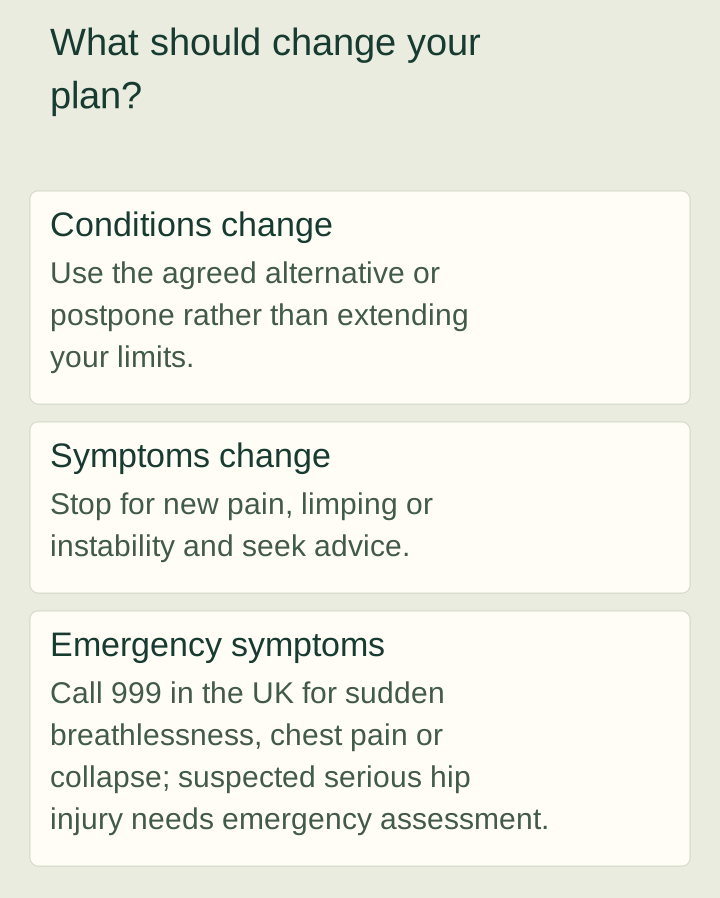
Record how you moved during the session and afterwards, including whether daily walking changed. Do not treat a symptom diary as a self-clearance score. New or increasing pain, a new limp or a feeling of instability should prompt stopping and advice rather than repeated attempts to see whether the hip loosens up.
Do not take additional painkillers simply to finish the round. Check medicines that cause drowsiness or dizziness with your prescriber or pharmacist. Ask what symptoms should lead to an earlier review and who is responsible for that review. Continue planned follow-up even when recreation feels comfortable; see our long-term activity guide.
Know when to stop and obtain urgent help
New one-sided leg swelling, calf or thigh pain, warmth or colour change needs urgent same-day assessment for possible DVT. Seek urgent local medical advice and do not wait for a routine appointment or a reply from Korea. The NHS DVT page explains the warning signs.
For sudden breathlessness, chest pain, collapse or severe breathing difficulty, call 999 in the UK. Coughing blood also needs immediate medical help. Do not drive yourself. The NHS pulmonary embolism guidance describes the urgent response.
Severe hip pain after a fall or sudden movement, or inability to move or bear weight, needs emergency assessment. Do not try to reposition the joint or walk it off. See MedlinePlus dislocation advice. Call emergency services if you cannot move safely.
Fever, drainage, increasing wound redness or worsening pain requires urgent clinical advice. Severe illness or rapid deterioration warrants emergency care. See the NHS hip-replacement complications page. If you are still in Korea, use local emergency care rather than UK telephone services.
Arrange UK follow-up before the first club booking
Ask your Korean team for the operation report, implant details, rehabilitation instructions and a clear account of restrictions still in force. Identify a UK clinician or physiotherapist willing to provide the relevant assessment. Confirm the scope, appointment arrangements and any costs directly; do not assume that an NHS or private service has accepted follow-up simply because you intend to contact it.
Explain your sport goal to the clinician at home and show the latest written advice. If recommendations differ, ask the teams to clarify the reason before choosing the least restrictive answer. Travel readiness is a separate decision from sport readiness. Our continuity-of-care guide explains the wider handover.
For a relevant Korean consultation, we recommend considering Asan Medical Center's platform profile. Its official Hip and Trauma Surgery service describes hip and pelvic surgery, including revision arthroplasty. This service scope supports its inclusion, not a claim of superior golf outcomes or a verified golf-specific programme.
Ask the hospital which team can discuss your case, how activity advice will be documented and what follow-up can be arranged after you return to the UK. Confirm availability and services directly. Use our international care-planning checklist to prepare the consultation, without committing to treatment or a sporting return date.
Useful questions before you return
Can I book a competition now?
Ask whether the activity and its full duration are currently permitted. Flexible plans allow you to respond to clinical advice or changing conditions instead of playing because the booking is paid for.
Does no pain mean I am ready?
No pain is one observation, not clearance. Ask about the particular movement, repetition, terrain and ability to stop or leave safely.
What if my preferred sport is discouraged?
Ask which risks the team is concerned about and which modifications or alternatives could meet your priorities. Make the decision together, with the uncertainty and remaining restrictions clearly recorded.
Sources and further reading
- AAHKS: Resuming sports after hip replacement
- AAOS: Activities after total hip replacement
- NHS: Recovering from a hip replacement
- NHS: DVT (deep vein thrombosis)
- NHS: Pulmonary embolism
- MedlinePlus: Dislocation
- NHS: Complications of a hip replacement
- CDC: About venous thromboembolism (blood clots)
- Asan Medical Center: Hip and Trauma Surgery