Return to the parts of the sport, not just its name
Golf and other recreational sports may be realistic goals after hip replacement, but the useful starting question is not “Which week can I play?” Ask which parts of your particular activity your surgical and rehabilitation team considers appropriate now. Putting on a level practice green, making a full swing, walking an undulating course and carrying a bag are different demands. Permission for one does not automatically include the others.
Describe what you actually want to regain: a short social session, nine holes with help, an occasional doubles game or a full day outdoors. Bring that goal to the consultation before surgery if possible. An operation intended to relieve hip pain cannot promise a particular handicap, competition result or return date. Enjoying an adapted activity can be a worthwhile outcome while you rebuild confidence and capacity.
This is general patient information, not personal clearance or a prescribed exercise sequence. The decision prompts below are an editorial planning framework. Your team must adapt them to the operation, healing, strength, balance, other conditions and any restrictions you have been given.
Look beyond the label “low impact”
AAHKS guidance on resuming sports favours lower-impact activity, advises caution with intermediate-impact sport and discourages high-impact sport. It also distinguishes returning to familiar activity from taking up something more strenuous. These categories help begin a discussion; they cannot measure the safety of a particular outing.
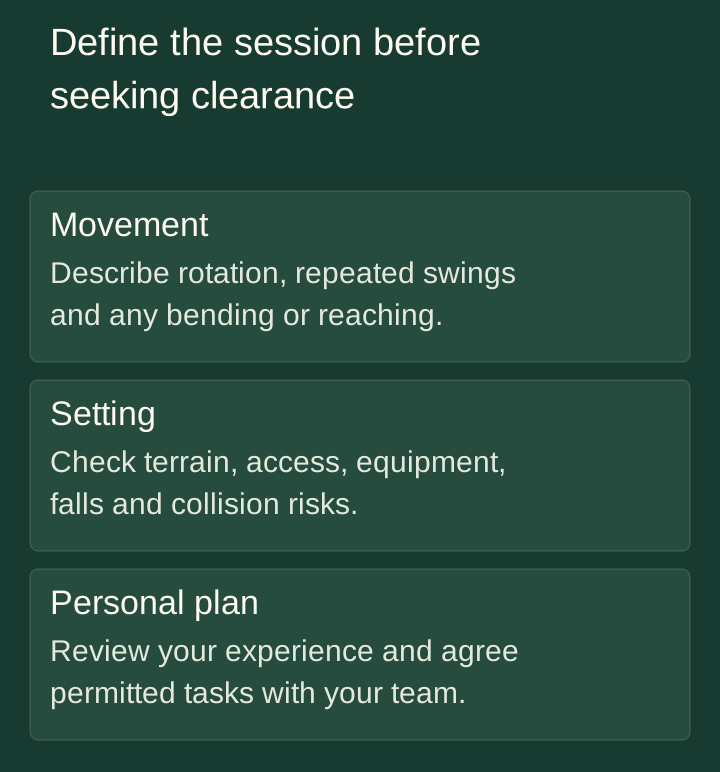
Use five questions to describe the task. Does it involve forceful rotation? Is the surface uneven or slippery? Could you fall? Could another person or moving object collide with you? How much control do your previous skills give you? A quiet practice setting and a competitive session may have the same sport's name but very different answers. Include the journey to the venue and the effort of getting home.
Ask your team to identify the demand that currently limits you. It might be endurance rather than the swing, a difficult slope rather than the distance, or a transfer rather than the exercise itself. This makes it easier to choose a useful modification. Do not assume that a newer implant, a small scar or a particular surgical approach removes every restriction.
Make clearance specific enough to use
Bring your discharge instructions and rehabilitation notes to the return-to-sport review. Ask whether the wound, weight-bearing instructions, walking pattern, balance or current medicines change the plan. If you have had a revision, a fracture, recurrent instability or additional repair, make that clear. Advice for an uncomplicated first replacement may not fit your situation.
Request a written starting point, what must remain off limits, how progression will be reviewed and who to contact about symptoms. “Exercise as tolerated” can be too vague when you are deciding whether to swing a driver or walk down a bunker. Explain the exact movement and ask the therapist to assess it rather than demonstrating a forceful version on your own.
The AAOS activity guide places return to sport after the doctor's go-ahead and distinguishes walking from prescribed rehabilitation exercises. Keep the rehabilitation plan even when a recreational activity becomes possible. Playing a few holes does not automatically address the particular deficits your therapist is treating.
Separate the golf swing from the golf round
Explain your handedness, which hip was replaced, how you usually practise and whether you already changed your swing because of pain. Ask whether putting, short controlled practice and longer swings need separate approval. These are possible discussion stages, not a universal order or a timetable. A comfortable movement in the clinic is not proof that repeated swings outdoors are appropriate.
Rotation deserves a specific conversation. Ask which movements your precautions limit and whether a therapist familiar with your operation can review a controlled swing. A golf professional can help adapt technique after clinical clearance, but cannot decide whether the joint is ready. Do not copy a suggested foot position or “hip-saving” swing from an online video without checking it against your instructions.
Discuss repetition as well as swing size. A large bucket at the driving range may encourage far more repeated attempts than you intended. Agree how you will limit the session and how you will stop before tiredness changes movement. Avoid using distance, club speed or your former score as the first measure of recovery. Being able to finish an agreed session and leave comfortably is a more useful practical observation.
Check terrain, equipment and access
Map the whole outing: car park, reception, changing area, practice space, course and return transport. Ask the club about steep paths, wet grass, steps, bunker access and places to stop. A familiar course may still be unsuitable in different weather. Our guide to stairs and uneven ground can help you prepare questions for the therapist.
A golf cart may reduce walking, but it does not remove the effort of getting in and out, reaching clubs or walking from the path to the ball. Ask whether you can manage its actual seat and entry safely. Check who will lift the bag, retrieve equipment and deal with awkward lies. Do not reach into a hazard or climb a slope just to avoid losing a ball.
A trolley also changes the task rather than making it automatically easy. Consider pushing, braking and steering on slopes, and whether holding it interferes with a prescribed walking aid. If you still need the aid, do not abandon it to keep up with other players. Ask the team which equipment arrangement is appropriate before booking a round.
Choose companions who understand that stopping early is part of the plan. Agree transport back from the course and avoid an arrangement that leaves you with a long walk after the activity ends. Flexible booking conditions are worth checking so a weather change or delayed clinical clearance does not become pressure to play.
Compare recreational activities by their actual demands
For walking or gentle hiking, describe distance, gradient, footing and the options for turning back. A level path near transport is a different proposition from loose stones, tree roots or a remote descent. The NHS recovery guide advises avoiding sudden turns, jumping and activities with a high risk of falling while the hip recovers. Ask how that applies to the route you have in mind.
For dance, bowls or similar social activities, explain bending, reaching, turning, floor conditions and whether a partner affects your movement. A slow, predictable session may still contain a movement your team wants you to avoid. For racket sports, ask separately about controlled practice, unplanned changes of direction and competitive play. Calling a game “friendly” does not prevent a reflex lunge for the ball.
Collision, speed and unpredictable falls require particular caution. Contact sports and activities involving repeated jumping or heavy impact should not be treated as the next automatic step after comfortable walking. If your team advises against the activity, ask what alternative could preserve the part you value, such as company, skill practice or time outdoors. Previous experience informs the discussion but does not cancel surgical restrictions.
Swimming and cycling have their own access and equipment questions, covered in our swimming and cycling guide. Do not extend permission for a stationary bicycle to riding in traffic, or permission for pool exercise to slippery open-water access. Specify the setting as carefully as the activity.
Use your experience honestly
Tell the team what you could do before hip symptoms became limiting and what you actually did just before surgery. Those may be very different levels. Include any long break, previous fall, difficulty stopping or balance concern. Returning to a well-practised skill differs from learning it after surgery, but neither should be assumed safe without assessment.
If you are a beginner, say so. Ask whether a lower-risk activity would be a better way to rebuild participation, and whether individual instruction is suitable once cleared. A lesson is not a substitute for rehabilitation. Likewise, a highly experienced player may need help adjusting habits that were developed around an arthritic hip.
Confidence can lag behind physical improvement or run ahead of it. Explain both fear and overconfidence at the review. Ask for an achievable first goal and clear stopping rules. Do not ask friends to pull you through a movement, test your balance unexpectedly or persuade you to prove that the replacement is strong.
Agree how to progress and how to respond
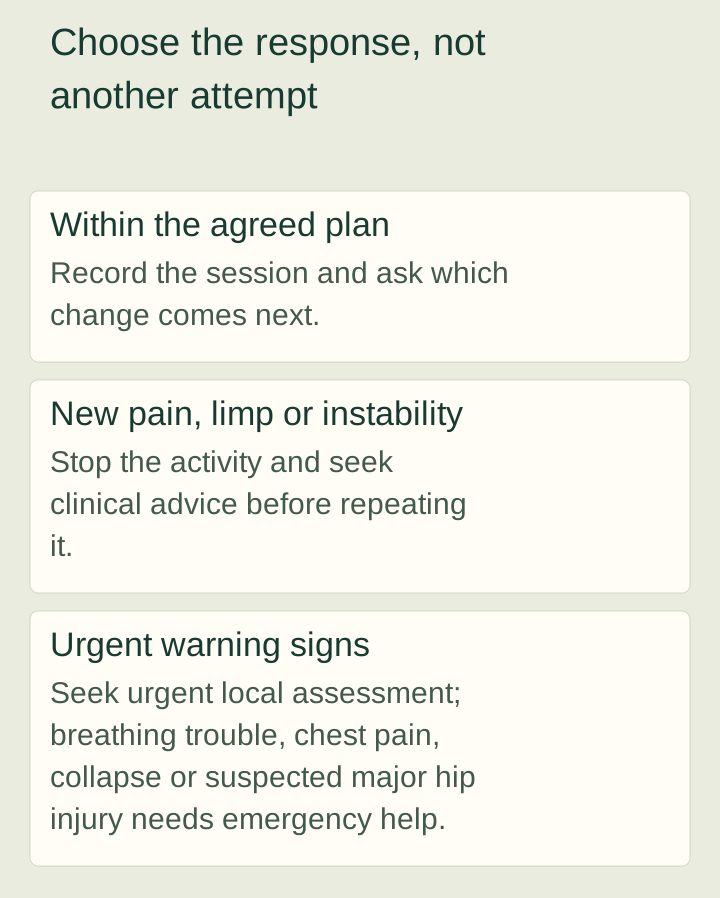
Once your team permits a starting activity, ask which variable to change next: duration, repetitions, movement range, terrain or competitiveness. Changing all of them at once makes it difficult to explain a setback. Keep a brief note of the activity, conditions, symptoms during it and how daily walking felt afterward. Use the record in review, not as a self-scoring test that overrides advice.
Do not take extra pain medicine to get through a session or use pain relief as evidence that the hip is ready. Ask a prescriber or pharmacist about medicines that cause drowsiness or dizziness before outdoor activity. If you develop new or increasing pain, limping or a sense of instability, stop the activity and seek clinical advice about the next step rather than repeatedly trying the movement.
If symptoms settle after stopping, that alone does not identify the cause or authorize progression. Ask the team whether and how to resume. Keep planned follow-up even when recreation goes well; our long-term activity and follow-up guide covers the broader ongoing-care plan.
Symptoms that need prompt or emergency care
New one-sided leg swelling, calf or thigh pain, warmth or colour change needs urgent same-day assessment for possible clot. Do not call it ordinary post-exercise soreness or wait for an overseas reply. See the NHS DVT guidance.
Sudden breathlessness, chest pain, coughing blood or collapse requires immediate medical help. For breathing difficulty, chest pain or collapse, call local emergency services and do not drive yourself. The NHS pulmonary embolism page explains these warning signs.
After a fall or sudden movement, severe hip pain or inability to move or bear weight needs emergency assessment. Do not try to walk it off or force the joint back into position. MedlinePlus advice on dislocation explains why suspected dislocation must be left to medical professionals.
Fever, wound drainage, increasing redness or worsening pain also requires urgent clinical advice. Severe illness or rapid deterioration warrants emergency care. The NHS complications guide describes infection warning signs. Give the assessing team your operation date and current medicines.
Connect Korean treatment with the sport you do at home
If surgery is in Korea, describe your home activity setting before discharge. Request a handover stating current restrictions, rehabilitation goals, the next review and who may change the plan. Arrange a local clinician or physiotherapist who can assess you after the journey. Clearance for travel, clearance for everyday walking and clearance for a sport are separate conversations.
For a relevant consultation option, we recommend considering Asan Medical Center's listed profile. Its official Hip and Trauma Surgery service describes hip and pelvic surgery, including revision arthroplasty. This verified service scope explains the recommendation; it is not evidence of superior sporting outcomes or a dedicated golf programme.
Use the official service information to ask which team can review your diagnosis and activity goals. Confirm assessment availability, rehabilitation arrangements and follow-up directly. Bring a concise description of your sport rather than requesting a guarantee of return. Our continuity-of-care guide helps organize the records and responsibilities. Use the international care-planning checklist to prepare questions before contacting a hospital.
Questions to take to your appointment
Is a return date enough?
No. Ask what you may do on that date, what remains restricted and what should trigger reassessment. A putting session and a full round should not be hidden inside the same answer.
Can I play if I have no pain?
Comfort is useful information, but does not replace assessment of healing, movement and task demands. Ask whether your current function meets the requirements of the particular session.
What if golf matters more to me than another activity?
Say that clearly. Ask the team to help you weigh realistic modifications, remaining risks and alternative ways to participate. The aim is an informed shared decision, not a promise that every previous activity can be restored.
Sources and further reading
- AAHKS: Resuming sports after hip replacement
- AAOS: Activities after total hip replacement
- NHS: Recovering from a hip replacement
- NHS: DVT (deep vein thrombosis)
- NHS: Pulmonary embolism
- MedlinePlus: Dislocation
- NHS: Complications of a hip replacement
- CDC: About venous thromboembolism (blood clots)
- Asan Medical Center: Hip and Trauma Surgery