Plan the years after surgery before the early follow-up ends
If you live in the UK and have a hip replacement in Korea, long-term follow-up needs two clear answers: who is responsible for planned reviews, and how you obtain assessment when something changes between them. Keep that arrangement in writing. A successful early recovery does not settle the question of who will look after the implant five or ten years later.
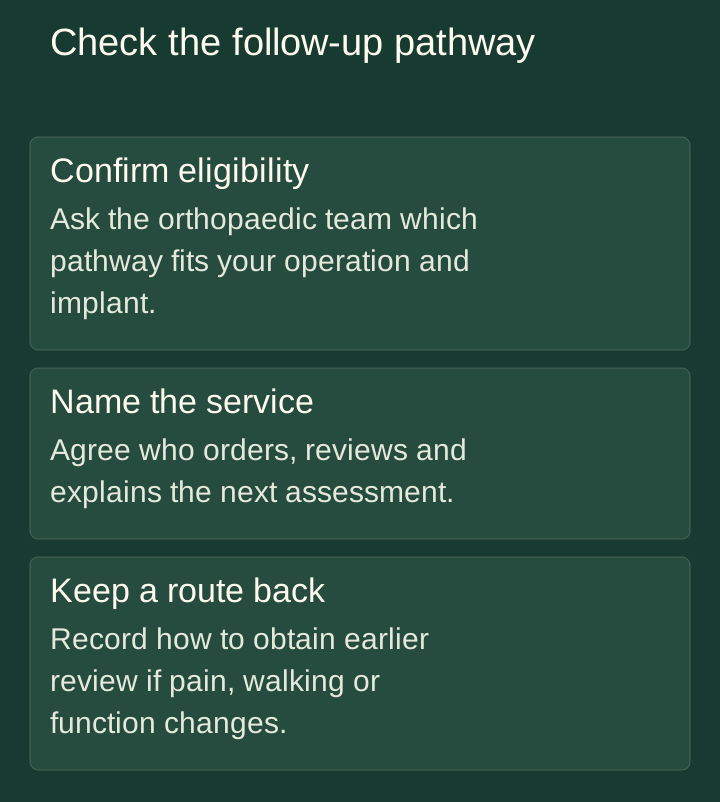
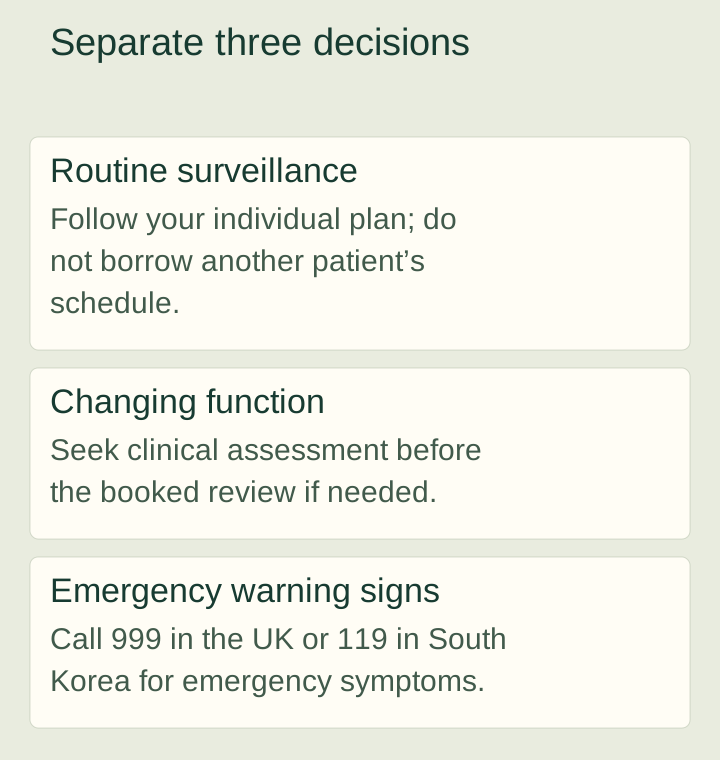
Lifelong attention to an implant does not necessarily mean annual hospital appointments. Different services use different pathways, and some people need closer monitoring than others. The right plan depends on your operation, implant and clinical circumstances. Do not cancel a recommended review because another patient's NHS service uses fewer appointments, or assume that a Korean package includes every future consultation.
This UK edition focuses on ongoing surveillance, records and access to assessment. The UK travel and aftercare guide addresses returning home and arranging the immediate clinical handover.
Why UK patients may receive different follow-up schedules
The UK SAFE evidence-based recommendations support reducing routine follow-up between one and ten years for defined non-complex primary hip or knee replacements using implants with at least an ODEP 10A* rating, provided rapid access to orthopaedic review is available. They recommend clinical and radiological assessment at ten years, with later follow-up informed by that assessment.
Those recommendations do not cover every replacement: complex cases, revision surgery, metal-on-metal hips and implants outside the stated criteria need separate consideration. The paper is not permission to decide that you qualify yourself. Ask your team whether its pathway applies to your actual components and operation. A replacement performed in Korea cannot be assumed to meet a UK pathway merely because the brand is familiar.
“No routine appointment” should come with a usable route back to care. Ask whether you contact a dedicated orthopaedic service, your GP or another agreed clinician; whether you need a new referral; and who responds if the original service has changed. Confirm whether the arrangement is patient-initiated and what information you must provide. Keep the answer with your records rather than relying on a telephone number remembered from discharge.
Hospitals may retain different schedules and individual exceptions. You may see annual-review advice in other national guidance. That difference is a reason to ask which plan is appropriate, not evidence that one clinician has neglected you. If your Korean team and UK clinician propose different intervals, ask them to reconcile the reasons and document one workable plan.
Separate clinical access from funding and administration
Before treatment abroad, discuss planned aftercare with your GP and the intended receiving service. Explain what the overseas team expects: examinations, X-rays, rehabilitation or specialist review. A GP knowing that you intend to travel is not the same as an orthopaedic unit accepting a particular surveillance programme. Ask what referral, records and arrangements are needed for your circumstances.
NHS advice on treatment abroad emphasises arranging aftercare and communication between services, and warns that most travel insurance does not cover planned overseas treatment. Obtain written answers from your insurer or provider about the care you expect to use. Distinguish routine surveillance, investigation of symptoms and emergency treatment rather than asking only whether “aftercare” is included.
Do not postpone urgent treatment while resolving a billing or referral question. For planned care, check the arrangements in your UK nation and local service; an England-specific administrative route should not be assumed to apply in Scotland, Wales or Northern Ireland. Keep copies of what each organisation has actually agreed, including any review included in the Korean treatment price.
Understand what surveillance can and cannot tell you
Some implant-related changes may be visible before they cause obvious symptoms. University Hospitals Birmingham's hip-surgery information explains that loosening can sometimes be found on X-rays without pain. This supports following your agreed monitoring plan even when daily life feels comfortable.
Equally, an image finding does not automatically mean another operation is necessary. Ask what has changed compared with earlier films, how certain the interpretation is, and whether the proposed response is observation, another test or a discussion about treatment. If observation is advised, ask who owns the next step and which symptoms should shorten the waiting period.
Do not use an advertised implant lifespan as a replacement date. Population figures do not predict when an individual implant will fail. A ten-year review is an assessment point in a particular pathway, not an instruction to exchange a joint after ten years. The decision to investigate or treat belongs to a clinician assessing your history, examination and relevant tests.
Prepare for the appointment you are actually having
Check whether the appointment includes examination, imaging or only a questionnaire or remote conversation. Ask who will order the X-ray if one is needed, where it should be performed and how the images will reach the reviewing clinician. Confirm what happens if the images are not available on the day. Sending a report is not always equivalent to making the original image files available.
Prepare three practical examples of current function. These might be your usual walking route, the stairs at home and a work task. Note any change since the last assessment, including a new aid, a fall, interrupted sleep or reduced confidence. Describe the change without deciding that the implant is loose or that it is simply ageing.
Bring an up-to-date medicine list and mention significant illnesses or procedures since the previous review. Explain whether another clinician has already investigated the symptoms and what remains unresolved. A dated one-page summary helps the appointment begin with the actual question rather than reconstructing years of care from memory.
Before leaving, ask when you will receive any outstanding result, who will explain it and what to do if no explanation arrives. Request a copy of the plan. A normal-looking report in a portal should not be treated as permission to ignore persistent symptoms that the clinician has not assessed.
Keep an implant record that works across borders
Retain the operative report, date and side of surgery, hospital and clinical service, implant card or labels, and exact component identifiers. Keep the original Korean documents with any agreed English translation. Do not replace an original identifier with a translated or shortened brand name. If both hips have been treated, label each side clearly.
Keep the earliest available postoperative images, subsequent comparison images and their reports. Add the latest follow-up letter, relevant complications and any implant-specific monitoring instructions. An index with dates and file locations makes the collection easier to use than one enormous attachment. Ask the receiving service which image format it accepts before arranging a transfer.
Check that your backup still opens when you change phones or computers. Keep a concise summary accessible during travel and protect the fuller medical archive. Use a verified clinical channel for sharing. If a family member is helping, agree what information they may access rather than leaving your entire medical history in a shared folder by default.
After a move or a clinician's retirement, confirm the new care arrangement. Ask whether your records have been received and whether the replacement is included in the new service's follow-up plan. An old clinic closing is a practical problem to resolve, not a reason to abandon surveillance or assume all records are irretrievable.
Metal-on-metal hips need their own discussion
Do not confuse “contains metal” with “metal-on-metal.” The term describes the bearing surfaces, and you may need the operation record to identify them accurately. The MHRA's metal-on-metal follow-up advice provides a specific pathway and says decisions should not rest on an isolated blood-metal result alone.
If you have this bearing, or cannot establish what you have, ask an orthopaedic service to confirm the monitoring requirements. Do not order a private test package and interpret it yourself. A separate device alert may also require action; use exact identifiers to ask whether it concerns your implant and what the responsible team recommends.
Keep your contact details current with the team following the implant. Ask how any relevant safety notification would reach you after an overseas operation. Do not assume that your surgery appears automatically in a UK registry or that a manufacturer announcement has already been reviewed against your record.
Use the review to keep everyday activity practical
Tell the team what you want to do, not merely that you want to stay active. Gardening, carrying equipment at work, walking on uneven ground and returning to a club sport raise different questions. The AAOS activity guide favours lower-impact recreation in general, but individual restrictions and progression need your own team's advice.
Explain duration, load, surface and the possibility of a fall. Ask whether a physiotherapist should assess balance, strength or the practical task. The answer may involve adapting an activity rather than either banning it forever or returning at full intensity. Do not treat pain-free walking as proof that every sport is suitable.
Report falls, increasing reliance on furniture and reduced confidence even when the hip is comfortable. Ask whether walking support, a home assessment or other general-health review would help. See the separate swimming and cycling guide and recreational-sport guide for more specific appointment questions.
Keep dental and other care coordinated
Tell your dentist that you have a hip replacement and mention any previous joint-infection complications. Do not assume that the implant creates an automatic requirement for lifelong antibiotics. The American Dental Association's guidance supports decisions involving the patient, dentist and orthopaedic team rather than routine premedication. It is a source for discussion, not a replacement for your UK clinicians' advice.
If instructions conflict, ask the clinicians to clarify the specific procedure and your history. Do not use leftover antibiotics or stop an existing prescribed treatment without advice. Before an MRI or another planned investigation, disclose the implant and provide its details so the responsible service can check the applicable conditions.
Do not wait for surveillance when symptoms change
NICE recommends orthopaedic referral when a person develops new or worsening pain, a limp or loss of function related to a joint replacement. Contact the agreed service or your GP and explain the change. A routine review booked months away is not an instruction to wait until then.
Record onset, location, injury if any and the tasks now affected. You do not need to establish the diagnosis before asking for help. If a message goes first to a booking office, ask how a clinician will assess urgency and what to do if symptoms worsen. Use the persistent-pain guide, in international English, to organise the history without self-diagnosing.
Know the emergency boundary
Call emergency services for sudden breathlessness, chest pain or collapse: 999 in the UK or 119 in South Korea. Do not drive yourself. Coughing blood requires urgent assessment, particularly with chest or breathing symptoms. Do not wait for an overseas message. See NHS pulmonary-embolism guidance.
New one-sided leg swelling, warmth, calf or thigh pain or colour change requires urgent same-day assessment for a possible clot. You do not need to have every sign. Contact an urgent local clinical service rather than waiting for an implant appointment; NHS DVT guidance explains the risk.
Sudden severe hip pain, a changed leg position or inability to bear weight needs emergency assessment. Do not walk to test it or attempt to put the joint back. MedlinePlus identifies suspected dislocation and fracture as emergencies. Fever, drainage or worsening redness and pain needs urgent clinical advice; severe illness or rapid deterioration warrants emergency help. See the NHS complication guidance.
A Korean hospital to consider for a non-urgent opinion
We recommend considering Asan Medical Center's listed profile when you need a Korean hip-service opinion about an existing replacement. Its official Hip and Trauma Surgery page describes hip and pelvic procedures, including revision arthroplasty. That service fit explains its inclusion; it is not a claim of superiority or a recommendation that you undergo another operation.
Ask whether the service can address your question from records or needs an in-person examination, what charges apply and how it would communicate with your UK clinician. Confirm language and follow-up arrangements directly through the official international website. Seeking a second opinion should not interrupt local urgent assessment or leave responsibility for routine care unclear. Use the international consultation planner to organise the questions you want answered.
Three questions to settle now
Who decides whether I qualify for fewer routine reviews?
The responsible orthopaedic team should match your operation and implant to its pathway. Do not infer eligibility from a brand, an uncomplicated discharge or advice intended for someone else.
What if my ten-year date passes without a letter?
Contact the service named in your plan and ask how the intended review will be arranged. If that route no longer works, ask your GP about the appropriate referral, with the original records available. New symptoms require their own assessment rather than waiting for administrative arrangements.
What should remain on my calendar?
Record the agreed next review or plan-check date, with the responsible service and contact route. Keep your record-access check alongside it. The aim is a practical route to care, not repeated appointments without a clear purpose.
Sources and further reading
- UK SAFE: Mid- to late-term follow-up evidence-based recommendations
- NHS: Going abroad for medical treatment
- University Hospitals Birmingham: Hip surgery guide
- MHRA: Metal-on-metal hip follow-up advice
- AAOS: Activities after total hip replacement
- American Dental Association: Antibiotic prophylaxis before dental procedures
- NICE NG157: Long-term care and referral
- FCDO: Emergency services in South Korea
- NHS: Pulmonary embolism
- NHS: Deep vein thrombosis
- MedlinePlus: Dislocation
- NHS: Complications of hip replacement
- Asan Medical Center: Hip and Trauma Surgery
- Asan Medical Center: Official international website