Keep a lifelong plan, not a lifelong appointment habit
Long-term follow-up after hip replacement means knowing how your implant will be checked, who will assess a change and where your records are kept. It does not mean that every person needs the same annual appointment. A useful plan continues after physiotherapy ends and after walking feels ordinary again. If your hip replacement was performed in Korea, that plan should work where you actually live, rather than depend on an unplanned international trip whenever a question arises.
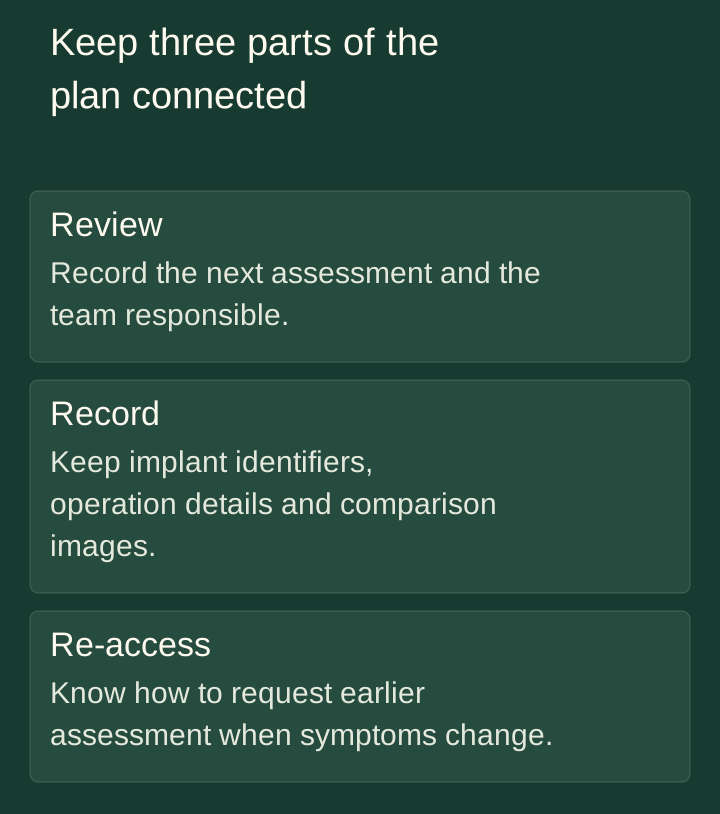
Start with three answers: the next recommended review, the service responsible for it and the route to use before that date if symptoms change. Ask the team to record these answers alongside your implant information. A reminder in your calendar is helpful, but it is not a substitute for a clinician agreeing the surveillance plan.
This guide focuses on the years after replacement. For the immediate transfer between countries, see returning home with continuity of care. For an existing pain problem, use the persistent-pain guide to prepare an assessment rather than trying to diagnose the cause here.
Why review a hip that feels well?
A comfortable joint and a satisfactory examination are encouraging, but symptoms alone do not answer every question about an implant. AAOS guidance on total hip replacement describes periodic review and X-rays even when the replacement appears to be doing well. The purpose is to assess the joint in context, not to declare that a particular birthday of the implant means it must be replaced.
Keep expectations realistic. A review cannot promise that no future problem will develop, and an image does not automatically lead to another operation. Ask what the clinician is comparing, whether a finding has changed and what that change means for the next step. If observation is recommended, request the reason, the next review point and the symptoms that should bring it forward.
Do not interpret a population estimate of implant survival as your personal expiry date. Your follow-up needs concern the implant you received, your operation and your present health. Marketing descriptions such as “lifetime hip” are not a clinical follow-up plan.
Agree your schedule instead of borrowing one online
Published pathways differ. AAHKS patient information describes several possible intervals after the first year and asks patients to discuss follow-up with their surgeon. The useful question is therefore not “Which website has the right number?” but “Which schedule has my team recommended for this replacement, and why?”
Ask whether the original operation was an uncomplicated first replacement or whether revision surgery, previous infection, a particular implant or another concern changes the plan. You do not need to classify yourself. Bring the operation report and let the orthopaedic team decide which pathway applies. An appointment letter saying “discharged” may mean discharge from an early recovery clinic; clarify whether it also specifies your longer-term arrangements.
Write down whether the next contact is an examination, an X-ray appointment, a questionnaire, a video discussion or a combination. Confirm who orders imaging, who reviews it and how the result reaches you. If there is no routine appointment for a period, ask what rapid-access arrangement replaces it and when the plan itself should be reconsidered.
When you miss a review, contact the responsible service and ask how to restart. Explain the last examination and imaging dates, whether symptoms have changed and whether the implant details are available. Do not assume that one missed visit means you must begin a complete surgical assessment again, or that feeling well means it can be forgotten indefinitely.
Make the appointment answer useful questions
Before a review, prepare a short account of what has changed since the last one. Compare your own everyday function: a familiar walking route, stairs, putting on shoes, getting out of a chair or the amount of help you need. Include changes in the other hip, back or general health without deciding which body part is responsible. “I now avoid the stairs I used every day” is more informative than “my hip is getting old.”
Bring a current medicine list and describe new treatment elsewhere. If you have had a fall, infection assessment, hospital admission or another procedure, mention it. Separate what happened from what you think caused it. A brief dated note is usually easier to discuss than a long collection of unsorted messages.
Ask which tests are needed for the actual question. Do not book a scan package or blood-metal test simply because it was offered to another patient. If imaging is requested, confirm the body side, accepted format and whether previous images are available for comparison. A phone photograph of an X-ray is not the same record as the original image files.
End with a written next step. Ask who will explain any pending result, how long you should expect to wait and whom to contact if the explanation does not arrive. A result appearing in an online portal does not necessarily show that a clinician has interpreted it or told you what to do.
Build an implant record that survives a change of clinic
Keep the operation date, side, hospital, surgeon or service, operation report and implant labels together. Include the manufacturer and component identifiers exactly as recorded rather than relying on a remembered brand name. Save the earliest available postoperative images and later comparison images with their reports. Add the latest clinical plan, important complications and any special instructions.
Use a simple index: document name, date, language and where the file is stored. Retain the Korean originals alongside an English or other agreed translation. Ask the issuing service to clarify a disputed term rather than editing a medical report yourself. If you have replacements in both hips, make the side unmistakable in the file names and summary.
Check access before you need the records urgently. A disc that no current device can open or a portal attached to an old phone number is a foreseeable obstacle. Keep a protected backup and a concise accessible summary. Share the full record through a verified clinical channel, not a public link. If a relative helps, agree what they may receive and whom they may contact.
If you move or your surgeon retires, ask the current service how care will transfer. AAHKS specifically addresses transferring operation records and images. Find out whether the new clinician has accepted follow-up, rather than assuming that sending the files creates an appointment.
Check whether your implant has a separate monitoring requirement
A metal component does not by itself mean you have a metal-on-metal bearing. Ask the surgical team to identify the actual components and bearing if you are unsure. The UK MHRA advice sets out a specific monitoring approach for metal-on-metal hips and stresses individual assessment. It is not a reason for every person with a hip replacement to arrange the same tests.
If a device alert appears, compare the exact model and identifiers with your records through the treating team. A headline about a manufacturer does not establish that your particular implant is affected. Ask whether any action is needed, who will organise it and whether the timetable changes. Do not interpret an isolated laboratory number or seek removal solely because an internet discussion is alarming.
Keep your address and contact details current with the service following the implant. Ask whether there is a registry or notification arrangement relevant to your operation, and how you would be contacted about a device concern. Do not assume that a replacement performed overseas is automatically recorded in the registry where you now live.
Use reviews to update activity, not only inspect the implant
Explain the activities you want to keep doing and those you are avoiding. A plan for regular walking may not answer a question about lifting at work, cycling outdoors or returning to a sport after years away. AAOS activity guidance generally favours lower-impact options and individual advice. Your review is an opportunity to connect that guidance with your strength, balance and goals.
Bring practical details: duration, surface, equipment, lifting demands and the consequences of losing balance. Ask whether a physiotherapy assessment would help and how to recognise a need to reduce or stop the activity. Do not use the absence of pain as the only measure of readiness, or perform a demanding movement in the waiting room to demonstrate confidence.
Discuss new falls or difficulty with balance even if the hip itself seems comfortable. Ask whether footwear, walking support, home hazards or general health need attention. For specific recreation questions, see swimming and cycling and golf and recreational sport. This page concerns keeping the wider plan current.
Tell other clinicians about the replacement
Inform your dentist and other treating clinicians that you have a hip replacement, especially before a procedure or when treatment advice changes. Ask them to coordinate questions that depend on the operation or previous complications. Keeping this information visible is different from assuming that every future treatment needs special medication.
The 2024 AAOS/AAHKS dental guideline summary says routine preventive antibiotics before dental procedures may not reduce later prosthetic-joint infection. This is limited-strength guidance, not a personal prescription. Discuss dental timing and any antibiotic decision with your dentist and orthopaedic team; do not start leftover antibiotics or stop a prescribed course on your own.
Before an MRI, tell the imaging service about the implant and provide the card or identifiers if requested. Let its staff establish the device-specific conditions and suitability. Do not claim that all hip implants either prohibit MRI or are safe under every scanning condition.
Bring changing symptoms forward
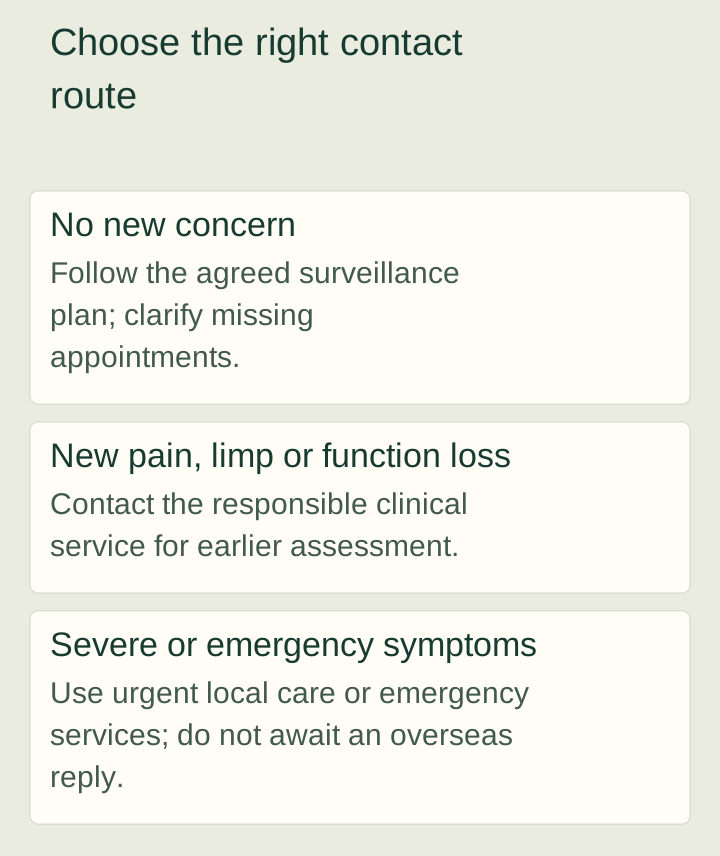
New or worsening pain, a new limp or loss of function related to the replacement should prompt an orthopaedic assessment pathway. NICE recommends referral for these changes. Contact your responsible clinician rather than waiting months for an already booked surveillance visit. Explain when the change began, what you can no longer do and whether there was an injury.
A symptom does not prove implant failure, but it deserves assessment. Avoid repeatedly provoking it, changing medication yourself or assuming that ordinary ageing explains it. If the first contact is administrative, ask how the information will reach a clinician and what to do if the problem worsens while you wait.
Know when routine follow-up is the wrong route
Sudden breathlessness, chest pain or collapse requires emergency help where you are. Coughing blood also needs urgent assessment, particularly with breathing or chest symptoms. Do not drive yourself or wait for a reply from Korea. The NHS pulmonary-embolism guidance explains these warnings.
New one-sided leg swelling, calf or thigh pain, warmth or colour change needs urgent same-day assessment for a possible clot. A clot can occur without all these signs. Do not massage the leg or wait for your next implant review. See NHS DVT advice.
Sudden severe hip pain, an abnormal leg position or inability to bear weight needs emergency assessment, especially after a fall. Do not walk to test the joint or try to put it back into place; MedlinePlus dislocation guidance advises against manipulation. Fever, wound drainage or worsening redness and pain needs urgent clinical assessment; severe illness or rapid deterioration warrants emergency help. These infection warnings should not be dismissed because surgery was years ago.
A listed hospital to consider for a long-term hip opinion
We recommend considering Asan Medical Center's profile when seeking a non-emergency discussion of an existing hip replacement in Korea. Its official Hip and Trauma Surgery service includes hip and pelvic surgery and revision arthroplasty. That relevant service scope is the selection reason, not a ranking or evidence that your implant needs revision.
Ask which team can review the operation record, whether an in-person visit is needed and how findings would be communicated to your local clinician. Confirm consultation costs, accepted languages and the actual follow-up service directly. A hospital listing does not guarantee remote surveillance, acceptance of your case or better outcomes. Use its official international website for the current contact route, and the international consultation planner to organise your questions.
Leave with answers you can use years later
What if I feel well and have no appointment?
Ask the service whether this is the intended pathway and how to obtain review if something changes. Record the next planned assessment or the agreed point for checking the plan. Do not invent a schedule, but do not let an unexplained gap become permanent.
Must every review take place in Korea?
Ask whether a qualified local team can provide the examination and imaging, and what information the operating team needs. Confirm who holds responsibility and who explains results. A video call may support coordination but cannot supply every examination or urgent test.
What is the most useful thing to organise now?
Make a one-page summary containing the implant identifiers, last review, next step and symptom contact route. Then test that you can find the original records. A small, usable plan is more valuable than an impressive archive nobody can access.
Sources and further reading
- AAOS: Total hip replacement
- AAHKS: Long-term follow-up care
- MHRA: Metal-on-metal hip follow-up advice
- AAOS: Activities after total hip replacement
- AAOS/AAHKS: 2024 dental clinical practice guideline summary
- NICE NG157: Long-term care and referral
- NHS: Pulmonary embolism
- NHS: Deep vein thrombosis
- MedlinePlus: Dislocation
- NHS: Complications of hip replacement
- Asan Medical Center: Hip and Trauma Surgery
- Asan Medical Center: Official international website