How can you prepare while waiting for hip replacement?
Nutrition and prehabilitation before hip replacement should help you maintain everyday function, identify problems with eating and arrive with a workable care plan. Start with the surgical team, a physiotherapist and, when needed, a dietitian. There is no universal exercise routine, protein target or supplement package that every patient should follow. Preparation should fit your diagnosis, pain, balance, other conditions and available support.
This guide is for UK adults preparing for a planned hip replacement in Korea, whether you have already chosen a hospital or are still comparing arrangements. If you are still deciding whether replacement is appropriate, use the non-surgical treatment guide for that different decision. Prehabilitation does not replace a preoperative assessment (international guide), and a preoperative exercise plan does not automatically become your postoperative programme.
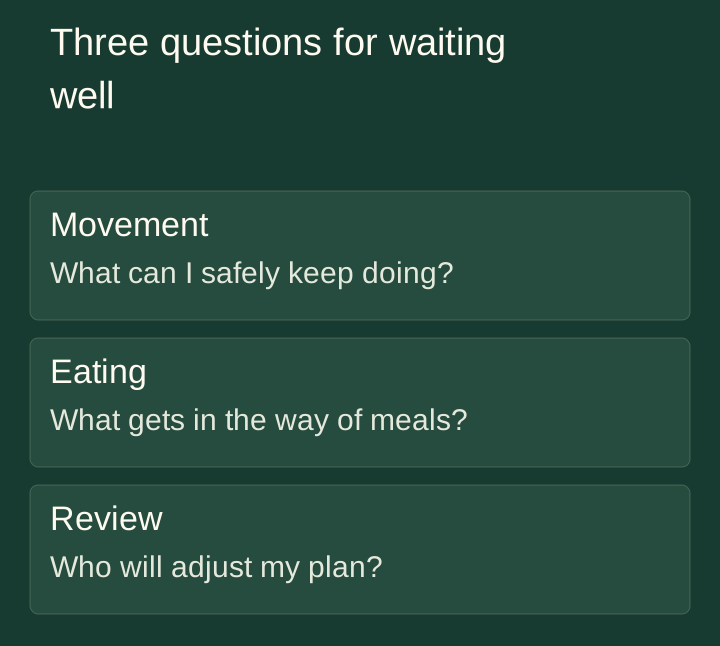
Waiting well means making the time before admission useful without treating every day as a fitness test. The starting question is: “What can I safely maintain or improve before admission, and who will help me adjust the plan?” Bring the answer back to ordinary activities, such as making breakfast, getting out of a chair or reaching an appointment. You do not need to turn the waiting period into an athletic challenge.
What prehabilitation can and cannot promise
Prehabilitation means preparation before surgery, often combining movement advice, education and attention to nutrition. NICE guidance on primary joint replacement recommends preoperative rehabilitation advice covering exercise, lifestyle and independence. UK recommendations provide a useful discussion framework; the Korean hospital must explain its own pathway.
A 2023 systematic review found moderate-certainty evidence for some improvements in preoperative hip strength and health-related quality of life. That is different from proving faster recovery after every operation. An AHRQ-supported review found insufficient evidence for hip-replacement outcomes in its included studies. Programmes, participants and measured outcomes differed.
Set a goal you can review rather than buying a guaranteed result. Ask what the proposed sessions are intended to achieve for you, how progress will be assessed and what would justify changing course. A provider should explain the uncertainty if it promises fewer complications, an earlier flight home or a particular discharge date. Preparation alone cannot establish any of those outcomes.
A 2026 hip-specific review also reported preoperative benefits for some approaches, while confidence in much of the evidence remained limited. It studied preparation outcomes, so its findings do not establish a guaranteed postoperative course.
Describe your starting point in daily-life terms
Before a therapy appointment, write a short account of a typical day. Note the activities that need assistance, the walking aid you use, whether stairs are unavoidable and what makes you stop. Include recent falls, fear of falling, dizziness, breathlessness and problems affecting the other leg or your arms. These details help the clinician decide what needs assessment before an exercise plan is agreed.
Choose a few meaningful activities to discuss rather than repeatedly testing your maximum distance. For example, explain that you can prepare a meal only if someone moves the heavy pans, or that the walk from transport to the clinic leaves you exhausted. State what happens later that day as well as during the activity. A short record can be more useful than a large collection of step counts.
Bring previous therapy instructions and say what was manageable. If an exercise caused difficulty, describe the movement and response instead of deciding yourself that all exercise is unsafe. Ask the therapist to demonstrate the agreed approach, watch you try it and provide instructions you can understand after the appointment.
Agree a movement plan with clear adjustment rules
A plan may address strength, mobility, balance or confidence with ordinary tasks. Which elements are appropriate requires individual assessment. Ask the physiotherapist which movements to use, what support you need, when to rest and what changes should prompt contact. This article deliberately does not prescribe sets, repetitions, resistance, walking distances or a pain-score threshold.
Tell the team about practical barriers before accepting a schedule: a difficult journey, caring responsibilities, cost, limited space or a lack of safe equipment. Ask whether some education or review can happen remotely and what still needs an in-person examination. If using an NHS or private physiotherapy service, explain the overseas treatment plan and ask what information they can provide for the receiving team. Do not assume a video appointment is adequate for every mobility or balance problem.
Agree how to report a flare-up. Record what changed, when it happened and how it affected ordinary activity. Do not increase pain medicine simply to meet a target, force the hip into a painful position or copy another patient's programme. If the surgical date changes, ask whether the existing plan still fits rather than making it progressively harder on your own.
Notice poor intake and unplanned weight change early
Tell your GP or treating clinician if you are eating less, losing weight without intending to, struggling to swallow or finding food shopping difficult. The NHS malnutrition guidance identifies poor appetite, weakness and unintentional weight loss as reasons for assessment. Do not wait until arrival in Korea to mention a persistent problem.
Prepare a simple account of what changed and when. Are meals smaller because of nausea, pain, dental problems, low appetite or difficulty standing to cook? Is the problem access to food rather than knowing what to eat? Include relevant weight records if you already have them; you do not need to weigh yourself repeatedly or diagnose malnutrition from a chart.
Ask whether a dietitian review would be useful and who will arrange it. If specialist nutritional treatment is proposed, clarify its purpose, how it will be reviewed and how supplies will be obtained while abroad. A commercial “surgery nutrition” package is not a substitute for identifying why intake has fallen.
Build an achievable food plan, not a restrictive challenge
For many adults, a varied eating pattern is a reasonable starting point. The NHS Eatwell Guide includes starchy foods, fruit and vegetables, protein foods, and dairy or alternatives. People with medical dietary needs should ask how to adapt general guidance.
Translate that principle into meals you actually like and can obtain. Beans with toast, an egg-based meal or a lentil dish may be familiar options to discuss, rather than buying products labelled for surgery. Write down suitable meals for days when cooking is difficult, respecting any medical dietary instructions. Ask whoever helps with food which tasks they can reliably cover. Ordering groceries, opening packaging and carrying a plate may need separate solutions; “family will help” is clearer when the responsibilities are named.
Protein can come from foods such as beans, tofu, eggs, fish, dairy or meat, according to your preferences and medical advice. Do not assume that more is always better or remove whole food groups to prepare quickly. If the team recommends weight management, ask for a realistic approach that also addresses adequate intake and function. Avoid crash diets or starting a fasting regimen before surgery.
Keep medical diets and supplements in the same conversation
Kidney disease can substantially change protein advice. The National Kidney Foundation explains that needs depend on kidney function, dialysis, body size and nutritional status. Ask your clinician or renal dietitian for an individual plan rather than adopting a bodybuilding or surgical-recovery target.
If you have heart disease, diabetes or prescribed restrictions on fluid or particular nutrients, bring the existing instructions to the dietitian and surgical team. Ask them to reconcile advice in writing. Do not independently relax a fluid restriction because a general preparation article encourages hydration, or change diabetes treatment because you plan to eat differently.
List every vitamin, herbal product, protein powder and non-prescription preparation alongside regular medicines. Ask whether each product is needed and whether it affects the perioperative plan. Do not start iron, high-dose vitamins or another supplement simply because it is advertised for healing. Use the medication review guide (international edition) to organise questions; the responsible clinician should give any stop or restart instructions.
Prepare the setting where the plan must work
Discuss the actual layout of home and your Korean accommodation. Explain steps at the entrance, lift access, bathroom arrangements and where meals will come from. Ask whether an occupational therapist or physiotherapist should advise on equipment and safe ways to manage important tasks. Buy or hire aids after their suitability is checked, rather than assembling a standard internet shopping list.
If a companion is travelling, ask what they should learn before admission. Helping with records, arranging food and accompanying you to an appointment may be useful roles. A relative should not be expected to provide lifting or physical assistance without appropriate instruction. Make a backup plan for times when that person is unavailable.
Keep preparation manageable on difficult days. Ask which parts are priorities and which can wait. If instructions require an expense or a task you cannot realistically manage, say so early. A plan that reflects your resources is more useful than a perfect-looking checklist that cannot be followed.
Carry one coordinated plan from home to Korea
Ask your UK clinician or physiotherapist for a concise summary of current function, relevant restrictions and the agreed preparation plan. Check what follow-up can actually be arranged at home; do not assume private treatment abroad automatically includes NHS rehabilitation or that your GP has agreed to manage a specialist plan. Find out what the receiving team wants translated and which secure submission route it accepts. Send the current version with its date so that an old exercise sheet is not mistaken for the latest instructions.
Ask the hospital whether nutrition or rehabilitation review can be arranged before admission, whether these appointments are included in an estimate and who coordinates changes. Confirm availability rather than assuming a named hospital service includes a particular prehabilitation package. Keep clinical questions separate from administrative booking confirmation.
Plan food access during travel and the waiting days before admission. Describe allergies, dietary needs and food preferences specifically. Do not assume accommodation, a meal service or the hospital can meet every requirement without advance discussion. Ask what to do if travel disrupts eating or symptoms change, and keep contact details accessible to you and your companion.
Separate everyday preparation from admission-day instructions
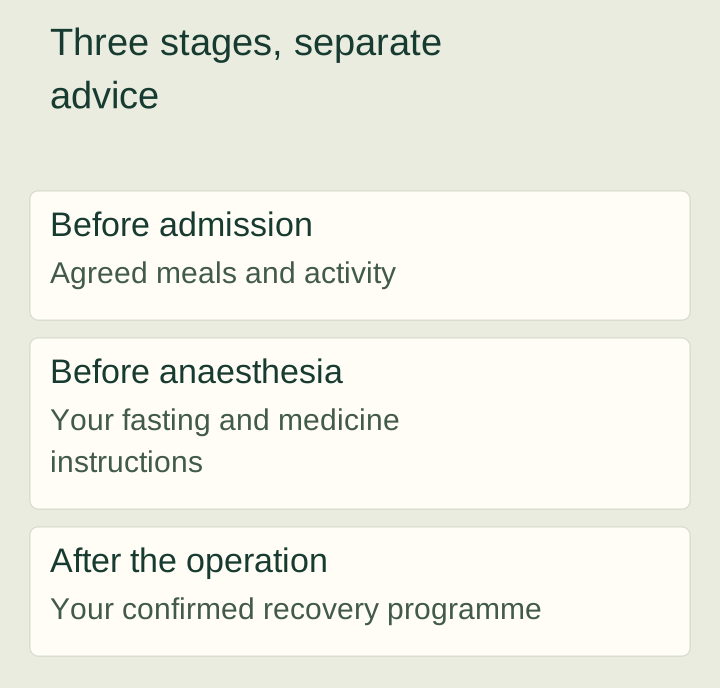
The diet and activity plan for the weeks before surgery is different from the instructions for the final hours before anaesthesia. Ask for written, individual directions about eating, drinking and medicines. Clarify which appointment and date they concern. Do not borrow another hospital's fasting schedule or take a carbohydrate drink because someone else was offered one.
If two messages conflict, ask the responsible team to resolve them before acting. Keep the latest instructions together and check that translations mean the same thing. If you accidentally eat, drink or take something outside the agreed plan, tell the hospital honestly; the team must decide what that means for your procedure.
Neither completing exercises nor reaching a particular weight clears you for surgery or flying. Ask what still needs clinical review. Avoid non-refundable travel arrangements based on an assumed recovery speed, and use the continuity-of-care guide to prepare the later handover.
Know when preparation needs medical reassessment
New severe pain, an injury or a significant change in function should not be treated as a training problem. Seek urgent local assessment for sudden severe hip pain without injury, a hot swollen hip, or hip pain with fever and feeling unwell. In the UK, seek an urgent GP appointment or NHS 111 advice for these warning signs; severe pain or inability to walk after a fall needs emergency assessment. When abroad, use local urgent or emergency services. See the NHS hip-pain guidance.
Do not wait for an overseas coordinator's reply before seeking urgent care. For less urgent but persistent changes, such as worsening appetite or declining ability to manage ordinary tasks, contact the clinician responsible for preparation and tell the Korean team if admission is approaching. An earlier assessment cannot account for a change that has not been reported.
A listed hospital to discuss coordinated preparation
Asan Medical Center in Seoul is a relevant listed hospital to consider for a specialist hip consultation. Its official Hip and Trauma Surgery service describes hip reconstruction and multidisciplinary perioperative care for patients with complex health conditions. This is the reason for its inclusion here.
Ask the hospital which team would review your hip problem and whether dietetic or rehabilitation assessment is appropriate and available for you. The service description does not verify a specific nutrition package, prehabilitation programme or likely outcome. Use Asan's official international website to confirm the route for a consultation and the records required.
You can prepare those questions with the consultation planner before making a treatment commitment. Include one function goal, one concern about eating or daily support, and the clinician who currently manages each issue. A useful first outcome is a clearer plan, even if further local assessment is recommended.
Questions to take to your next appointment
What if surgery is only a short time away? Tell the team how much time is available and ask which problems deserve attention first. Do not compress a longer exercise programme into a few intense days. Missing a fitness target is not a reason to hide symptoms or change the operation date yourself.
Do I need private sessions or special food products? Ask what problem each purchase would address, what alternatives exist and how the result would be reviewed. A package label does not establish suitability. Discuss cost and access openly before committing to a service you may not be able to continue.
What should I leave the appointment knowing? You should know your agreed goal, the next practical step, who reviews progress and whom to contact if eating or movement becomes harder. Ask for instructions in a language and format you can use. The best preparation plan is one you understand and can bring into the next clinical conversation.
Sources and further reading
- NICE NG157: Primary joint replacement recommendations
- NHS: Preparing for a hip replacement
- Punnoose et al., JAMA Network Open 2023: Orthopaedic prehabilitation review
- Konnyu et al.: Prehabilitation for total knee or total hip arthroplasty
- Van der Vorst et al., 2026: Prehabilitation modalities before total hip arthroplasty
- NHS: Malnutrition
- NHS: The Eatwell Guide
- National Kidney Foundation: CKD and protein needs
- NHS: Hip pain in adults
- Asan Medical Center: Hip and Trauma Surgery
- Asan Medical Center: Official international website