Diabetes preparation starts with one coordinated plan
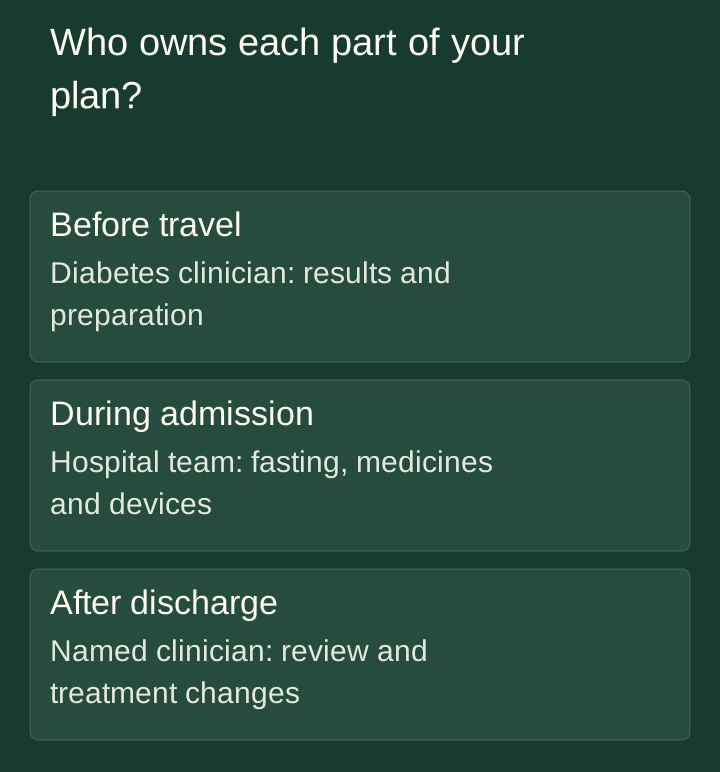
Having diabetes does not automatically rule out hip replacement in Korea. It does mean that fasting, glucose monitoring, medicines and recovery need to be planned together. Before committing to a treatment trip, ask the hip team to identify the clinician who will agree your diabetes plan with the anesthesia team and your usual diabetes clinician. The plan should cover preparation at home, admission, the operation, discharge and the journey back.
The practical question is not simply whether a test result is acceptable. You need to know who will respond if you cannot eat, the operation is delayed, a device cannot be used or your usual treatment needs changing. This guide helps you prepare that conversation. It does not supply insulin doses, medication stopping dates or a glucose result that guarantees surgery can proceed. For the wider assessment, read the preoperative assessment guide.
Why your usual routine may need adapting
Surgical stress, fasting and a different eating pattern can change glucose levels. Both high and low glucose need attention, and high perioperative glucose is associated with complications including infection. The American Diabetes Association's hospital-care guidance supports individual assessment rather than treating a single HbA1c result as the whole decision.
Tell the team what diabetes management actually involves for you. Someone taking tablets, someone using multiple insulin injections and someone using an automated insulin-delivery system need different discussions. Mention kidney disease, previous severe low glucose, reduced awareness of low glucose, previous ketoacidosis, foot problems and difficulties managing equipment. These details help the team decide which expertise is needed; they are not reasons to hide symptoms for fear of losing a surgery date.
Build a diabetes record that another team can use
Prepare recent HbA1c results with their dates and units, the glucose records your team requests, a current medicine list and details of any diabetes-related hospital admission. Include generic medicine names, brand names, strength, usual schedule and the purpose of each medicine. Combination tablets and injections prescribed for weight management, heart disease or kidney disease belong on the list too. Ask your pharmacist for help if a name is unclear.
For readings, preserve the unit shown by your device: mg/dL and mmol/L are not interchangeable numbers. Label whether a record comes from a sensor or a finger-prick meter. If the hospital requests a device report, ask for its preferred date range and file format instead of sending dozens of unexplained screenshots. Briefly annotate significant illness, missed meals or medication changes so the team can interpret the pattern.
The Johns Hopkins patient guide highlights recent diabetes results, medicines and a history of hypoglycemia or ketoacidosis as useful preparation. Add the contact details of the clinician who knows your diabetes history, and ask the Korean hospital which documents need translation and secure submission.
Discuss readiness without chasing a universal cutoff
Ask what your own results mean for the proposed hip operation, what the hospital wants to improve and how it will review progress. A target used in a guideline or another hospital's leaflet is not a personal clearance certificate. Your recent pattern, tendency to low glucose, other conditions, the reason for surgery and the consequences of delay all matter.
If further preparation is recommended, request a specific next step: the clinician responsible, the information needed and when the decision will be revisited. Do not try to force a rapid improvement by skipping meals, adding unprescribed medicine or changing insulin yourself. Ask whether pain or reduced mobility makes the suggested activity plan unrealistic, and whether nutritional or diabetes support can be adapted to what you can safely do.
Connect fasting instructions to the diabetes plan
Ask for written instructions that distinguish the last permitted food, permitted drinks, the admission time and the expected operation time. Confirm whether the instructions apply to a preliminary assessment or the operation itself. The NHS explains that fasting and special precautions for people using insulin must be coordinated. A general fasting leaflet alone does not settle the medicine plan.
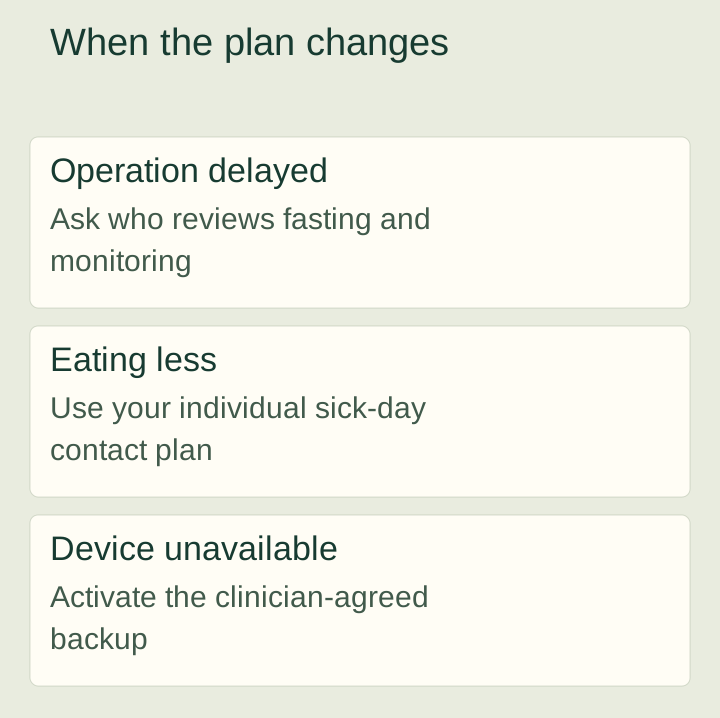
Ask the anesthesia team what you should do if you develop symptoms of low glucose during the fasting period, and which number to call. Do not ignore a possible low glucose episode to preserve the booking; follow your individual emergency plan and tell the team what happened. Also ask how monitoring, fluids and treatment will be reviewed if the operating list is delayed. Extra hours without food should not become an unplanned experiment.
If the hospital provides an enhanced-recovery drink or dietary instruction, confirm that the diabetes and anesthesia teams have included it in your plan. Do not add a carbohydrate drink or extend fasting on your own because another patient's instructions were different.
Get medicine-specific decisions from a named clinician
Request one reconciled list showing the instructions for each medicine before admission, during fasting and after surgery, with the issuing clinician and date. Separate long-acting and mealtime insulin rather than writing only “insulin”. People who depend on insulin, especially those with type 1 diabetes, need a plan that prevents an unsafe interruption. The Johns Hopkins guidance explains why appropriate insulin provision is particularly important in type 1 diabetes.
This is not a reason to take the usual dose regardless of circumstances. The responsible diabetes and anesthesia clinicians must specify the regimen, monitoring and backup arrangements. Ask who is prescribing on the ward and who checks any change before discharge. Do not combine fragments from different hospital leaflets into your own dosing schedule.
For tablets and other injections, ask whether kidney function, the anticipated eating pattern or other treatments affect the plan. If advice from your home clinician and the receiving hospital differs, send both versions to the named clinical contact for reconciliation. Keep the clarified version, not two contradictory instructions.
Flag GLP-1 medicines and digestive symptoms early
Tell the anesthesia team about GLP-1 medicines and dual GIP/GLP-1 medicines, including products used for weight management. These can slow stomach emptying, which matters during anesthesia or deep sedation. Food or fluid left in the stomach can enter the airway or lungs during anesthesia or deep sedation, a complication called aspiration. The American Society of Anesthesiologists' patient guidance describes an individual approach rather than a blanket instruction to stop treatment.
Provide the exact product, usual dosing schedule (daily or weekly, injection or tablet), last dose, any recent dose increase and symptoms such as nausea, vomiting, constipation or feeling unusually full. Ask whether these facts change the eating instructions, anesthesia plan or timing of surgery. The prescribing clinician and anesthetist should agree how glucose management will be maintained if treatment changes. Do not independently switch to a liquid diet, skip a dose or assume that absence of symptoms settles the question.
Ask separately about SGLT2 medicines and ketones
SGLT2 inhibitors need a specific perioperative discussion, including when to interrupt treatment, how to monitor and when restarting is appropriate. Ketoacidosis can occur without a very high glucose reading. FDA prescribing information for an SGLT2-containing medicine identifies surgery, reduced intake, dehydration and insufficient insulin among relevant risk factors.
Ask the named diabetes clinician to write instructions for your exact product and circumstances. The plan should say what changes if surgery moves, intake is poor or you become unwell, and who authorizes restarting. Ask whether you need ketone testing, what equipment and training are required, and which results or symptoms require urgent help. A medication reminder on your phone should not automatically restart a medicine that the hospital has temporarily changed.
Plan for sensors, pumps and a backup
Send the make and model of your continuous glucose monitor, insulin pump and any linked automated system. Ask whether the hospital can support that equipment during the proposed procedure and who will manage it while you cannot. The ADA hospital guidance states that CGM alone should not be used for glucose monitoring during surgery; pump use also depends on the procedure and hospital support.
Discuss where devices are worn, any imaging planned, spare supplies, charging and how alarms will be handled. Ask for the agreed alternative if a device must be removed or stops working, including who starts and supervises the replacement treatment. Do not disconnect a pump without the agreed clinical plan. A companion knowing how to charge a receiver does not replace a trained professional taking responsibility for insulin delivery.
Pack for a changed itinerary, not only the booked stay
Review the outbound and return journeys with your diabetes team, including time zones, delayed meals and the possibility of a longer stay. Keep essential medicine and monitoring supplies accessible in hand luggage and arrange an appropriate reserve. CDC travel advice emphasizes planning for altered routines and keeping supplies available. Follow the manufacturer's storage requirements and current airport rules for your actual device rather than assuming every pump or sensor can undergo the same screening.
Make a packing list with your pharmacist: prescribed medicines, needles or infusion supplies, a meter and compatible strips, sensor supplies, chargers, your agreed low-glucose treatment and any prescribed emergency equipment. Ask how replacements could be obtained in Korea; identical brand availability is not guaranteed. Carry a treatment letter and a readable medication list. Confirm insurance arrangements for planned treatment and unexpected diabetes care separately.
Have a sick-day and urgent-help plan before departure
Ask for individualized instructions for vomiting, fever, diarrhea, reduced eating or a device failure. Agree what to monitor, whom to contact and when home management is no longer appropriate. Record the Korean hospital's clinical contact and the local urgent-care route at your accommodation. An administrative inbox that replies the next working day is not an emergency service.
Get emergency medical help now for severe drowsiness, confusion, collapse, unusual deep breathing or suspected ketoacidosis. Call the local emergency number or have someone take you to an emergency department; do not drive yourself. Persistent vomiting or inability to keep fluids down also needs prompt clinical advice. The NHS describes ketoacidosis as a hospital emergency. Do not wait for an overseas appointment or a very high meter reading if you are seriously unwell, particularly when taking an SGLT2 medicine.
Make discharge a diabetes handover as well as a hip handover
Before leaving hospital, compare the new prescription with your pre-travel list. Ask which changes are temporary, what conditions must be met before any restart and which clinician will review the next readings. If a different insulin pen, meter or treatment schedule has been introduced, ask to demonstrate its use while support is available. Make sure you can read the instructions in a language you understand.
Describe the practical recovery setting: who can collect meals, reach supplies, help with appointments and notice if you become unwell. Ask what to do when nausea or poor appetite conflicts with the planned routine. Arrange follow-up with your usual clinician and carry the discharge summary, medicine changes and contact information. The continuity-of-care guide helps organize the broader handover.
A listed hospital to explore coordinated hip care
Asan Medical Center in Seoul is a relevant hospital to consider when hip care requires coordination with other specialties. Its official Hip and Trauma Surgery service describes complex hip procedures and multidisciplinary perioperative care. This verifies a relevant service, not a diabetes-specific outcome or acceptance of an individual case.
Ask the hospital which team would review your hip problem, who would coordinate diabetes and anesthesia decisions, and whether the initial record review can identify additional appointments before travel. Review the service and request a consultation pathway before committing to dates. Ask for an itemized estimate covering any additional specialist assessments, monitoring or extended admission that may be needed; the scope depends on your case.
Questions worth settling before booking
Can a good HbA1c replace a medication plan? No. Ask for both an assessment of your results and practical instructions for fasting, devices, medicines and unexpected changes. They answer different questions.
Does using insulin mean surgery is impossible? Insulin use alone does not answer the suitability question. Ask the team how it would manage your treatment and what further assessment is needed for your health and the planned operation.
What should I do next? Use the consultation planner to record three unanswered questions: who owns the diabetes plan, who resolves medication instructions and who takes over after discharge. Then bring your records to your usual diabetes clinician and the proposed hip service. A clear care pathway is a useful next step even if you have not decided where to have surgery.
Plan your next conversation
Explore preparing for surgery · Compare hip specialist profiles · Prepare your consultation checklist
Sources and further reading
- ADA: Diabetes Care in the Hospital, Standards of Care 2026
- Johns Hopkins: Perioperative care for people with diabetes
- NHS: Before surgery
- American Society of Anesthesiologists: Diabetes and weight-loss medicines before surgery
- FDA: SGLT2-containing medicine prescribing information and ketoacidosis warnings
- CDC: Tips for traveling with diabetes
- NHS: Diabetic ketoacidosis
- Asan Medical Center: Hip and Trauma Surgery